AI drones undertake high-risk jobs along the supply chain
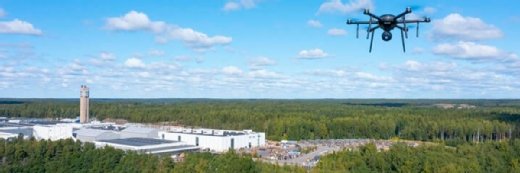
From power line and bridge inspections to remote and heavy cargo deliveries, autonomous AI drones are becoming the supply chain's version of air traffic controllers.
Supply chains plagued with inefficiencies, bottlenecks and manpower issues are getting a boost from AI-enabled drones. Today's AI drones in the enterprise provide new data capturing capabilities, autonomous functionality and improved logistical operations.
Unlike early unmanned aerial vehicles (UAVs), which were manually flown by a person on the ground, the new AI drones can navigate and fly autonomously, detect and recognize objects, use advanced algorithms to maintain stability, interact with other technologies and automatically deliver packages and cargo.
Supply chain drone applications usually have a person monitoring activity behind the scenes. "Our pilots are like air traffic controllers," explained Beth Flippo, CEO and founder of Dexa, formerly Drone Express, an autonomous drone delivery company specializing in last-mile logistics for local retail and food. "They sit behind a screen, and they load the mission in of what it's supposed to do, and if the drone is having a problem, they can issue a command, like 'land,' 'go to a safe zone' or 'launch your parachute.'"
Otherwise, Dexa's delivery drones are fully autonomous. "These literally are pilotless vehicles, and eventually we won't even need the pilot to load the mission in," Flippo said. AI drones will then "truly become air traffic controllers," she said. "They will just be watching aircraft like air traffic today."
To prevent disruptions along the supply chain, autonomous AI drones are being used remotely to inspect bridges and power lines. "In autonomous inspections, AI becomes the operator," said Alden Jones, vice president of product management at drone maker Skydio. "The drone understands its surroundings, plans safe paths and collects data from consistent angles with minimal operator input."
The collected data is processed by AI software "to detect early signs of failure, like corrosion or cracks, turning raw images into actionable insights," Jones explained. "Together, these steps enable a shift from reactive inspections to condition-based maintenance, where problems can be identified earlier and addressed before they lead to failures."
AI drones are performing automatic bridge inspections for the Ohio Department of Transportation. Before using Skydio autonomous drones, Ohio bridge inspectors required $800,000 aerial lift trucks involving humans in high-risk operations. The AI drone bridge inspections are now done statewide eventually with more than 40 deployments, lowering the risks and costs while increasing inspection data quality and speed.
AI drone inspections are growing globally with many aimed at lowering personal risk and saving time.
AI is detecting faults on powerlines with approximately 90% accuracy.
Alex BrownCEO, Skyports Drone Service
The staff at the Yunnan Power Grid in China, for example, would take 20 days to inspect 60 miles of critical power lines, climbing each tower in mountainous terrain. Autonomous drones from UAV manufacturer Jouav now perform detailed inspections using AI analytics to identify issues without onsite human intervention.
Inspections of bridges, powerlines and hard-to-reach areas are easier targets for AI drones. "At the moment, we're using AI mostly in our powerline inspection product where AI is detecting faults on powerlines with approximately 90% accuracy," said Alex Brown, CEO of Skyports Drone Service. "It still has a human in the loop but makes things so much more efficient. In our surveillance business, we're using AI more, too -- for example, in automatically recognizing objects that the drone is looking at."
In addition to visual data collection and analysis, one of the main functions of AI in drones is to manage the drone itself. "A lot of it comes down to sensing on board the drone, so that it doesn't crash into things as well as the intelligent operation and navigation, helping it recognize the world that it's in and what it's sensing," said Scott Shtofman, vice president and counsel for regulatory affairs at the Association for Uncrewed Vehicle Systems International. "AI is providing some intelligence, analysis of what the drone is seeing, as well as ways to keep the drone from running into things."
AI drones speed component deliveries to factories to ensure just-in-time manufacturing.
Winsupply, a 70-year-old construction distribution company, wanted to automate the movement of supplies to its business customers. "We would take product out of our distribution center, and we have what we call a will-call counter," said Ryan Whitney, director of enterprise data at Winsupply. "UPS comes and does pickups there, and the associates at the will-call counter would package up, say, a box of PVC and schedule 40 elbow pipes … We would take 10 of those [fittings], put them in a box, and we'd hand it off to the drone express team. They attach it to the drone, and they would fly it off to the job site and drop it down at the job site," saving contractors "a lot of time and energy."
Drone payload weights continue to increase from relatively small commercial supplies to significantly heavier pieces of cargo or work equipment.
An all-electric AI drone from Air can automatically transport 550 pounds for 100 miles. "It's all automatic," said Rani Plaut, Air CEO and co-founder. An Air drone uses AI to look for locations and automatically flies to a designated destination and waits for human approval to land. "Behind the scenes, an operator is watching it," Plaut noted. If the drone doesn't receive approval to land, the AI technology on board selects the best location to land.
Sandi Banerjee, president and COO of drone developer Arcanus, said the company is considering using drones that could lift 650 pounds. "Imagine replacing heavy lift ground transport to a UAV, so something that could pick up, say, an HVAC unit and lift it to a top of a building or move it to a point where a crane can then pick it up and hoist it, moving supplies along a predetermined route," Banerjee explained.
There are two main use cases for drones. One of them is delivering to difficult-to-reach addresses.
Chris PaxtonStrategic insight and innovation manager, Royal Mail
The U.K.'s national mail service Royal Mail is legally required to deliver all types and sizes of packages to 32 million addresses, five days a week for parcels and six days a week for letters, according to Chris Paxton, strategic insight and innovation manager at Royal Mail. "There are two main use cases for drones," he said. "One of them is delivering to difficult-to-reach addresses."
Deliveries were required to remote locations, such as the Orkney Islands, where parcels were transported on the daily ferry boat but went undelivered in bad weather. Royal Mail and Skyports Drone Services launched the Orkney I-Port trial in 2023 to use drones to transport packages with weights up to 13 pounds. The drones delivered packages between operation mail centers, not directly to consumers.
"What we've done with our drone trials is look at how we can use drones to connect those operational sites," Paxton said. "We fly things on the drone from one site out to the postmen and postwomen who ultimately do the deliveries."
In the U.K., the Royal Mail needs permission from the Civil Aviation Authority to do drone flights between mail centers. "It's a lot easier than somebody like Amazon, who's got to prove to the CAA that they're able to deliver to all the [individual customer] addresses," Paxton said. "Every single address is going to have a different risk profile. I might have a toddler running around, you might have a dog running around, there might be a tree that's overhanging one property, there might not be a tree in another one."
In the U.S., drones are regulated by the Federal Aviation Administration with certain drones allowed to fly beyond the visual line of sight. FAA Part 135 is a domestic air carrier license for unmanned flights. "It's the only way you can fly cargo for compensation in the national airspace," Dexa's Flippo said. "If you don't have a 135, you are not allowed to earn money for those deliveries ... It's kind of like the Holy Grail. There are only four other companies in the U.S. that have it, and it's Amazon, Google, Wing, Zipline and us."
Whether for remote inspections or package deliveries, AI drones can save considerable time and increase operational efficiencies -- and they're getting better at what they do.
Chuck Martin, a New York Times bestselling author, futurist, speaker and columnist, has been a thought leader in emerging digital technologies for more than three decades.