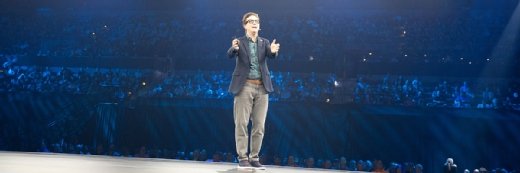
Sean McCormack's secret to CIO success: understand the business inside and out and place every task directly on the calendar.
As CIO of First Student, a large student transportation company, Sean McCormack oversees all aspects of technology, including IT strategy, cybersecurity, data analytics and product management. The role is less about technology itself and more about how IT supports the business and day-to-day operations at scale. McCormack's approach blends disciplined time management with a hands-on leadership style that prioritizes direct engagement with his teams and the frontline workforce.
Key takeaways from his day-to-day leadership include the following:
Heavy focus on IT strategy and innovation.
Regular stakeholder engagement and project oversight.
Monthly field trips or "go sees" to understand technology in action.
Intense calendar control to balance planned work and emergencies.
In the following interview, McCormack explains the nuances of his role and reveals how a modern CIO can balance competing demands and maximize innovation.
Editor's note: The following transcript was edited for length and clarity.
What falls within the scope of your role as CIO of First Student?
Sean McCormack: My role is comprehensive when it comes to technology. It includes technology strategy and innovation, cybersecurity, data analytics, the project management office that runs all the projects, maintenance and support, infrastructure and operations, product management and software development. We also have all the deployments, the field installations, the location hardware upgrades -- anything technology-wise.
What does a typical workday look like?
McCormack: There is no typical workday. It's completely variable. However, I try to focus my time on several buckets. One is strategy. This includes communicating our strategy with employees at town halls and during calls with the CEO, the board and our private equity firm.
Two is projects. We always have many projects going on, and that's where I'm focused on steering committees and how the projects are progressing. Three is a lot of stakeholder engagement. I have recurring one-on-ones with all my peers and key stakeholders in the business. That's intended to touch points and understand, for example, with our CEO, what challenges he has and how things are going from his perspective.
Fourth is my team. I spend time with my team in one-on-ones and staff meetings. Then there's a focus on getting out and seeing the business. I'm a big believer in what I call "go sees." This is about trying to visit a location at least once a month, meet with people on the ground, talk to drivers and see how our technology is being implemented.
Five is vendors. I spend a lot of time with vendors trying to understand their capabilities and how our relationships are going. Then, the last one is innovation. AI is a good example of this. This includes education, customer and partner outreach, and attending conferences. It's about trying to see what's happening in the market and how we can apply it.
How do you manage your calendar?
McCormack: My executive assistant helps, but I'm maniacal with my calendar, because it's the only way I can control things. I read a book years ago that literally changed my life -- 15 Secrets Successful People Know About Time Management, by Kevin Kruse.
If you just rely on a to-do list, you'll always be behind, because it won't necessarily be on your calendar.
The key point was that people tend to rely on to-do lists. The problem is, if you just rely on a to-do list, you'll always be behind, because it won't necessarily be on your calendar. Everything on my to-do list is on my calendar.
I also leave certain blocks of time open. Every morning, I set aside time for day prep. Every afternoon, I reserve time for wrap-up. I try to block Fridays completely, because that's when I'm focused on all the deliverables, personal development and catching up with people that I have to do.
Additionally, I build some time into every day for emergencies that may arise. I normally block two to three hours each day for this.
How much of your day is spent dealing with planned things vs. unplanned problems?
McCormack: On average, it's about one to two hours of unplanned activities, which can include production incidents, personnel issues or contractual problems. That's why I must reserve time for myself. I learned long ago that if I don't do that, I'll spend from 6 to 8 p.m. catching up on emails and working on the weekends.
I'm actually pretty good at time management now. I don't advertise this, but I normally only work 8 a.m. to 6 p.m., and I don't work much on the weekends. I don't think I'm necessarily doing less or more than anybody else. I'm just much better at time management
How do you approach work-life balance?
McCormack: Everyone really needs time outside of work to disconnect. I'm very intentional with family, friends and health. I try to get to martial arts twice a week, and at least twice a week I try to do some other type of physical fitness. I was in the military a long time ago, and I learned that, out of everything, exercise is the best way to manage your stress -- and in these roles, you have a ton of stress.
I also try to do things outside of work that get my mind completely off work. My wife and I do dance classes. We're very active in our community. We volunteer and do a lot with friends and family. These periods of being unplugged give me the energy I need to focus when I'm at work.
You were the chief technology officer (CTO) at Harley-Davidson for a while. Is there a difference between a CIO and a CTO?
McCormack: It's how you craft it. You can look at any of those roles, and it really depends on the person who's in it and where they focus. I've always been in technical roles, but my focus has always been business. I don't talk to colleagues about technology. I mostly talk about business problems and how to solve them. I don't spend time reading books on development and servers. I spend time understanding business processes, strategic communications, change management and business KPIs.
When I worked at Harley-Davidson, the first thing I did was read a book about the company's history. Then I got deep into lean manufacturing -- the Toyota way. When I worked at W. W. Grainger, I tried to understand e-commerce and distribution centers. When I was at Miller Brewing Company, I was trying to understand how people make beer and what bartending is like. I really try to understand the business, because that is how you're effective.
If you're a technical CTO or CIO, you'll be inward-facing and have a limited effect. If you can flip that -- have technical people be internally facing -- and make your job more focused on the business and the market, you'll have a broader effect and a lot more opportunity.
How did you get up to speed on your current employer's industry?
McCormack: I came in fast because I'm part of private equity, and the expectation was to hit the ground running, which I love. I did two things. First, the CEO -- who was also new -- and I went to every business unit and said, 'Hey, I want you to give us a briefing on your area.' We asked people in each unit to show us how they operate, what KPIs they use and how technology is either helping or hurting.
That was fabulous, because it gave both of us a very clear snapshot of how the business operates. Based on that, I quickly created a blueprint of the business and its operations. We ended up using it for the board and a lot of other things. Then I was able to create my technology strategy. The strategy really resonated with people because it basically just read back to everybody what they told me they needed.
I'm a big believer in physically going to the business and talking to people on the ground.
The second one is doing the go-sees. I think that's the most effective thing you can do, because what people will tell you in a corporate office is different from what you'll hear on the ground. At Harley-Davidson, they used to do what's called "walk a mile," where we had to work in a dealership. At Miller, we had to bartend and do beer distribution. I'm a big believer in physically going to the business and talking to people on the ground.
Do you have an AI strategy in place?
McCormack: We're ahead of most companies. I vetted that with our private equity owner, EQT, and what they're seeing across other portfolio companies. We conducted a benchmark with AWS and spoke with both Gartner and Info-Tech.
We're running AI in production at scale across several areas. One example is AI cameras. We've got AI cameras on 6,000 vehicles and we're going to have 46,000 by the end of the year.
We're using AI for our recruiting processes. For instance, we have something called Olivia, which is a chatbot that helps us hire drivers. We'll hire 20,000 to 30,000 people in a two to three-month period. Our Olivia bot does that, and it's had a massive success rate.
We've rolled out Microsoft Copilot across the company. We're using AI for software-assisted development and are starting to explore true agentic software development. We're using AI for data extraction.
We're starting to experiment with conversational AI for things like driver callouts. We have to make hundreds of phone calls every day just to ensure drivers are showing up to the job. We're also running a proof-of-concept with voice AI for customer support.
What is the most important trade show on your calendar?
McCormack: When I was at Harley-Davidson, I was working with a lot of startups, and there were some great events in the start-up ecosystem. It was like a Shark Tank type of thing. Now, I focus more on industry-centric events where I can meet customers. However, from a tech perspective, it's AWS, because they're leading the market. We're a heavy consumer, and they just keep coming up with really cool innovations.
Tim Murphy is site editor for Informa TechTarget's IT Strategy group.