How to build an effective big data strategy
Big data initiatives won't deliver business benefits without a comprehensive strategy to guide data management and analytics work. Here's how to build one.

Smart organizations use big data to better understand their customers, identify market trends and improve business operations, thereby boosting financial performance and gaining a competitive advantage over rivals. However, investing in big data technologies and applications without a strategic plan is a recipe for wasting time, money and resources.
Without a well-defined strategy for managing and using big data assets, a company might end up with separate, uncoordinated initiatives. There's a risk of duplicate or conflicting analytics and AI projects, as well as ones that aren't aligned with strategic business objectives.
Developing a comprehensive strategy to underpin big data applications is easier said than done, but the guidance and steps outlined below will help data leaders manage the process.
What a big data strategy includes
An effective big data strategy maps out how the data will be used to support business processes and decision-making. It defines specific business goals for big data applications and sets guidelines for using data to ensure compliance with privacy and regulatory requirements. To align big data initiatives with business needs and objectives, business leaders must be involved in developing the strategy from start to finish.
The strategy also specifies procedures for managing the big data environment. That includes details on how data management and analytics teams will address various big data challenges, such as the following:
- Collecting and processing a combination of unstructured, semistructured and structured data from both internal and external sources.
- Integrating different data sets to give end users a comprehensive view of relevant data.
- Identifying and fixing data quality problems to ensure data is accurate, consistent and trustworthy.
- Controlling storage and associated data management costs.
Building a big data strategy
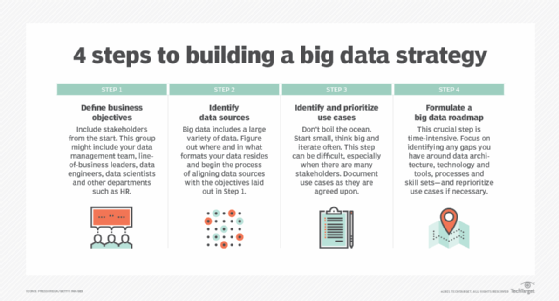
Here are four steps to take when formulating a big data strategy for an organization.
1. Define business goals and objectives for big data applications
Start by defining the business objectives that the strategy aims to achieve. Businesses aren't the same, so there's no one-size-fits-all answer here. Align the strategy with corporate business objectives, critical KPIs and key business problems the company needs to address.
Input from senior executives and business managers on business goals and needs ensures that the strategy supports their priorities -- and that the organization will adopt it. Also involve data scientists and analysts who work with the business on analytics initiatives, as well as members of the data management team.
2. Identify relevant data sources and assess data readiness
The next step is identifying useful data sources to incorporate into the strategy and assessing the readiness of their data assets. As part of the assessment, document data formats, profile data, measure quality levels and evaluate data integration and transformation requirements.
Map data sources to the strategy's business objectives and gauge data readiness accordingly. For example, if improving CX is a business objective, the readiness assessment should cover any data assets related to customer touchpoints.
3. Identify and prioritize big data use cases
Think big on use cases, but start small when developing plans for big data applications. Be realistic about how much the data management and analytics teams can handle at once. Upfront analytics can help identify applicable -- and achievable -- use cases by uncovering patterns, correlations and other useful data insights.
Prioritize use cases based on factors such as their potential business benefits and the required budget and resources. Depending on the number of departments and business units involved, this process can be complex. Work with the various stakeholders to create a plan, then document which use cases will be pursued so everyone is aware of the prioritized list.
4. Create a roadmap for big data projects
Plotting a roadmap for big data applications is often the most time-consuming step when building a big data strategy. Even after the roadmap is completed, it isn't set in stone. It will likely evolve over time as business objectives, priorities and opportunities change.
As part of the roadmap, identify gaps in data technologies, processes and skill sets that could affect the success of planned applications. The gap analysis will inform investments in the big data architecture and the internal resources needed to support the applications. It might also prompt a review of the prioritized use cases to assess whether any changes are needed due to existing gaps that can't be filled immediately.
Be flexible when implementing the strategy
Flexibility is often the most important principle to adopt when implementing a big data strategy. Business needs, data and available tools and technologies aren't static, so strategy development isn't a one-and-done exercise.
Data leaders must be prepared to quickly adjust budgets, technologies, staffing and data management and analytics processes in response to changing circumstances. For example, IT infrastructure changes might be necessary to ensure end users can access critical data from new sources. Increasing deployments of enterprise AI applications also create new data demands that must be factored into big data strategies.
Similarly, required roles and skill sets might change over time. As a result, building strong teams to support big data initiatives typically relies on a combination of external hiring and retraining or upskilling of current employees. The balance between those approaches will likely fluctuate depending on particular staffing needs.
Editor's note: TechTarget editors updated this article in March 2026 for timeliness and to add new information.
Kathleen Walch is director of AI engagement and community at Project Management Institute. She previously was co-founder and managing partner of Cognilytica, a technology research and training firm acquired by PMI in 2024.
Dig Deeper on Data Management
-
![]()
How to develop an enterprise data strategy: 12 key steps
By: Anne Marie Smith, Ph.D.
-
![]()
Execs see AI and automation as long-term strategic investments
By: Cliff Saran
-
![]()
Successful data operations follow a data governance roadmap
By: Jerald Murphy
-
![]()
How to develop an ECM strategy and roadmap
By: Geoffrey Bock