Qdrant boosts performance, reliability to meet AI needs
As customers look to move past experimentation and put pilots into production, the vendor's new features better prepare its platform for modern enterprise workloads.
With AI workloads requiring higher performance, fresher data and more complete transparency than traditional analytics workloads, vector database specialist Qdrant launched new features in Qdrant Cloud to address the demands of AI development.
Accelerated indexing via graphics processing units (GPU) addresses performance by building the vector indexes that enable AI tools to retrieve relevant data substantially faster than was previously possible with Qdrant Cloud. Meanwhile, multi-AZ clusters guarantee that data is always available by replicating data across three availability zones and audit logging captures all operations performed through the Qdrant API to provide transparency.
Given that the new features address practical issues that directly result in whether an AI tool can perform well enough to move into production, they are significant additions for Qdrant Cloud customers, according to Devin Pratt, an analyst at IDC.
"This release is about making Qdrant Cloud more production-ready," he said. "It should help customers move faster, reduce operational risk and put stronger controls around AI retrieval."
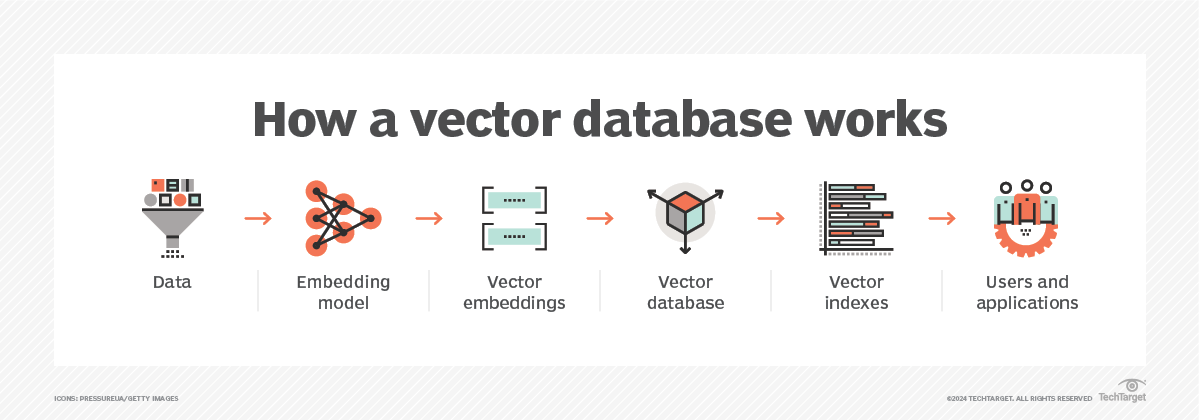
Vectors are numerical representations of data, including unstructured data such as text and audio, that make data searchable by agents and other automated systems so it can be discovered and used to inform AI and analytics applications.
Qdrant, based in Berlin and New York City, is a vector database vendor that competes with fellow specialists such as Pinecone and Weaviate as well as broad-based data management providers that offer vector database capabilities including AWS, Databricks and Oracle.
Performance for production
Vector databases were introduced in the early 2000s but remained a niche feature until OpenAI's November 2022 launch of ChatGPT marked significant improvement in generative AI (GenAI) technology and sparked surging interest in AI development.
This release is about making Qdrant Cloud more production-ready. It should help customers move faster, reduce operational risk and put stronger controls around AI retrieval.
Devin PrattAnalyst, IDC
AI tools such as chatbots and agents require far more relevant data to be accurate than traditional data products, including reports and dashboards. In addition, they benefit from real-time data, so the outputs they deliver include input from the most current available information.
With unstructured data representing most of all data, vector databases help provide the data volume AI tools demand. In addition, they can process data at high speed to guarantee the freshness of the data being fed into AI pipelines.
As a result, throughout 2023 and 2024, the popularity of vector databases exploded. However, most data management tools, including vector databases, were not designed for AI.
They were usable when enterprises were experimenting with AI, developing pilot initiatives to learn and refine their plans for AI before putting tools into production. But vector indexing alone did not deliver high enough accuracy for most projects to move past experiments, nor did vector databases have enough power to maintain performance under the scale of AI workloads.
Now, to address the different demands of AI development, numerous vendors are replacing their capabilities with those designed to better enable enterprises to move AI projects into production.
For example, Databricks launched Instructed Retriever and MongoDB introduced new embedding and reranking models to improve the data retrieval process, GoodData and InsightSoftware -- among others -- added and improved semantic modeling and other tools that address the context fed to AI, and vendors including Actian and Teradata have added vector databases to address AI workloads.
Now, Qdrant is similarly adding capabilities designed to improve AI development with the additions of GPU-accelerated indexing, multi-AZ clusters and audit logging in Qdrant Cloud.
Like Pratt, Kevin Petrie, an analyst at BARC U.S., similarly noted that the new features address the needs of AI developers and are therefore valuable additions.
"These features strengthen Qdrant's position as a vector search specialist that helps AI developers build sophisticated agentic applications," he said. "Qdrant seems to be thriving in this niche."
Better performance and increased transparency are especially valuable for AI workloads, Petrie continued.
"Faster indexing helps operationalize applications in less time, which is critical as enterprises move into full-scale production with agentic AI," he said. "Audit logging is critical because AI adopters are finally starting to take governance seriously. They need transparent, explainable workflows to comply with internal policies and external regulatory requirements."
GPUs are chips that provide the compute power that systems require to carry out workloads. Traditionally, many systems were built with central processing units, but GPUs provide substantially more power and are therefore better suited for the demands of AI.
Multi-AZ clusters assure a system's reliability by replicating data across different availability zones within a region so that if availability in one zone goes down, the system still operates in the others with no delay and no need for users to act. And audit logging provides a trail that users can follow to address AI's unique compliance and security requirements.
All were added to address the different demands AI workloads place on vector databases, according to Bastian Hofmann, head of product at Qdrant.
"Vector search is running in production at scale for our enterprise customers," he said. "Multi-AZ and audit logging came directly from customer requirements -- higher uptime … and compliance visibility are essential when vector search sits on the critical path of your application."
GPU-accelerated indexing was made available in Qdrant's open source database in 2025. Now, with CPUs not providing enough performance to power enterprise AI workloads at scale, Qdrant is adding power to its fully managed service.
"As production datasets and write volumes have grown, CPU-only indexing is no longer sufficient for certain workloads," Hofmann said. "Bringing GPU indexing to Qdrant Cloud means customers can run these heavier workloads in production without managing GPU infrastructure themselves."
Beyond aiding existing Qdrant Cloud customers, the new features could help Qdrant distinguish its vector database capabilities from those of competing platforms, according to Pratt.
In particular, he noted that with high availability and audit logs becoming commonplace, the performance enabled by GPU-powered indexing -- speeding up how quickly Qdrant's database can prepare large or changing datasets for search -- could prove to be a competitive advantage.
"The most differentiated capability in this release is faster indexing," Pratt said. "The availability and audit features matter, but they are quickly becoming enterprise expectations."
Petrie similarly noted that the new features help Qdrant Cloud stand apart from other vector search offerings. However, vector search alone has proven insufficient for feeding AI and retrieval-augmented generation (RAG) pipelines. Adding more retrieval methods could therefore further differentiate Qdrant from competitors, Petrie continued.
"AI and RAG workflows need broader retrieval capabilities," he said. "They need to search text via keyword matching, find table values via SQL queries, identify relationships via knowledge graphs, and so on. So …. I would recommend that Qdrant broaden its retrieval methods and source data types to remain competitive in an increasingly multimodal world."
Informa TechTarget
Looking ahead
Just as Qdrant's latest features are aimed at fueling AI workloads, the vendor's product development roadmap is focused on further improving scalability, performance and search relevance, according to Hofmann. In addition, Qdrant plans to add more transparency and observability capabilities, he continued.
"On Qdrant Cloud, we're focused on operational simplicity -- easier cluster management, fewer manual steps -- and deeper integrations into enterprise systems so teams can plug Qdrant into their existing infrastructure without friction," Hofmann said.
Pratt, meanwhile, suggested that Qdrant address how easy it is to use specialized vector search as part of a broad data ecosystem.
It doesn't need to become a full-featured data platform that provides all the capabilities itself, he noted. But deeper integrations with AI development frameworks, data warehouses, lakehouses, cloud platforms, AI and data governance tools and other capabilities that make up a data and AI stack would be beneficial.
"One of Qdrant’s opportunities is to make specialized vector search easier to use inside the enterprise data platforms customers already rely on," Pratt said.
Eric Avidon is a senior news writer for Informa TechTarget and a journalist with more than three decades of experience. He covers analytics and data management.


 Informa TechTarget