Teradata updates vector indexing suite to aid AI development
New capabilities including hybrid search and support for multi-modal embeddings are aimed at helping users access the data needed by agents and other cutting-edge applications.
After first launching vector indexing capabilities last July, Teradata on Monday unveiled a coming update of Enterprise Vector Store aimed at better enabling customers to access the data needed to develop accurate, trustworthy AI applications.
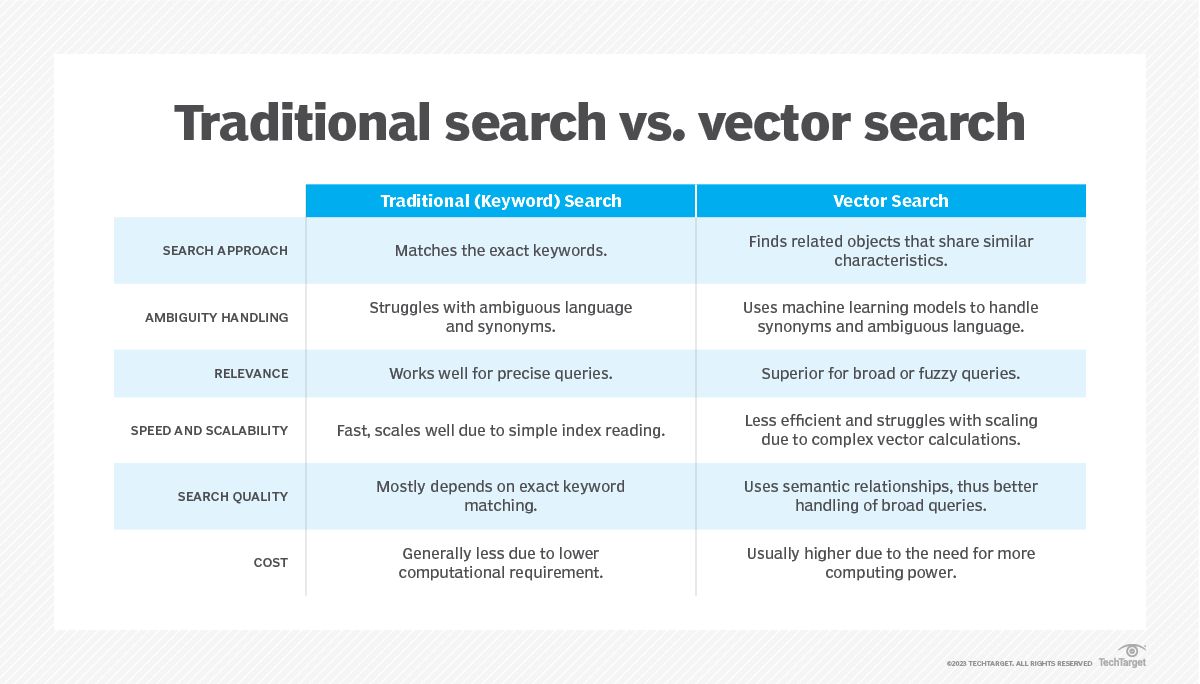
New capabilities include hybrid search that combines semantic and keyword search for more accurate results than when each is used alone and support for multi-modal embeddings -- text, audio and images -- with more robust semantic representations than before to help customers discover relevant data for task-specific AI agents and other applications.
The new capabilities were introduced during the Gartner Data and Analytics Summit, a conference hosted by the research and advisory firm in Orlando, Fla. General availability is scheduled for April.
Given that Teradata's Enterprise Vector Store update will add capabilities that collectively help customers reduce the number of different systems needed to develop production-ready AI applications, it is significant for Teradata users, according to David Menninger, an analyst at ISG Software Research.
"Agentic AI is where all the attention is focused right now," he said. "Vector embeddings and vector stores are critical to agentic AI providing the backbone for retrieval-augmented generation. The dilemma for enterprises has been that they have to cobble together agentic AI solutions by combining many different components."
Additionally, from a competitive perspective, while many vendors now provide vector indexing capabilities, Teradata's support for multiple unstructured data types is somewhat unique, Menninger continued.
"Our recent analysis of more than two dozen data platform providers indicates that 95% include vector capabilities, but Teradata is one of the few that offers automatic ingestion of a variety of unstructured data sources," he said. "And, as it is typical of Teradata, they've invested in providing a highly scalable solution."
Based in San Diego, Teradata is a longtime data management and analytics vendor. Like many of its peers, the vendor has added AI development capabilities in response to surging enterprise interest in building AI applications since OpenAI's November 2022 launch of ChatGPT marked significant improvement in generative AI (GenAI).
For example, Teradata in September 2025 unveiled AgentBuilder to aid agentic AI development and in January introduced AgentStack -- which included AgentBuilder -- to help customers deploy and manage agents.
Vector vitality
Vector indexing has been around for a couple of decades with the first vector databases dating back to the early 2000s. Until recently, however, it was a niche capability used by search-driven organizations such as e-commerce companies and healthcare providers to discover relationships between data.
Vector embeddings and vector stores are critical to agentic AI providing the backbone for retrieval-augmented generation. The dilemma for enterprises has been that they have to cobble together agentic AI solutions by combining many different components.
David MenningerAnalyst, ISG Software Research
Rising interest in GenAI beginning in late 2022 and now agentic AI changed the value enterprises place on vector indexing, turning it from a luxury to a necessity.
Vectors are automatically generated numerical representations of unstructured data such as text and images to give unstructured data a form of structure so it can be searched, integrated with traditional structured data and used to inform the applications enterprises use to help make data-driven decisions.
GenAI and agents, meanwhile, require vast amounts of high-quality data -- exponentially more than traditional analytics tools such as reports and dashboards -- to deliver consistently accurate results. AI outputs are based on aggregations of data rather than individual data points, so if there is not enough relevant data, AI tools will hallucinate.
Unstructured data, which now represents as much as 90% of all data, helps enterprises amass the requisite data volume for chatbots, agents and other AI applications to deliver trusted outcomes. Vector indexing, meanwhile, is one of the main means of making unstructured data operational.
Vendors such as Pinecone and ChromaDB are vector database specialists. But with vector indexing now more of a necessity, data platform vendors such as Databricks and Snowflake began adding such capabilities a couple of years ago so customers didn't have to integrate a specialized vector database into their development pipeline.
Teradata was slower to add vector indexing to aid AI development, unveiling Enterprise Vector Store in March 2025 and making it GA four months later. Now, the vendor is planning an update featuring capabilities based on observing how customers want to use AI, according to Sumeet Arora, Teradata's chief product officer.
"Teradata's approach to building AI capabilities is grounded in use-case-led platform development," he said. "Across [more than] 150 AI proofs-of-concepts, we see demand for multi-modal data including documents, videos, images, and more. Teradata's Enterprise Vector Store … is meeting our customers' growing needs for autonomous capabilities."
In addition to hybrid search and multi-modal embeddings, Teradata's Enterprise Vector Store update will add the following capabilities:
An integration with Teradata Unstructured -- the vendor's feature set for integrating unstructured data -- to automatically ingest and process multiple modes of unstructured data.
Added dimensions for vector embeddings to make relevant data more discoverable for task-specific applications.
A direct integration with AI development platform LangChain that enables joint customers to use LangChain's capabilities to build enterprise scale retrieval-augmented generation pipelines and easily move enterprise-grade applications from prototype to production.
While customer feedback provided the impetus for developing the upcoming new Enterprise Vector Store capabilities, the added dimensions are perhaps the highlight given that they improve representations of unstructured data, according to Donald Farmer, founder and principal of TreeHive Strategy.
Meanwhile, he noted that the update, as a whole, has the potential to add valuable features for customers while helping Teradata provide a more competitive set of vector indexing capabilities.
"Their experience with multi-modal data at scale holds out the potential of a high-performance solution," he said. "There are some good potential use cases here for multimedia processing and potentially biomedical applications such as genome sequencing. Teradata needs this release, but it's not a major step forward."
Informa TechTarget
Looking ahead
Once the Enterprise Vector Store update is released, Teradata will continue to emphasize making it easier for customers to develop and deploy agents and other AI applications, according to Arora.
"Teradata remains focused on its vision of enabling the autonomous enterprise by leaning hard into the concept of an autonomous AI and a knowledge platform ready for agentic workloads," he said. "We intend to make this possible wherever our customers need it -- any cloud, on-premises, or hybrid -- enabling innovation velocity, price-performance and security."
Menninger, meanwhile, suggested that Teradata and its peers add better support for operational data using online transaction processing in addition to the analytical data they have historically supported with online analytical processing.
"Agentic AI is blurring the lines between analytical and operational systems, but operational systems typically require a different data platform architecture than analytical systems," Menninger said. "We see many data platforms adding an integrated component to deal with operational data in addition to analytical data, so that may become a competitive necessity over time."
Eric Avidon is a senior news writer for Informa TechTarget and a journalist with more than three decades of experience. He covers analytics and data management.


 Informa TechTarget