
5 skills needed to become a prompt engineer
With the rise of generative AI, prompt engineering has emerged as a new profession. Desired skills include refining prompts, analyzing AI output and ensuring alignment with business goals.

The evolution of AI has enabled the development of sophisticated large language models (LLMs) capable of ingesting, processing and delivering an enormous amount of detailed information to human users. AI tools, such as ChatGPT and other generative AI systems, are fundamentally changing the way people work, study and search for information.
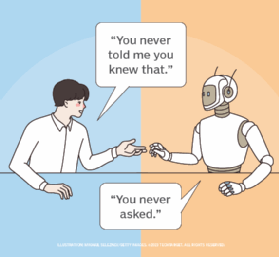
But, as with people, finding the most meaningful answer from AI involves asking the right questions. AI is neither psychic nor telepathic. Although the technology can glean context with ever-increasing effectiveness, it can't intuit, which means it doesn't know what a user wants until it's explicitly stated. In addition, AI can't provide specific details until the user provides precise parameters for their question. Users must coax or prompt AI systems to deliver a desired output by adding specific, actionable details to their question.
As AI continues to evolve and demonstrate value in human endeavors, there's a need for professionals who understand how to prompt, posing questions or actions to the AI in the most efficient and effective ways possible. Prompt engineering is becoming a viable computer science role and career path.
What is prompt engineering?
Prompting is a familiar concept. It's done every time users query an AI-driven search engine like Google or Bing. In the broadest sense, prompt engineering is the art of asking the best question to elicit the most meaningful response from an AI system. This involves strong language skills, using nouns, verbs, relevant examples and other vocabulary arts to query the AI.
A generative AI user performs some of the tasks of a prompt engineer when they ask AI questions. An engineer, on the other hand, delves into the nuances of language input and observes how the AI output responds. This lets the prompt engineer refine the LLM's development and find AI limitations, errors and defects that AI developers can address. As part of training an AI system, prompt engineers can also help it understand how to interpret and deal with various prompts. The role of prompt engineer is a mix of programming, instructing and teaching.
To understand the importance of prompts, consider the example of a user querying AI about a simple real-world topic, such as awards in the entertainment industry. A user asks the following question:
"Who won the movie award?"
This is an ineffective prompt because it's far too broad. The AI might respond by returning every winner of every movie-related award for every year where data is available. It would result in an unmanageable list that a user would need to parse manually.
However, the user could ask a more specific question, such as the following:
"What movie won the Academy Award for Best Picture in 2025?"
The AI with adequate data and training could effectively respond with a specific answer. In this case, the movie Anora won the Academy Award for Best Picture in 2025.
The prompt engineer must ensure the AI's answers to questions are correct. If the results are absent, incomplete, unpredictable or unintended, the engineer can train the AI to provide the correct answers -- or report issues to the development team for remediation.
For the Academy Award example, a prompt engineer might test the AI by asking the following question:
"What movie won the Academy Award for Best Picture in 1917?"
Since the first Academy Award ceremony was held in 1929, the prompt engineer should pay particular attention to how the AI responds and what explanations it provides. This is because there is no data to answer the query, as the Academy Awards didn't exist in 1917. Any other response would be erroneous and require corrective training from the prompt engineer.
Prompt engineering techniques
Prompt engineers use numerous techniques to craft the inputs that guide AI systems toward relevant, accurate and detailed responses. Successful engineers understand and use a range of techniques to build prompts for diverse situations and platforms. The following are some of these techniques:
- Direct prompting. A prompt with precise and detailed directions. This approach avoids ambiguity through action verbs, and defines the length, format and tone of the output.
- Persona prompting. Also known as role playing, persona prompting instructs the AI to take a defined role, such as an experienced sales professional. This can cause the AI to improve its contextual understanding and generate specialized output.
- Few-shot or zero-shot prompting. Examples, or shots, help an AI recognize patterns and deliver specific styles and formats in its output. However, examples can be difficult or even impossible to provide, forcing the prompt engineer to construct prompts using few-shot or no-shot prompting. If no examples are provided (zero-shot), the AI only uses its trained information.
- Chain-of-thought prompting. The path from an AI prompt to AI output can be opaque and difficult to follow. CoT prompting asks the AI to approach complex tasks or problems as a series of logical steps. This helps the engineer understand how the AI arrived at its output, provides transparency and enables better corrective actions as needed.
- Decomposition prompting. Also called prompt chaining, decomposition is the reverse of CoT prompting. Here, the prompt engineer breaks the problem into a series of smaller problems using several prompts where the output of one prompt delivers the input to the next.
- Contextual prompting. These prompts include important background information, relevant data and meaningful scenario descriptions. Context engineering is a level of prompt engineering that helps the AI to produce more refined or tailored responses.
Prompt engineering tools and platforms
Prompt engineers don't simply use the AI interface to pose their queries. They also rely on an assortment of tools and platforms to facilitate prompt creation, testing, optimization, version control, cost, performance monitoring and automation. Job seekers can improve their opportunities by demonstrating familiarity with numerous tool types, such as the following:
- Prompt prototyping. Prompt engineers use prototyping tools for rapid prompt creation, testing and iteration. These are especially useful when interactive or complex workflows are involved. The goal is to visualize features, test user experience, test hypotheses and create functional examples that users can share with project team members and other stakeholders. Examples of prototyping tools include Anthropic's Claude Console, Microsoft's Azure OpenAI Studio, Google's Vertex AI and OpenAI's Playground.
- Prompt management. Prompts can be straightforward, but prompt engineers focus on building complex and detailed prompt structures. These can involve numerous prompts chained together. Prompt engineering treats prompts like code, and prompt management tools can save and apply version controls to document each prompt. Examples of prompt management tools include LangChain's LangSmith, PromptLayer and PromptPanda.
- LLM frameworks. Prompt engineers work extensively with LLMs, which must understand, process and respond to prompts. LLM frameworks help orchestrate prompt creation, manage data flow, validate responses and enable AI agents to handle complex multistep reasoning. Examples of LLMs include LangChain, LlamaIndex and Microsoft's Semantic Kernel.
- Prompt testing. When engineers treat prompts like a segment of software code, comprehensive testing and evaluation are required. Prompt testing and evaluation tools can test, benchmark and offer improvements to LLM applications. This lets prompt engineers gauge prompt quality, compare model versions and performance, and ensure that AI systems meet established operational criteria. Examples of testing and evaluation tools include LangSmith Evaluation, OpenAI Evals, PromptimizeAI and PromptLayer.
- Prompt optimization. Engineers can often refine AI prompts for better results or performance. Optimization and automation tools refine prompts for faster, more accurate and less expensive results. These tools often use internal AI to refine and systematically find the most effective instructions. Examples of prompt optimization tools include AutoPrompt, OpenAI's Prompt Optimizer, PromptLayer and PromptPerfect.
What does a prompt engineer do?
From an employment perspective, prompt engineering is an abstract form of UI engineering. For example, a traditional UI engineer is responsible for ensuring that the UI is intuitively designed, easy to navigate and provides clear responses and behaviors for users. Generative AI poses different UI challenges because users simply ask the AI for what they want. The UI is the prompt mechanism itself for LLMs like GPT. The prompt engineer must understand how the AI works, recognize how the AI will respond given specific prompts, ensure that the AI delivers meaningful output or responses for any input prompt and recommend corrective action when it doesn't.
Today's prompt engineer serves a cross-disciplinary role with the following three components:
Develop, test and refine AI prompts
The core role of any prompt engineer is to work with AI platforms to develop new prompts. Engineers test AI behaviors and the outputs resulting from prompts. They improve prompts and implement AI guardrails to maintain safe, ethical and predictable AI output when given new or unexpected prompts. Troubleshooting is also a core responsibility. A prompt engineer must spot AI limitations and errors, and develop strategies to remediate them.
For example, a prompt engineer working with a healthcare AI platform might develop prompts to inquire about patient diagnoses and test how the AI responds when input, such as patient names or medical terminology, is misspelled. Then, they make recommendations or changes to refine acceptable prompts or AI responses. Prompt engineers are usually involved in ongoing AI training and refinement.
Collaborate across-disciplines
A prompt engineer is typically part of the development team, often serving in a consulting and quality-control role. The engineer works with product developers to design and code the AI platform. They can also be part of the data team, which establishes the data set and trains the AI platform, or the business team, which is comprised of project stakeholders.
A prompt engineer is usually tasked with aligning prompts to company goals and user needs. For example, at a healthcare provider, a prompt engineer might work on how an AI platform uses medical terms, and how it presents patient data and diagnoses. Prompt engineers also collaborate with project or business teams to optimize prompts for performance and cost, such as minimizing compute time and latency.
Analyze and report
Finally, a prompt engineer must understand analytics. They need to monitor and correlate inputs and outputs and establish meaningful metrics to measure the AI platform's behavior and performance. These analytics are useful to AI developers, data scientists and the business team.
Garbage in, garbage out, or GIGO, is one of the oldest axioms of computer science, but with AI, it's more relevant than ever. For example, a prompt engineer might analyze AI responses to specific prompt sets and alert the data science team to signs of data bias that could require more training or a review of data content. Similarly, AI prompt responses that indicate data gaps or cause unpredictable results might signal the need for a data review, algorithm refinement or model training.
Prompt engineer salaries
How much can a prompt engineer make? Estimates vary dramatically, but salary reports range anywhere from about $100,000 at the entry level to $200,000 for senior staff to more than $400,000 per year for top earners in certain industries.
Based on Glassdoor 2026 U.S. salary data, the average annual salary for a prompt engineer was about $127,000, depending on experience and industry. This might seem like a lot for relatively straightforward work, but it's important to look deeper.
Prompt engineering is a growing IT role, and job complexity and responsibilities vary by company and AI platform. The highest-paying roles require deep knowledge of AI and extensive programming skills to construct complex prompts that involve thousands of precisely chosen words. That's extensive expertise that few people possess.
5 core skills needed to become a prompt engineer
The skill set needed to qualify for a prompt engineering job isn't long, but it can be deceptively broad. This is typical for emerging roles that are still being defined by a rapidly developing industry. Prompt engineering roles generally ask for the following five skills:
- Strong verbal and written communication skills. Unlike many IT roles, prompt engineers must communicate with AI systems through words and phrases. Detailed prompts can be quite complex and involve hundreds, even thousands, of carefully chosen words. In addition, the cross-disciplinary nature of prompt engineering makes communication and collaboration important.
- Programming proficiency. Although prompt engineering isn't exactly programming, it's common for prompt engineers to have some involvement in coding -- whether they participate in developing the AI platform itself or use the programming skills to automate testing and other functions. This often requires several years of experience with languages, such as Python or its peers. It also helps to have a strong knowledge of APIs, operating systems and CLIs. Precise requirements will depend on the company and the AI platform.
- Prior prompt experience. Given that prompt engineering is a relatively new role, it's difficult to pinpoint a minimum level of prior experience, since the traditional three-to-five-year experience benchmark is hardly applicable. Still, most employers will look for prompt engineers with demonstrated experience in building and testing AI prompts, along with experience working with major models, such as GPT, and platforms, such as ChatGPT.
- AI technology knowledge. Prompt engineers rely on language skills, but they still require a comprehensive understanding of natural language processing, LLMs, machine learning and AI-generated content development. This is important if the prompt engineer has coding or other AI platform development responsibilities.
- Data analysis experience. Prompt engineers must understand the data provided to an AI platform, the data used in prompts and the data the AI generates in response. This requires strong knowledge of data analytics techniques and tools. An employer might look for several years of experience analyzing structured and unstructured data sources. This knowledge is essential when looking for data bias and other data issues and ensures the quality of the AI output.
In addition to these five core skills, prompt engineers must demonstrate mastery of soft skills, such as problem-solving and analysis, along with the ability to collaborate effectively with cross-functional teams.
Prompt engineering courses, certifications and career opportunities
Today, there aren't any college-level degrees in prompt engineering. Most prompt engineering candidates start with a bachelor's or master's degree in computer science.
Degrees in AI, engineering, data science and even linguistics can also launch a prompt engineer's career.
Beyond that broad foundation, prompt engineers rely on a mix of practical experience along with online courses and certifications. Certifications can include Blockchain Council's Certified Prompt Engineer; universities such as MIT, Purdue University and the University of Michigan offer related certifications in AI and ML. Online education platforms, such as Coursera, edX, NetCom Learning, Refonte Learning and Udemy, also provide practical skills in prompt engineering.
Prompt engineering roles have their own unique requirements. Understand the education and experience required for a specific job opportunity, and ensure that formal education, continuing coursework and practical experience meet those requirements.
Stephen J. Bigelow, senior technology editor at TechTarget, has more than 30 years of technical writing experience in the PC and technology industry.