Free DownloadWhat is GenAI? Generative AI explained
Generative artificial intelligence, or GenAI, uses sophisticated algorithms to organize large, complex data sets into meaningful clusters of information to create new content, including text, images and audio, in response to a query or prompt. While the technology is still in relatively early -- and volatile -- days, progress thus far has already resulted in generative AI fundamentally changing enterprise technology and transforming how businesses operate. This guide takes a deeper look at how GenAI works and its implications, with hyperlinks throughout to guide you to articles, tips and definitions providing even more detailed explanations.
GenAI in product manufacturing cuts costs but adds risks
In product design and manufacturing, GenAI systems are consolidating supplier data, improving processes and cutting significant software costs -- yet they raise unique concerns.
The third-party manufacturing worksheet scheduler didn't work to his satisfaction, so Moulydharan Vallal, manufacturing design and implementation manager at battery material maker Sila Nanotechnologies, built his own in a few months using ChatGPT.
The generative AI-built scheduler replaced a spreadsheet and checks equipment availability, upcoming maintenance, material levels and storage capacity. The Sila team has been building other systems, including a scenario-planning model that tracks the cost of goods sold. Over the past two years, build-your-own systems has saved the manufacturer "hundreds of thousands of dollars" in software costs, according to Vallal, who credits GenAI for the savings. The cost of building systems, he said, "is almost collapsing to zero."
GenAI-developed systems have the potential to replace third-party software applications in several industries, but GenAI's use in manufacturing poses different kinds of concerns. When integrating AI-related capabilities into manufacturing systems, any system failure can shut down production.
AI explainability is critical, said Austin Locke, principal and global lead for data science and AI at Rockwell Automation. "If the AI system is designed as a black box, there's definitely resistance to that in manufacturing," Locke said. Still, manufacturers aren't resistant to advanced technology.
Manufacturers have long used high-performance computing (HPC) systems, including leasing the U.S. government's most powerful supercomputers, to test and design products in virtual environments, such as the wings of airplanes. Before the advent of HPC, manufacturers had to build physical prototypes and test each one.
HPC runs its computationally intensive simulations based on physics to produce an output "closer to nature" and more realistic, said Steve Conway, independent consultant for AI and HPC. AI is "just one more step removed from nature -- from realism," he explained. It examines historical data to identify the best design options. As a result, HPC makers are integrating AI into their systems, Conway added.
GenAI in product design: Who's the inventor?
While GenAI can help design products, select materials and produce innovative components, it can also create legal risk because U.S. copyright law doesn't recognize machines as inventors. "To be able to get a patent, the inventor has to be a human being. And the question becomes, Who is the inventor?" conjectured Shabbi Khan, a partner at consultancy Foley & Lardner and co‑chair of AI, automation and robotics group.
We're pretty much at the point now where LLMs can give you an answer - and that's the invention.
Shabbi KhanCo‑chair of AI, automation and robotics group, Foley & Lardner
Until recently, large language models (LLMs) were viewed as tools for generating ideas and producing content. But "we're pretty much at the point now where LLMs can give you an answer -- and that's the invention," Khan explained. "You have an obligation to the patent office. You have the duty of good faith and candor, which includes declaring that you are the true inventor of this technology."
A business can claim that a human, not AI, produced the invention, but there could be significant legal risk in doing so. "You may get away with it, and nobody will notice until something gets litigated," Khan noted. The real inventor can surface in discovery, when a party is required to "provide all documentation relating to the conception of the invention," he added. "And if somebody comes across your LLM history, it could really jeopardize certain things."
A practical guardrail is to treat AI's involvement as a starting point. "Don't use the output as is," Khan advised. "Think about tweaks, go experiment with it, modify it."
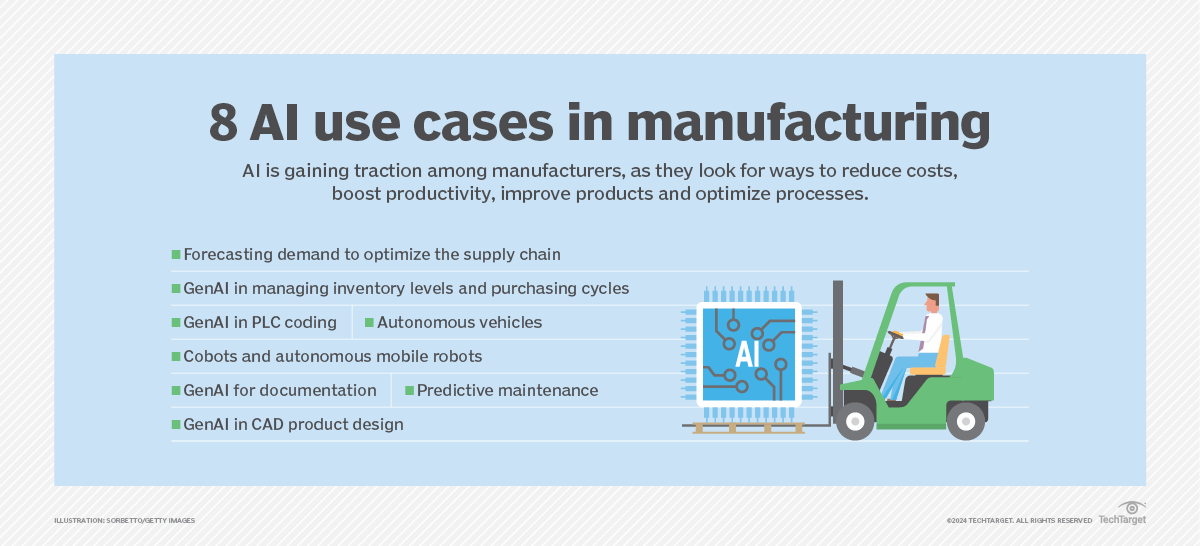
Design, manufacturing and warehousing get a big lift from GenAI-powered systems.
GenAI in autonomous processes
Geminus AI makes an intelligence layer that sits on top of existing industrial control systems, such as those from Schneider Electric and Rockwell, said Greg Fallon, CEO of Geminus.AI. The platform uses GenAI to ingest the operations data and return specific control settings to improve process performance. In manufacturing plants that rely on HPC and physics‑based simulations, Geminus AI's platform augments those systems by using what it calls "physics‑informed" AI models to drive continuous, real‑time control decisions.
While the process can run autonomously, Fallon noted, the decision depends on the customers. "We have some customers who prefer to have a human in the loop because they don't have the autonomous backups in place," he said. "We have other customers that are fully comfortable running autonomously."
There are also GenAI-infused tools that can improve manufacturing speed and efficiency. "Engineers spend more time searching for information than using it," said Chris Cope, vice president of engineering at CADDi, whose tools are designed to centralize data, such as drawings, spreadsheets and data, stored in manufacturing supplier systems.
In addition, "generative AI is really good at extracting knowledge and intent from engineers," said Nathan Evans, co-founder and head of climate and AI at digital manufacturing platform provider Fictiv. That kind of context from engineers is vital. GenAI can build at the "speed of thought," Sila's Vallal said, but "without context [from people], it will break."
Patrick Thibodeau has worked for several decades as an enterprise reporter, focusing on IT and workforce management, ERP, high-skills immigration, tech policy, and high-performance computing.