Battle of the bots: Best GenAI chatbots for business
Businesses are deploying multiple GenAI tools to support productivity. Success requires choosing the right tools for the right use case and keeping a close eye on the outcomes.
Generative AI chatbots for employee productivity are commonly deployed as a company's first foray into AI, but identifying use cases and matching the right tool for the right job is critical to ensure any AI project meets ROI, data privacy and efficiency expectations.
So said Jeff Wilhelm, founder and CEO of independent consultancy Infused Innovations. By 8:30 on a Monday morning in February, Wilhelm already had three such AI requests sitting in his inbox.One client, he said, emailed him in a bit of a panic about falling behind with AI. A second email came from a corporate executive seeking help in communicating his company's use of AI to a customer. A third email requested support in assessing AI risks.
For any GenAI tool to pass muster for corporate use, it must meet five responsibility criteria: safety, security, data privacy, accuracy thresholds and legal/compliance requirements, said Fernando Schwartz, chief AI officer at healthcare technology company Claritev. "If any tool does not satisfy our CSO, our legal team, our AI team and all those five things, it's not moving forward," Schwartz said.
GenAI chatbots for business: Options and features
Microsoft 365 Copilot and OpenAI ChatGPT Enterprise are the top choices for GenAI productivity assistants, according to data from Gartner's "2025 GenAI and Agentic AI in Enterprise Apps Survey." But only 8% of the 360 IT application leaders surveyed said they rely on a single tool; 92% of respondents said they planned to prioritize three GenAI productivity tools over the next 12 months.
GenAI chatbots for business range from general-purpose to task-specific and typically include data privacy and security levels to protect enterprise data. Providers and their chatbots for business are listed alphabetically, along with features, applications and capabilities.
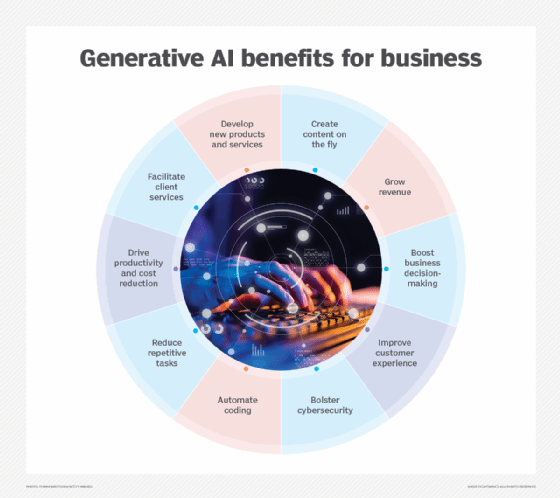
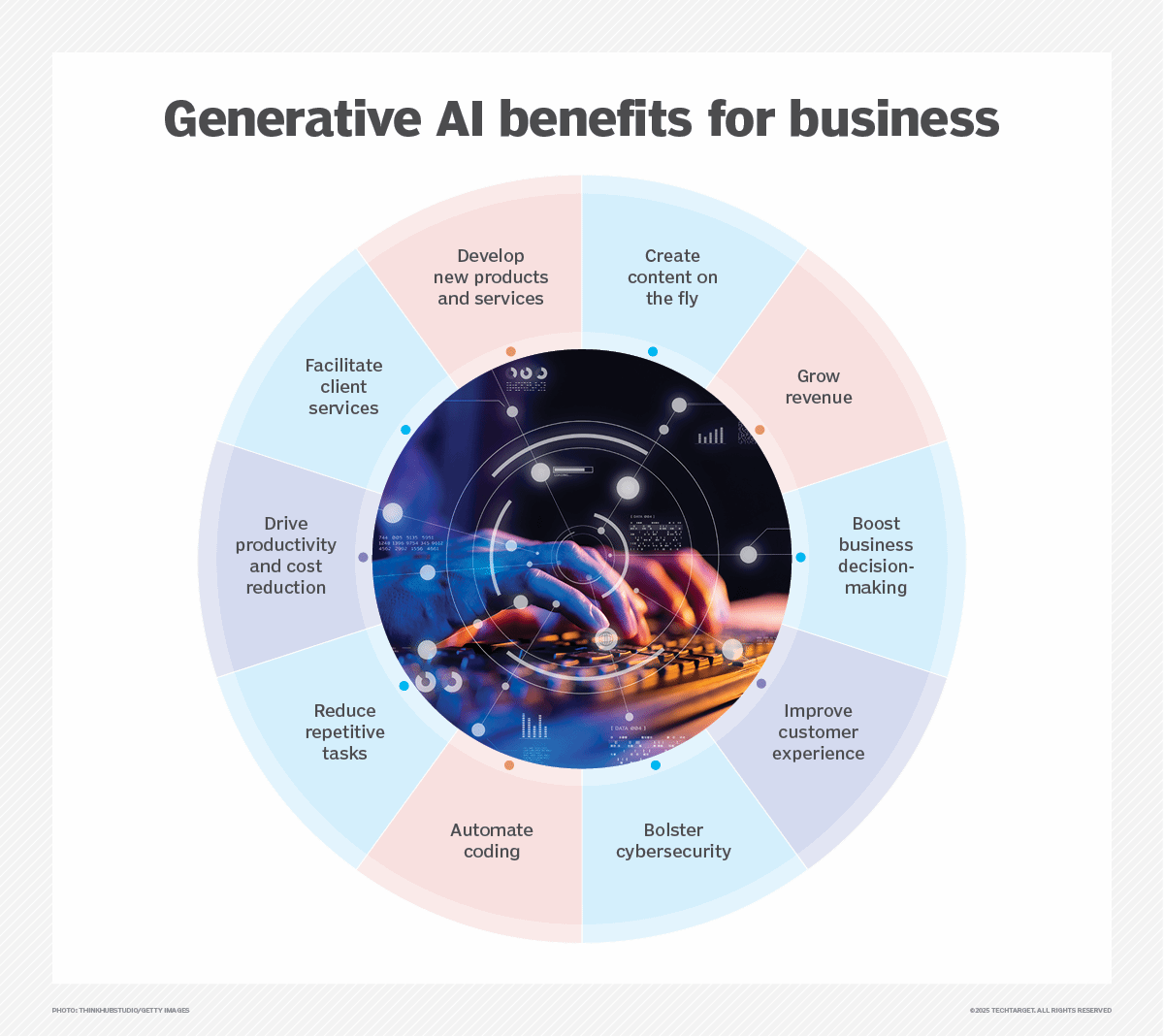
When built and deployed properly, GenAI chatbots can improve key business functions.
Amazon Q
This GenAI assistant is built on Amazon Bedrock for shops using AWS. Amazon Q lets employees query and summarize internal data, generate content and work across connected business systems. It integrates with enterprise data sources such as S3 and SharePoint and delivers responses based on a user's identity and role. It supports SOC 1, SOC 2 and SOC 3 eligibility and SCIM via AWS IAM Identity Center.
Anthropic Claude Enterprise
Positioned for long-context reasoning and document-heavy workflows, Claude is suited for legal, compliance and research uses such as lengthy contracts and technical documentation. It includes single sign-on (SSO) with domain capture, role-based access controls, SCIM provisioning, SOC 2 compliance and contractual data-handling protections for companies with strict governance and review requirements.
Google Gemini Enterprise
Integrated into Google Workspace, Gemini is a natural fit for businesses that use Google Cloud and Workspace. With native multimodal capabilities, including text, image and video, Gemini supports in-context creation and analysis across Docs, Sheets, and Gmail without workflow switching. It also supports large context windows of 2 to 10 million. Enterprise deployments use identity, SCIM provisioning and an SOC 2-aligned compliance framework.
Microsoft Copilot
Copilot includes a family ofAI assistants for different purposes delivered through multiple products and licenses. Microsoft 365 Copilot for productivity is embedded in Word, Excel, Outlook and Teams and grounded in Microsoft Graph. Prompts and responses are scoped to the organization's tenant and respect existing Azure Active Directory permissions. Copilot offers SOC 2 compliance and supports SCIM-based identity lifecycle management.
Mistral AI
This France-based company's LeChat AI assistant is distinct in its native GDPR compliance. Mistral releases its model weights so businesses can host it on their own private servers. Its context window is much smaller than other options, and it only supports text and images. But those constraints also make it easier to keep costs down due to lower latency and reduced compute requirements.
OpenAI ChatGPT Enterprise
The enterprise-level version of the top consumer AI tool supports employee productivity such as content generation, coding support, data analysis and reasoning tasks. It includes data non-training guarantees, SOC 2 compliance, SSO and SCIM provisioning.
Perplexity Enterprise
Known as an AI-augmented research and knowledge discovery tool rather than a conversational chatbot, it supports searches across public web sources and internal documents, returning trustworthy answers with citations for traceability. The platform supports enterprise security requirements, including SOC 2 compliance and SCIM provisioning, making it a compelling option for teams prioritizing source attribution and research integrity.
Slack AI
Formerly Slackbot, Slack AI acts as an embedded agent layer within the Slack platform, pulling from messages, files and channels to answer questions, summarize conversations, prepare for meetings and assist with content creation. Unlike the other chatbots listed, Slack AI doesn't access the open web; it's constrained to data available within the Slack workspace. The Slack platform supports SOC 2 compliance and SCIM-based user provisioning via enterprise identity controls.
xAI Grok Business
Differentiated by its access to sentiment from X (formerly Twitter), Grok offers a large context window up to about 2 million tokens and agentic search capabilities for navigating large, unstructured data sets. Though xAI emphasizes encryption and enterprise security features are emphasized by xAI, CIOs might not yet see the compliance, governance controls and long-term support assurances compared to more mature enterprise AI platforms.
In addition, AI chatbots geared to specific functions include Jasper Enterprisefor marketing teams, Oracle Analytics AI Assistant forERP-heavy enterprises and Salesforce Einstein Copilot for CRM-centric organizations.
Build AI, buy AI or both
For employee-facing tasks aimed at productivity where the goal is to save time, buying off-the-shelf AI assistants makes sense, but enterprises commonly build AI tools as well, said Gabriele Rigon, a Gartner senior analyst focused on conversational AI. Gartner's research published September 2025 revealed that 44% of those surveyed said they built their own GenAI tools for productivity using services like OpenAI via Azure APIs. "Normally, the larger the use case, the more complex, the more you need to mix and match different kinds of AI techniques," Rigon said.
Building POCs allows an organization to see how well AI applies to solving a problem and if it's worth continuing further.
Jeff WilhelmFounder and CEO, Infused Innovations
Businesses can justify building their own AI tools when they have stringent privacy and security requirements or plan to use AI for transformational projects like proprietary drug discovery. In this case, a company would want to own the AI technologies driving their innovation, Rigon explained.
Major AI software providers such as Azure OpenAI Service, Google Vertex AI Agent Builder and IBM Watsonx Assistant give internal development teams everything they need to build their own AI tools.
To help his clients experiment with AI for specific use cases, Wilhelm works with them to build proof of concepts. "Building POCs," he said, "allows an organization to see how well AI applies to solving a problem and if it's worth continuing further." Microsoft's AI ecosystem, with Copilot Chat, Copilot Business, Copilot Studio and AI Foundry, "allows for a maturity curve that includes specific layers like Work IQ, Fabric IQ and Foundry IQ, all governed by Agent 365," he added.
Top-tier models, including Anthropic, are available as in-tenant deployments, which provides flexibility for IT teams. "This lets us pick the best tool for the client while ensuring data and models remain co-resident, without sending sensitive data to external APIs," Wilhelm noted. In addition, the tools within the vendor's ecosystem allow for model version management, A/B testing, monitoring model skew and drift, responsible AI and many other enterprise requirements, he said.
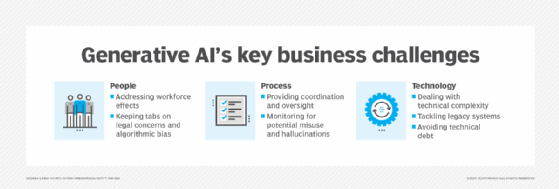
Attaining positive GenAI ROI requires a granular approach to product, process and people.
Managing GenAI's ROI challenges and risks
While research shows most companies have deployed GenAI to help employees save time on rote tasks and provide faster access to information, those benefits might not translate into top- or bottom-line results.
The ROI of AI productivity tools might be hard to quantify on a spreadsheet, but businesses soon won't be able to operate without them, Claritev's Schwartz said. "Some of these tools are just becoming table stakes," he explained. "It's just like having email. How do you quantify the value of email? If you don't have it, you just can't do business."
Beyond GenAI for productivity, one of the biggest challenges Wilhelm sees is businesses viewing AI as a "silver bullet" while pursuing far less process understanding than they would when making other technical decisions. "I have been through massive projects like CRM and ERP implementations, cloud migrations, workforce modernization initiatives -- all that had months of rigor in vendor [and] tool selection and a full understanding of risks and impacts and financials," he explained. "These days, there is such a rush to 'do something' that the C-suite story about a process that 'AI will solve' doesn't match the ground truth."
For example, a seemingly simple process explained in one sentence often turns out to be dozens of individual steps when modeled, Wilhelm said. He sees this situation so often that his firm built a tool to help map out business operations. "Identifying those steps in the process is critical," he noted. "It reveals where AI is appropriate, where it isn't and where human-in-the-loop is required. Without that granular process work, the ROI remains theoretical."
Another concern with AI deployments, particularly when moving beyond GenAI and into agentic AI, which works autonomously, is AI's ability to go off the rails and potentially cause damage. "How you architect your solution is very important," Schwartz said. "GenAI does a lot of things off the path. And because of that, it's also very easy to do a lot of things wrong."
One safeguard Schwartz deployed is an AI gateway, which channels all API traffic. "Now you have a way to see what's happening there and govern it, with human oversight, and provide a kill switch if things were to go sideways," he said. The barrier of entry to AI has disappeared, he added, but it's critical to keep an eye on things with a mix of human-in-the-loop and automation because when AI "breaks," it could be costly.
"Entering the AI race is not hard," Schwartz said. "Exiting it in one piece -- that's the hard part."
Bridget Botelho is a technology journalist covering artificial intelligence and emerging IT industry trends.