
Why and how enterprises should build a green AI initiative
Executives making AI decisions must consider ethics, compliance and now environmental impact. Learn how green AI aligns governance and sustainability to improve digital strategies.

Green AI is a governance, risk, cost and strategy issue that IT leaders are increasingly discussing in the boardroom. It's no longer being dismissed as simply part of technical optimization or environmentally friendly marketing.
Green AI is the practice of designing, developing and deploying AI systems that minimize energy consumption, carbon emissions and resource use, reducing the environmental footprint of these systems. It does this without compromising business value or innovation.
Various realities are driving the green AI movement, including the following:
- Rapid growth of AI energy demand from hyperscale data centers.
- AI workloads that increase enterprise power consumption.
- Rising carbon reporting and compliance requirements tied to digital operations.
Enterprise technology leaders must understand the importance of green AI to be able to identify priorities and risks for their business. The practical framework below can help establish green AI initiatives aligned with business goals.
Why bring green AI into the boardroom?
Green AI affects financial oversight, enterprise risk management, regulatory compliance and corporate reputation. These factors make it a critical part of boardroom agendas. Several key areas are driving the shift toward green AI adoption.
Finances
AI has fundamentally changed enterprise cost structures. AI models require significant investment in upfront training and have ongoing inference costs. These systems consume immense quantities of compute resources, often running continuously in production environments. The costs multiply as organizations deploy AI throughout their businesses.
IT leaders have two specific concerns:
- Cost unpredictability. AI workloads scale rapidly and unpredictably without strong governance.
- Capital inefficiency. Overprovisioned models and unnecessary retraining cycles increase costs.
Model rightsizing and optimized training and retraining are closely related to both financial discipline and environmental responsibility.
Infrastructure and energy constraints
The rapid growth of AI workloads is colliding with the limits of physical infrastructure. Data centers already face power constraints and grid bottlenecks, which can delay construction. AI's demand for high-density compute -- GPUs and accelerators -- means access to energy-efficient infrastructure becomes a strategic advantage. This raises operational questions for organizations, such as the following:
- Can our infrastructure scale without exceeding energy budgets?
- Are we exposed to regional energy volatility?
- How resilient is our AI strategy to power constraints?
These concerns extend beyond technical capacity and require executive-level strategic guidance and support.
Regulatory and compliance pressures
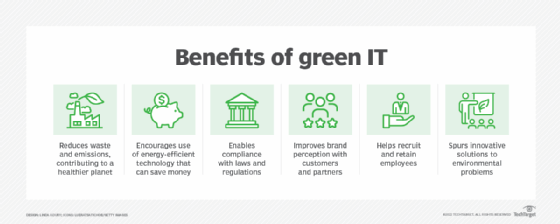
Regulatory requirements for sustainability reporting and compliance are increasing globally. ESG disclosures require expanded transparency into businesses' energy consumption and carbon emissions.
Enterprises with AI expansion plans must consider the following:
- How AI-related emissions factor into Scope 2 and Scope 3 greenhouse gas reporting categories.
- Whether regional or local entities have digital sustainability regulations in addition to any national requirements.
- The risk of misaligning internal AI evolution with public sustainability commitments.
Without careful governance, the competing priorities of environmental commitments and AI-driven innovation can conflict. Boards are now responsible for ensuring accurate disclosure and long-term environmental alignment in AI reporting and governance. Investors and rating agencies are also increasingly evaluating how companies manage digital sustainability.
Strategic risk and brand implications
AI's capabilities amplify value and risk. As organizations move from experimentation to enterprise-wide AI deployment, the environmental, security and financial consequences compound. Green AI is a boardroom topic because its effect on critical functions -- strategy, operations and risk -- directly shapes organizational success. Consider the following effects on businesses:
- Cost structure.
- Operational resilience.
- Regulatory compliance.
- Investor confidence.
- Corporate reputation.
Public awareness of AI's environmental footprint is also growing. Companies that proactively manage and communicate responsible AI scaling can differentiate themselves. Sustainable AI becomes part of brand positioning. Organizations must determine how to scale AI responsibly, predictably and aligned with enterprise strategy.
Green AI practices to prioritize
Green AI embeds cost discipline, risk management and long-term sustainability into AI strategy. Use the following best practices to manage AI across the organization.
Deliberate model selection and model reuse
Not every use case requires the largest available model. Teams should right-size models to business requirements, selecting task-specific or modular architectures where possible. Overpowered models increase compute expenses without necessarily improving business outcomes, directly affecting ROI. A disciplined AI model selection process improves cost efficiency, reduces energy consumption and enhances scalability.
Fine-tune existing models rather than train new models from scratch. Creating internal model libraries enables organized and careful model selection. The result is lower training cost and faster time to value.
Optimize training frequency and inference workloads
Many AI systems are retrained on fixed schedules rather than on performance thresholds or business needs. Similarly, inference systems might run continuously at full scale, even during low-demand periods.
Governance should ensure the following:
- Justified retraining cycles.
- Model performance monitoring to identify retraining requirements.
- Managing always-on AI agents to prevent unnecessary compute use.
These practices reduce operating expenses and energy consumption.
Carbon- and cost-aware workload scheduling
Cloud providers offer visibility into regional carbon intensity and energy sourcing. Enterprises can schedule nonurgent training workloads during periods of lower grid consumption. For organizations with public sustainability targets, carbon-aware scheduling provides tangible, reportable outcomes.
Embedding sustainability metrics into AI governance
Green AI is only valuable when it's measurable. Common metrics include the following:
- Energy per training run.
- Inference energy per 1,000 queries.
- Cost per model iteration.
- AI-related cloud spend over time.
Incorporate these metrics into AI governance boards, procurement reviews and executive dashboards. By tying sustainability indicators to financial and operational KPIs, organizations create accountability, transparency and auditability. These practices align AI expansion with enterprise-wide ESG commitments.
Common pitfalls and strategic tradeoffs
Organizations must govern green AI initiatives with the same rigor as any other strategic priorities. Consider some of the pitfalls that could undermine a green AI effort if not addressed early:
Prioritizing overoptimization over business value
One risk is prioritizing minimal energy consumption over performance, speed or revenue. Green AI is meant to balance business value with sustainability, not minimize carbon emissions at all costs. Executives should require cost-benefit analyses that evaluate performance, risk, ROI and environmental impact.
Treating green AI as a one-off initiative
Green AI can't be a short-term cost-cutting exercise or sustainability campaign tied to a single project. AI systems evolve continuously, and their energy footprints change as use scales. Early gains can quickly erode without lifecycle governance.
Lack of clear ownership
Define executive ownership early. The role typically falls to the CIO, CTO, chief data officer or sustainability leaders. Define executive accountability and KPIs to mitigate any confusion among stakeholders. Cross-functional coordination and outcomes linked to performance metrics also help.
Vendor greenwashing
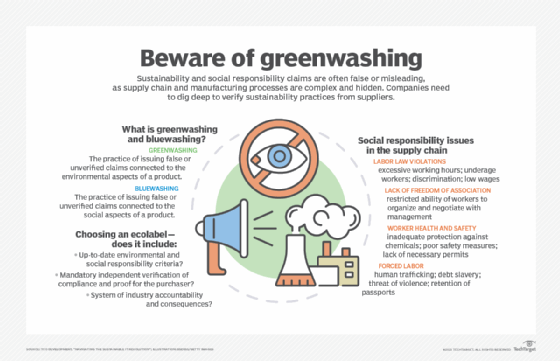
AI and cloud vendors often promote carbon-neutral services and capabilities, but these claims vary in transparency and methodology. Due diligence is essential to ensure that third-party environmental claims withstand scrutiny. Failure to do so could result in noncompliance and prevent organizations from realizing their KPIs.
A practical Green AI framework for enterprises
The following is a five-step framework to guide business leaders toward green AI transformation. Recognizing the importance of each stage helps ensure a comprehensive and scalable approach.
Step 1: Establish an executive mandate and define objectives
Begin with a clear mandate from top leaders that defines why green AI is important, tying it back to the broader enterprise strategy. Clarity at this stage prevents fragmented efforts later.
Key questions at this stage include the following:
- What role will AI play in a long-term growth model?
- What percentage of the IT energy footprint is AI-related?
- How does AI expansion affect the energy profile and cost base?
- How should sustainability influence model and vendor selection?
- Where are the highest-cost AI workloads?
Step 2: Create a baseline and measure
Conduct a baseline assessment of AI-related energy use, cloud spend and model training frequency. The goal is to identify the most resource-intensive and inefficient workloads. This baseline establishes priorities and creates a benchmark for improvement.
Step 3: Identify pilot opportunities
Don't attempt an enterprise-wide transformation. Target high-impact pilots, which are typically large training workloads, high-volume inference systems or continuously running AI agents. Target quick wins that demonstrate measurable impact to build internal credibility and create reusable governance patterns.
Step 4: Integrate sustainability across the AI lifecycle
Embed green AI at every lifecycle stage, including the following:
- Design. Incorporate sustainability criteria in architectural decisions.
- Development. Set efficiency targets for training and fine-tuning.
- Deployment. Monitor energy per transaction or user interaction.
- Operations. Govern retraining frequency and scaling thresholds.
Integrating sustainability into AI governance makes it part of ongoing decision-making.
Step 5: Monitor, report and refine
Ensure sustainability metrics appear in executive dashboards alongside cost, risk and performance indicators. Regular review cadences let leaders continuously adjust as AI use expands. Tie metrics to performance reviews and procurement decisions for greater discipline.
Damon Garn owns Cogspinner Coaction and provides freelance IT writing and editing services. He has written multiple CompTIA study guides, including the Linux+, Cloud Essentials+ and Server+ guides, and contributes extensively to Informa TechTarget, The New Stack and CompTIA Blogs.
Dig Deeper on Enterprise AI Strategy
-
![]()
Efficient chips cannot save inefficient software
By: Abhijit Sunil
-
![]()
Neom partners with DataVolt on $5bn hyperscale datacentre project for digital infrastructure
By: Andrea Benito
-
![]()
IT Sustainability Think Tank: How IT sustainability entered the mandate era during 2025
By: Shane Herath
-
![]()
How AI and the Trump administration are fuelling ‘quiet quitting’ on IT sustainability
By: Tiago Ventura