
Getty Images/iStockphoto
How agentic AI can transform ERP for your business
Experts say agents could soon automate various ERP workflows, but the risk of error is significant, and the necessary data infrastructure and business context aren't yet in place.

Agentic AI has become the headline act for ERP vendors promising software that doesn't just answer questions but executes multi-step business processes on its own. This implies a shift from screens and forms to conversational interfaces, and from automation that needs a human at every step to automation that keeps running after everyone goes home.
Analysts suggest progress has been more incremental than that.
It's true that generative AI (GenAI) and agentic AI in ERP are making real gains across unglamorous areas like robotic process automation (RPA) and process mining, and enterprises are starting to deploy it for real -- from generating board-ready financial briefing books to fighting AI-generated fraud. But when the technology is applied poorly, flipping the AI switch and expecting process excellence can introduce new risks when the AI isn't grounded in strong data and governance foundations, which most enterprises haven't built yet. And the reliability ceiling looms overhead whenever the work requires deep business context.
There is a recurring tension in crafting an adoption strategy that hits the sweet spot between genuine reimagination and overreach. Agents can demolish time sinks and automate problems no one ever bothered to automate. But AI can become a liability when it is pointed at high-stakes, context-heavy decisions like tariffs, compliance and supply chain regulation. That means the easiest AI wins might require bounded domains, clean data and business knowledge that can be scraped off the public web.
How the major vendors are pitching agentic ERP
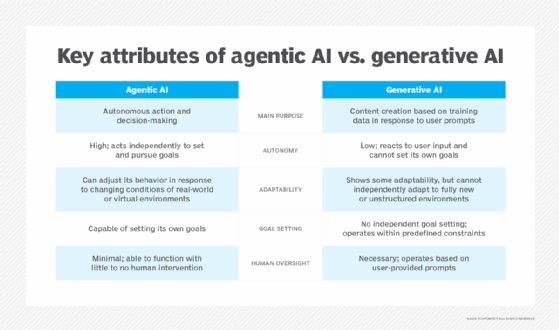
The big ERP vendors have converged on nearly identical language. SAP, Oracle, Microsoft and Workday all describe the same arc: ERP is evolving from a system of record that logs what happened to a system of action or outcomes that decides on and does the work. Underneath the slogans, they draw the same line between a copilot, which suggests a next step and waits for a person to act, and an agent, which reasons over enterprise data, makes decisions and executes multi-step work across systems with limited human input.
Beneath the matching slogans is a spectrum of ideas about where the agent lives. At one end, the agents live inside the system of record, on the argument that governance, audit trails and permissions come built in when the agent never leaves the transactional system. At the other end, agents meet the work across applications through an orchestration or connector layer. This approach trades tight coupling for reach and flexibility while taking on the burden of maintaining the connectors that stitch the systems together. Over time, all the major ERP vendors will likely tune their offerings to support each customer's sweet spot.
Midmarket and second-tier ERP players differentiate less on the agent story than on their particular focus. Some lean on vertical depth and ship agents that are preconfigured for specific industries such as manufacturing, distribution or asset-heavy operations. Others compete on value and data sovereignty, pairing lower per-user pricing with a pitch that customer data and the underlying AI model stay in-house.
Separately, a wave of venture-backed, AI-native finance and ERP startups is going after the back-office core directly, promising things like a near-instant financial close and arguing that legacy systems are clunky and slow to implement. But these startups will face challenges competing with legacy vendors' integration breadth and compliance depth, along with the plain difficulty of persuading a company to rip out and replace the system its books already run on.
How agentic ERP is different
 Holger Mueller
Holger Mueller, vice president and principal analyst at Constellation Research, said agentic AI creates the foundations for more conversational interfaces for asking questions and developing new automations. This promises to reduce limitations, increase flexibility and lead to better ways of bundling automation.
The vision is toward automation that runs autonomously without human supervision. "It's like you go home after work and your agents keep working," Mueller said. The promise lies in shifting the long-standing manual/automation ratio away from people and toward software. But the catch with true autonomy is that plenty can go wrong.
Brian Sommer, president of TechVentive, an ERP consultancy, draws a line between general-purpose generative AI and the narrower, task-specific models he expects to do real ERP work. Broad generative tools are fine for open-ended tasks, but compliance-grade questions call for something smaller, focused and cheaper to run. Translating an invoice from Greek to Spanish is a great use for a generalized GenAI tool. But when you need the Financial Accounting Standards Board requirements for a particular industry at a certain point in time, a smaller large language model (LLM) infused with the appropriate context will be more efficient and cost-effective.
Process automation and improvement
Joshua Greenbaum, principal at Enterprise Applications Consulting, said a good starting point is to think of agentic ERP as the next generation of RPA and process intelligence. The goal of RPA has always been about streamlining processes and stripping out human interaction, but it never reached the apogee it was supposed to, Greenbaum said. Agentic AI places a new layer on top of the processes that already matter and already work.
 Joshua Greenbaum
"It's the next iteration of how we automate processes to streamline them and take as much human interaction out as possible," he said. "That's pretty much all agentic is doing."
The other aspect of the agentic AI trend in ERP is that it shines a better light on process improvement. Greenbaum sees a credible role for AI in what process consultants have long done by hand: interviewing people and mapping how work actually flows. Where a consultant brings a hundred business transformations' worth of professional judgment and experience, AI can review hundreds of real examples and propose a reasonable improvement strategy, potentially more systematically.
"An AI can look through hundreds of actual examples and come up with a reasonable strategy for doing a better job -- maybe a little better, a little more systematically, with equal or higher reliability than a smart consultant," he said.
Promising agentic ERP use cases
 Brian Sommer
Sommers's most vivid use case is a command-line request that produces an entire deliverable end to end, such as financial updates for the board or "close enough" estimates for executive scenario planning. He said clients visibly light up at the prospect because it attacks a notorious time sink without pretending to deliver a finished product.
For example, a finance team might ask a conversational interface to generate all their financial statements, annotate them, provide all the footnotes and cross-references, and then build a briefing book they can share with the board, the bank and everybody else. With just one request, the AI generates the entire work stream.
"They're not looking for the absolute perfect final product," Sommer said. "Just get me way down the road and save my staff hundreds of hours."
Yet he's careful to note these are early innings. Today's agents aren't eliminating entire roles, but they are easing parts of people's workloads. Freeing up entire bodies could come later, but that's not the current purpose.
Another use case is defensive and aimed at AI-generated noise and fraud, according to Sommer. For example, job applicant volumes are exploding because citizen AI tools can fire off thousands of applications per person. He also points to a broader pattern of bad actors, from competitors to rogue nation-states, weaponizing the same tools. The response, increasingly, is to fight fire with fire.
Risks and challenges
Mueller treats the central risk of agentic AI-equipped ERP as familiar rather than novel: Like any new automation, it simply might not work at first, and trust will have to be earned. He reaches for historical parallels -- the first software-assisted closing of books, the first automated payroll run -- to argue that skepticism gives way to appetite once the technology proves itself, and then to normalization. He's already seeing that normalization across many business functions.
"Every CFO was worried the first time they closed the books with software," Mueller said. "Then trust gets built. And then comes the appetite to get more automation done until it becomes normal."
Greenbaum warned about the risk that automation will become a substitute for thinking.
"A lot of companies assume that if they just throw the AI switch, process excellence will be there," he said. "The answer is no: You still have to do the hard work and make real human decisions about what that process should look like."
Without checks, balances, control and testing, he argued, agentic AI can run amok. And it can do so at far greater scale than in past shadow-IT episodes because automated programming tools generate so much more automation than humans ever could.
"There's more code being written by AI systems than can be tested. And these are black-box tools. We don't really know what they're doing when they write code," Greenbaum said.
Best practices for agentic ERP
For Mueller, readiness comes down to data. Agents need access to all the relevant data and the computing power required to use it, which points him at the data lakehouse as the foundation of choice. Most enterprises aren't there yet, he said, but the gap presents a competitive opportunity.
"AI is only as good as its data foundation. Most enterprises aren't ready for a universal data foundation, but it's a race, and those who do their homework fast will win," Mueller said.
Greenbaum cited the importance of business context, which he said will be a critical differentiator for agentic ERP success. For the moment, AI-first ERP vendors conspicuously lack the rich business context curated by businesses and by legacy ERP vendors that have been learning from their enterprise clients over the years. It's also early days for big AI model vendors like Anthropic, Google, Microsoft and OpenAI, who are only beginning to recognize that the deep domain knowledge that runs a global enterprise can't be scraped off the public web.
For example, the messy reality is that a large-scale manufacturer might run 14 different ERP systems, all making the same product, each with its own bill of materials sourced from 4,000 suppliers that each call the same part by a different number -- alongside tariffs, customs, compliance and bills of lading. Old-school ERP vendors built that knowledge over decades. An LLM without it can produce an attractive front end while collapsing on the back end, Greenbaum said.
"You can design a great order-to-cash system with an LLM. But absent that context, you're just pretending you have a standardized process."
The future of agentic ERP
Greenbaum expects enthusiasm to cool as the reliability ceiling becomes undeniable. Absent deep business context and well-bounded domains of functionality, he argued, agentic systems will be only marginally reliable. "You're not going to dare to trust your company's success to something that, at best, is 90% accurate," he said.
Mueller expects adoption to move very fast, with coding leading the way. "In a few years, we won't be able to think how we did it without them," he said.
Sommer argues the next leap depends on data that resides outside the systems of record. His example comes from monetary policy. When the Fed changes the funds rate, a manual scramble erupts across the enterprise: Purchasing scales back or defers purchase orders, treasury recomputes cost of capital and financial impact, credit and collections push customers to pay sooner -- all at once, with no single point of control.
That scenario suggests an opportunity in developing an agentic AI tool that watches external signals rather than internal records. It detects the Fed rate change, cascades the implications across the next four quarters of earnings estimates, financial statements and cost of capital, and recommends which purchase orders to push back to free up cash.
But getting there requires ERP vendors to change their AI posture. "Vendors need to quit tweaking the individual pieces of ERP and start radically reimagining how to solve problems that have never been automated before," Sommer said.
George Lawton is a journalist based in London. Over the last 30 years, he has written more than 3,000 stories about computers, communications, knowledge management, business, health and other areas that interest him.