Inside the push to turn AI agents into suite functionality
Salesforce, Oracle, Workday and Zoom are pushing AI agents into suites and workflows, but each is taking a different path toward practical enterprise adoption.
Like it or not, most enterprises are heterogeneous. That is what makes the current vendor agentic AI push so notable. Even in messy, mixed software environments, companies are starting to act as if AI agents can become a normal part of the suite.
Salesforce, Oracle, Workday and Zoom all suggest that agentic AI is moving out of the concept stage and into enterprise software itself. The important point is not just that vendors are talking about agents; it is that they increasingly seem to believe agents are ready to become a standard capability that organizations should expect from enterprise software.
That is easier said than done.
Trust, integration, security and orchestration are still very much in play. But the product direction is becoming harder to miss. Vendors are starting to act as if agentic AI belongs inside the software layer -- not off to the side as some future experiment.
Salesforce makes the practical case first
Salesforce is taking the most practical route of the group. Rather than treating agentic AI as a product within itself, it is integrating Agentforce into its SMB suites as a value add. By putting prebuilt agents into standard subscription tiers, Salesforce seems to be trying to take some of the mystery out of agentic AI and turn it into another commonplace tool users should increasingly expect from its products.
That matters because Salesforce is aiming at everyday busywork -- work that is less strategic and less likely to cause catastrophe if something goes wrong. In that sense, Salesforce makes the first believable phase of agentic AI look less like autonomous decision-making and more like the addition of an assistant to each employee to make work more manageable and streamlined.
Salesforce is also starting to give that approach a more explicit operating logic, emphasizing context, control, observability and orchestration as the elements that make agentic deployments work in practice.
4 different routes into suite-based agentic AI
One useful way to read the current wave of announcements is that the vendors are not really making the same pitch.
Salesforce is trying to normalize agents by embedding them into familiar product tiers and everyday tasks.
Oracle is making the broadest claim, tying agents to business objectives and a staged path toward autonomy.
Workday is grounding its case in trusted HR and finance data, permissions and process logic.
Zoom is extending the argument into the workflow layer, where conversations and meetings become inputs to finished work.
Seen that way, the story is not simply that AI agents are arriving; it is that vendors are trying to define what kind of suite functionality agents should become first: packaged and practical, broad and strategic, data-grounded or workflow-bridging.
Oracle goes bigger on ambition
Oracle appears to be diverging from Salesforce's approach in a few important ways. It is introducing 22 new agentic AI applications tied to business objectives, whereas Salesforce is integrating Agentforce into existing suites. Oracle also keeps using the language of business objectives, which goes beyond what Salesforce is promising.
It is going big rather than narrow.
That bigger language matters. Oracle is framing agentic AI not as a helpful add-on, but as a way to move enterprise applications beyond their traditional role as systems of record and toward coordinated action. You do have to wonder, though, whether Oracle is also telling customers something else: Don't worry so much about orchestration, because we will deliver the agents you need inside our own environment.
That is where the questions start.
Even if those agents come from the same company, how well do they actually work together in parallel without friction? And how far does that confidence travel once those agents have to operate in the more heterogeneous software environments most enterprises actually run?
Trust still has to be earned
Oracle's human-in-the-loop to human-in-the-lead autonomy model also matters. It is a step ladder to agentic AI independence, and it makes adoption feel more manageable by not forcing autonomy from the start. That is logical. Trust has to be earned before agents are granted more independence.
Trust has to be earned before agents are granted more independence.
At the same time, that ladder points to one of the real limits of agentic AI right now. If oversight is required to build trust, then human review can become a resource problem of its own. Vendors know enterprises are not ready to jump straight from AI assistance to full autonomy. Oracle is simply the clearest here about trying to walk customers toward that outcome in stages.
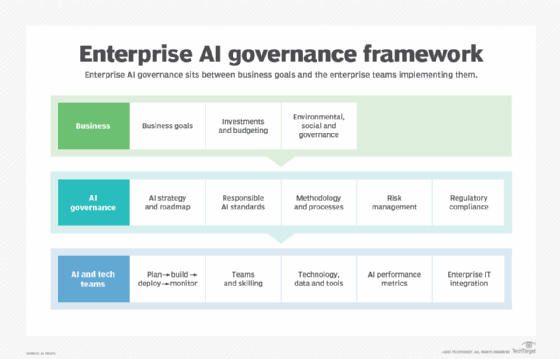
An enterprise AI governance framework helps explain what vendors still have to solve as they push agents into software suites: data access, permissions, oversight and reliable execution.
Workday grounds the case in data and process
Workday is making a different case.
To Workday, agentic AI matters less as a flashy interface with specially designed prompts and more as a gateway to maximizing what is achievable from trusted HR and finance data inside a system of record. Its argument is that enterprise AI gets stronger when it sits inside an existing software environment with a trusted data foundation.
That is what the system of record means here. The AI is not just generating answers; it is operating in a system that already contains the permissions, workflows, compliance rules and business logic needed to guide usage.
Salesforce makes agents feel packaged. Oracle makes them feel expansive. Workday makes them feel integrated, grounded, and, in some ways, less likely to unintentionally wreak havoc.
Still, Workday raises its own version of the same larger question. It talks about openness through connectors, but the real value of its AI offering clearly lies in the tight integration of AI within its own environment, guided by trusted HR and finance data.
That makes sense. But it also underlines a broader truth: Vendors might talk about openness and interoperability, yet the real competitive fight still seems to rest in how well agents work inside each vendor's own products.
Zoom pushes agents into the workflow layer
Zoom extends the story beyond classic business apps.
What Zoom adds is the idea that agentic AI is not staying inside core enterprise applications. Instead, it is moving into the wider workflow, where work is discussed and then completed.
So, this is not just a collaboration and communication software play. It is a play to turn collaboration and communication software into a more integral part of completing tasks and achieving business objectives. Its clearest phrase is the promise to turn conversations and meetings into finished work.
That line matters because it suggests that agentic AI has a role to play in collating, summarizing and surfacing insights in ways that otherwise would not be achievable with this kind of automation and smarts. Zoom is trying to bridge the gap between daily communication and collaboration and the wider enterprise application layer.
What feels credible there is how AI can achieve specific tasks such as note-taking, summarization and follow-up. What still feels less clear is how all of that ultimately integrates with the broader software environment to contribute to finished work in a reliable way.
Even so, Zoom pushes the story beyond the single application. It makes the broader enterprise-software story feel less like a story about single applications and more like a story about bridging the gap between enterprise software platforms to achieve business goals.
Different routes, similar destination
Taken together, these moves suggest that vendors are trying to reach a similar destination in different ways.
Salesforce is trying to make agentic AI a daily fact of life sooner by embedding it into familiar suites and narrower use cases. Oracle is trying to lead customers toward a broader, more autonomous model tied to business objectives. Workday is making the case that agents become more credible when they are grounded in trusted enterprise data and governed by the logic of the application they sit within. Zoom is trying to connect the place where work gets discussed with the place where work gets done.
The common thread is not that one vendor has solved agentic AI; it is that vendors increasingly believe agents belong inside the software layer. The harder questions now follow: What kinds of agents are arriving first, where they can be trusted and how far they can move beyond the applications that created them?
James Alan Miller is a veteran technology editor and writer who leads Informa TechTarget's Enterprise Software group. He oversees coverage of ERP & Supply Chain, HR Software, Customer Experience, Communications & Collaboration and End-User Computing topics.