Part of:Google Cloud Next 2026 conference coverage
Merck, Home Depot tap Gemini Enterprise for AI agent development
Blue chips will expand use of Gemini Enterprise AI agents on a revamped platform, but how far its appeal will extend beyond the Google Cloud user base remains to be seen.
Published: 23 Apr 2026
LAS VEGAS -- Google touted dozens of big customers for its Gemini Enterprise Agent Platform this week, including a new $1 billion deal with Merck, but how effectively the platform will pull new customers from a plethora of competitors is an open question.
Merck previously partnered "around the edges" with Google Cloud but, four or five months ago, began seeking a more comprehensive approach to AI agent development, according to Dave Williams, the multinational pharmaceutical company's chief information and digital officer.
"Just two and a half months ago, I [decided] we'd like to get more serious and really define a truly strategic, long-term partnership," Williams said in an interview here this week with Informa TechTarget. "I don't think any of us thought we'd get it done this quickly, but we were able to get it done three weeks ago."
Under the multi-year deal, Merck will deploy the Gemini Enterprise Agent Platform across its research & development, manufacturing, commercial and corporate departments. Forward-deployed engineers (FDEs) from Google Cloud and DeepMind will be embedded in Merck teams to deploy the platform, train foundational AI models to support drug discovery, update the company's business workflows to incorporate AI agents, and train its 75,000 employees.
Merck also works with several other enterprise vendors that all tout comprehensive AI agent platforms, including AWS, Microsoft and ServiceNow, which it will continue to use, Williams said. But the combination of Google's DeepMind expertise and willingness to commit many FDEs won it the strategic partnership, he said.
Dave Williams
"You have PhDs on both sides of the table talking about how we can leverage advanced AI and machine learning to accelerate understanding human biology, which, for us, means we accelerate drug discovery, which means we get medicines to patients faster," Williams said. "That's unique."
Williams declined to quantify Google's "significant investment" in FDEs under the deal, but said it was greater than that of other vendors Merck considered.
"Not all are willing to send a meaningful amount of FDEs, and we're a large company. And so when a company says, 'Hey, yeah, we can [send] two or three folks,' that doesn't move the needle for us," Williams said. "It's a significant investment in human capital -- in this case, Google differentiated themselves."
Google Cloud AI users cite expertise, full-stack strength
Citi's head of wealth, Andy Sieg, told a similar story about why the bank chose to work with Google to develop its Citi Sky AI avatar, which will roll out to customers later this year. Citi signed a strategic partnership with Google Cloud 18 months ago, and the two companies are mutual clients. But Google's foundational models, which don't require translating voice inputs to text before generating voice outputs, offered quality advantages for the project, Sieg said.
"The quality of the video and voice is exceptionally important … the details, down to the inflection of the voice, the movement during pauses in between questions," Sieg said in an interview with Informa TechTarget. "Without that quality of video and voice, this idea of creating a trusting relationship with an agent, I think would be a stretch."
For The Home Depot, Gemini Enterprise provided data and AI context integration and portability across a wide range of layers in the AI stack, alongside audio quality in Google's Dialogflow CX service. These layers range from BigQuery databases to Gemini Enterprise for CX, which the retailer is using to launch new AI voice agents this year.
"One of our first initiatives was moving our website to be hosted in the cloud over a decade ago -- our relationship starts with the hyperscaler side, and then works up the stack from there," said Angie Brown, CIO at The Home Depot, during a panel presentation this week. "We have Gemini Enterprise and the [agent development kit] framework to help us build agents, then things like Gemini CX at the top layer. … The portability between the layers has helped us tremendously."
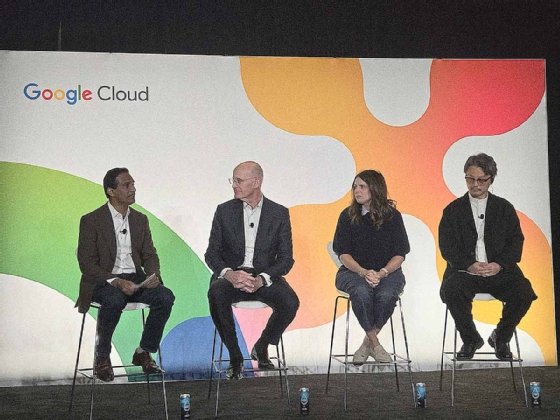
Google Chief Product and Business Officer Karthik Narain, left, moderates a panel session featuring (from left) Citi Wealth's Andy Sieg, Home Depot CIO Angie Brown and Shinichi Inoue, Capcom vice president of game development platform and AI solutions.
AI platform competition hot and full of echoes
Amid hundreds of product updates at Google Cloud Next this week, the cloud provider touted customer growth for its AI portfolio. Some 75% of Google Cloud customers use AI, according to a media briefing presentation by Google Cloud CEO Thomas Kurian this week. In the fourth quarter of 2025, Google signed twice as many new AI customers as it had in the first quarter; it won more billion-dollar deals in 2025 than in the last three years combined. Google Cloud press releases and conference presentations featured dozens of large companies, from AutoZone to Vodafone.
We have the beginnings of a product category that helps sellers and customers by providing a basis for comparison and selection, but the flip side is that some of the novel ideas are getting lost in the bigger storyline.
Jason AndersenAnalyst, Moor Insights & Strategy
However, while Google also bolstered its full-stack advantage with the Gemini Enterprise Agent Platform, many of the new features echo updates from rivals over the last six months, including Microsoft's Agent 365, AWS AgentCore, ServiceNow's Autonomous Workforce, Salesforce Agentforce and many more.
Generally, virtually all enterprise tech vendors are building in data context, knowledge graphs, AI security and governance features to similar platforms, and most can claim an existing foothold in large enterprises, said Jason Andersen, an analyst at Moor Insights & Strategy.
"We are now seeing a number of minimally differentiated platforms," Andersen said. "We have the beginnings of a product category that helps sellers and customers by providing a basis for comparison and selection, but the flip side is that some of the novel ideas are getting lost in the bigger storyline."
Google and others are essentially replicating the agent structure introduced with Anthropic's Claude Cowork at scale, Andersen said. It's good news for existing customers, but "it does not settle the argument for me as to what AI capability will drive a shift in new customer signups," he said.
"Initially, we suspected the models, but almost every provider supports multiple models," Andersen said. "I had some faith it might be the tooling, but that has been subsumed into the platforms. Could it possibly be something on the management side [such as] security, policy, governance or something else? I'm not sure. For now, I only see platforms as a means to satisfy the [existing customer] base."
Beth Pariseau, senior news writer for Informa TechTarget, is an award-winning veteran of IT journalism. Have a tip? Email her or connect on LinkedIn.

 Dave Williams