LAS VEGAS – Google deepened integrations among its cloud and AI services within a new Gemini Enterprise Agent Platform, bolstering its "soup to nuts" agentic AI pitch to enterprise IT buyers.
A bevy of product updates this week moved Google's AI platform from a focus on AI assistants to multi-agent orchestration, including long-running and autonomous agents that require more persistent collective memory and stronger grounding in enterprise data, according to Google Cloud CEO Thomas Kurian.
"Gemini Enterprise is now the end-to-end system for the agentic era, the connective tissue between your data, your people and your goals," Kurian said during a Cloud Next keynote presentation here Wednesday. "It transforms disconnected processes into a single intelligent flow."
Gemini Enterprise Agent Platform builds on the existing Vertex AI agent development service, adding agent-to-agent orchestration that uses deterministic processes to consistently delegate tasks among coordinated subsets of agents. A new graph-based framework for Agent Development Kit (ADK) defines agent coordination logic more clearly.
Memory Bank and Memory Profilesreplace temporary sessions with persistent context, enabling agents to recall specific user details and project histories over months. Under the new platform, agents are issued cryptographic identities for security, and individual AI agent sessions are tracked and traced across disparate systems.
A new Gemini Enterprise app builds persistent agent memory and introduces new interfaces for agentic collaboration between technical and business teams, including Project and Canvas, which keep shared team assets in context and generate assets such as documents and spreadsheets, respectively. The Gemini Enterprise Agent Platform can feed multi-agent workflows into Google Workspace apps and connect to a new Agentic Data Cloud and Agentic Defense security and governance platform, both rolled out this week.
Add that swath of new features to Google's in-house AI chips and widely used cloud infrastructure, and it paints a stronger and more cohesive picture of its strengths in enterprise AI agent management, said Matthew Flug, an analyst at IDC.
"Google has entrenched hardware that has been rivaling GPUs for the longest and probably has the strongest reputation behind GPUs for AI workloads [in TPUs]," Flug said. "It also has developer tools to build and manage agents, and an end-user AI app in Gemini -- no one else has those three. That full lifecycle is what they're really hoping differentiates them."
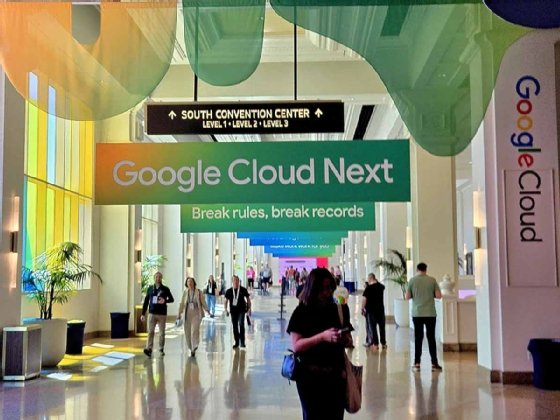
Google rolled out updates to Gemini Enterprise for AI agent orchestration at its Cloud Next 2026 conference.
Google Cloud Storage adds AI infrastructure strength
On the heels of beefed-up AI chips unveiled this week, Google Cloud infrastructure services introduced performance improvements, AI-driven data classification and agentic connections that underpin the expanded Google Gemini Enterprise platform.
The Managed Lustre service, based on a high-performance parallel file system, boosted storage bandwidth 10 times compared to the previous version, supporting up to 10 TBps. Google's Object Storage service introduced a high-performance tier called Rapid, available as either a temporary cache or a permanent Rapid Bucket, which serves data using Google's Colossus distributed storage platform. Colossus, which previously wasn't available to customers, provides sub-millisecond read / write latency.
Google Cloud Storage also added Smart Storage, which automatically analyzes unstructured data and generates metadata and context. Smart Storage connects to the Agentic Data Cloud's new Knowledge Catalog to provide context to AI agents. Smart Storage also includes a managed Model Context Protocol (MCP) server to enable agents to access the Cloud Storage API. MCP connections to Google Storage Intelligence that allow for more refined queries will follow in the coming months.
While MCP has surged in popularity alongside AI agents, the open source protocol remains a relatively early work in progress, cautioned Jason Andersen, an analyst at Moor Insights & Strategy.
The rationalization around it is maybe six parts, a kind of mental and taxonomy [exercise], and then [four parts] using the opportunity to bring in more enterprise-grade features.
Devin Dickerson,Analyst, Forrester Research
"MCP is a good connection technology, and it's coming along, but it has some limits," Andersen said. "It does not offer much in terms of interaction and bi-directional sessions. It's good enough, but there's a lot more agents could do with the APIs."
Google Cloud deepens agentic data, security
Gemini Enterprise Agent Platform draws on existing Vertex AI features, and Google's new Agentic Data Cloud and Agentic Defense platforms are partially a repackaging of features it previously had, said Devin Dickerson, an analyst at Forrester Research. For example, developers using Vertex AI could already make secure calls to AI models through the platform instead of using API keys.
"I'm not surprised to see them pushing this a little bit harder, and I think the rationalization around it is maybe six parts, a kind of mental and taxonomy [exercise], and then [four parts] using the opportunity to bring in more enterprise-grade features," Dickerson said.
Agentic Data Cloud's new preview-stage Data Agent Kit will include skills, tools, extensions, and plugins for IDEs, notebooks and agentic terminals developers use, including VS Code, Gemini CLI, Codex and Claude Code. This could simplify how developers interact with the overall Gemini Enterprise framework, compared with previous options, Dickerson said.
"There's been some sprawl and confusion … with Vertex AI. Previously, if I wanted to build an AI app or an agent and deploy it in GCP, maybe I'm going to just integrate the Gemini API into my app," he said. "Or maybe I'm going to build an agent in ADK and deploy it on Cloud Run. Or maybe I'll orchestrate my agents in [Google Kubernetes Service]. When should I do each of these?"
The updated Gemini Enterprise platform includes three new features for AI agent governance: Agent Identity, Agent Registry and Agent Gateway. As with its AI agent development features, these updates don't break entirely new ground in a market now saturated with enterprise AI agent platforms, said Bradley Shimmin, an analyst at the Futurum Group.
But the platform's comprehensive AI agent management and governance, alongside data management features such as the Knowledge Catalog and Smart Storage, could give Google at least a temporary edge, Shimmin said.
"Building a unified repository of not just agents but tools and skills, plus MCP servers, and applying policies using a gateway, is a holistic approach where others might not be as comprehensive," Shimmin said. "Although I wouldn't be surprised to see the same thing from competitors within a fortnight."
Google revs up multi-cloud coopetition
Cloud vendors, including Google, aren't blind to the ubiquity of AI agent platforms, and most have begun offering easier connectivity and portability across their services, such as the Interconnect - multicloud project, to support enterprise AI. Agentic Data Cloud's updates this week include a cross-cloud data lakehouse that federates data management across third-party tools and cloud providers without requiring data to be copied or ingested into its cloud. Also as of this week, Gemini Enterprise Canvas can export documents and slides to Microsoft 365.
New support in AI application security tools from Google subsidiary Wiz -- the first integration between Google Cloud and the former unicorn startup -- further bolsters Google's multi-cloud presence, said Katie Norton, an analyst at IDC.
"Wiz gives Google a more credible and differentiated operating model for securing agents across mixed environments," Norton said. "Whether it materially challenges Microsoft will depend on whether these pieces operate consistently across heterogeneous environments, whether policy enforcement is practical rather than operationally heavy, and whether Wiz remains credibly multi-cloud, rather than becoming too tightly Google-centered."
Beth Pariseau, senior news writer for Informa TechTarget, is an award-winning veteran of IT journalism. Have a tip? Email her or connect on LinkedIn.