Atlassian Jira Planner joins spec-driven development AI coding trend
As enterprises grapple with tokenomics, Atlassian emphasizes upfront planning to improve downstream efficiency. But optimizing AI coding costs and quality remains complex.
Atlassian Jira is the latest software delivery vendor to jump on the spec-driven development bandwagon to address AI coding bottlenecks during deployment.
Spec-driven development, which emerged from API development practices, emphasizes defining a software system's structure and behavior before code is written. It's been embraced by AI coding tools such as AWS Kiro, GitHub and Cursor over the past year as a way to improve organizational control and team collaboration compared to prompt-based AI coding.
Atlassian's new Jira Planner, released in preview this week, brings that concept to a different part of the software development lifecycle (SDLC) -- the requirements planning stage, where Jira has traditionally been a strong choice among enterprise DevOps teams. Jira Planner can contribute enterprise context based on Atlassian's Teamwork Graph to development specifications, reducing the likelihood of conflicts further down the pipeline during testing and deployment.
This is part of Atlassian's answer for alleviating a common DevSecOps bottleneck for enterprises, as large volumes of AI-generated code strain software testing and deployment systems on the way to production.
Ming Wu
"It's pretty common knowledge that the coding stage itself accounts for only about 15% to 16% of the time developers spend across the SDLC, so more than 84% of that is a bottleneck that reduces productivity," said Ming Wu, head of engineering for DevAI at Atlassian. "So that's why, even though the adoption rate for coding agents now, on average, in the industry is above 90%, the productivity gain has actually plateaued at 10% to 15%, and the planning stage is one of the pain points we identified."
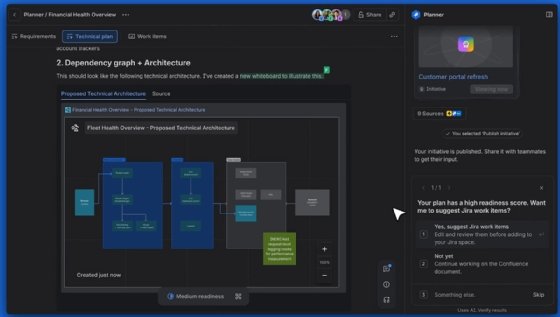
Jira Planner pulls from a company's existing codebase, Jira and Confluence history and team context to generate a structured technical spec in Confluence that is readable by both humans and machines, according to a company blog post.
Atlassian also made its new Jira Coding Agent, previously known as Rovo Dev in Jira, generally available within the main Jira interface. It's joined this week by support for third-party coding agent alternatives in the same drop-down menu in the Jira UI, including Claude, Code, Cursor and GitHub Copilot, with Codex coming soon.
Spec-driven development at the planning stage and the team level could theoretically address both AI coding quality issues and costs down the line, said Jim Mercer, an analyst at IDC.
"It helps to make smarter decisions upfront, earlier in the process, because agents will have access to this broader base of knowledge around how [a team is] doing things," Mercer said. "That helps with quality, keeps them from rolling back and should help make spec-driven development quicker, because [requirements] should be better understood."
An ever-shifting AI coding cost equation
Spec-driven development decreases token counts for coding, but tends to distribute them elsewhere.
Rick GenevaAnalyst, Forrester Research
While spec-driven development can yield cost savings, it can sometimes also shift cost burdens to other parts of the enterprise application stack, said Rick Geneva, an analyst at Forrester Research, who recently implemented a spec-driven development project at his previous employer, S&P Global, where he was director of software engineering.
"Spec-driven development decreases token counts for coding, but tends to distribute them elsewhere, such as Copilot for business users, project planning, test and outcomes planning, etc." Geneva wrote in an email to TechTarget. "More planning files are created than code. Today, this is also using tokens, but on different tools and models, so it doesn't necessarily show up in the engineering budget."
As enterprises seek a more coherent strategic approach to AI, it remains difficult to find an "end-to-end" tool that brings together the entire SDLC for AI coding, Geneva wrote.
"There are no tools that link the entire end-to-end development lifecycle from business plan to coding plan, but I see hints that the industry is headed in that direction," he wrote. "I have no idea how long it will take to get there, but you can now see a shift in products such as Jira (or anything that can maintain a persistent context) … This is the next big innovation in agentic coding. [Vendors] all want to own the larger project/business context 'source of truth' and 'standards'."
Atlassian Jira Planner blends context from its Teamwork Graph with spec-driven development to guide AI coding tools.
Atlassian's enterprise AI rivalry with ServiceNow
Atlassian Jira faces stiff competition from business workflow management vendors, most notably ServiceNow, to serve as that overall business AI agent orchestration tool, but Atlassian's traditional strength in software development will help its appeal to some enterprises, Mercer said.
"Planning is Jira's claim to fame, from long before we got into GenAI -- particularly if you're a long-term user, you've already got this rich data in there to make intelligent decisions," he said. "As we think about organizations adopting agentic ways of working, who's to say that Atlassian's position here doesn't put them in a strong spot to be that core data plane that can be used across the organization?"
Other analysts have pointed out a lack of configuration management database (CMDB), a historical strength for ServiceNow, as a potential weak spot for Atlassian, but Mercer disagreed.
"Every organization I've spoken to outside of a ServiceNow customer who's tried a CMDB [finds] they're always out of date, out of sync," he said. "You hear a lot about it from ServiceNow because they built their company on it, but I don't see a future for CMDBs here."
Atlassian AI roadmap focuses on visibility
Atlassian's to-do list, as it works toward a strategic 'system of work' for business and software workflows, includes improving visibility into AI usage, quality and activity, based on its 2025 acquisition of DX, Wu said.
DX AI cost management, shipped this week, reports on spend and token data across AI coding tools, correlates them to teams and projects, and estimates cost per pull request. A previous release offered users insights into how teams use AI tools, down to the session level, along with assessments of code repositories' readiness for AI use. Next, Atlassian DX will add support for local session writeback to capture AI activity on local developer machines for organization-level analysis, according to Wu.
"Honestly, I think the entire industry is still at the beginning of this journey with AI visibility," Wu said. "This is definitely an investment area."
Beth Pariseau, senior news writer for Informa TechTarget, is an award-winning veteran of IT journalism. Have a tip? Email her or connect on LinkedIn.


 Ming Wu