How 5G and SD-WAN work together to empower enterprises
5G's performance advantages and improved integration with SD-WAN make the combination an increasingly powerful and affordable networking option for distributed enterprises.

5G's high-performance, low-latency wireless connectivity is steadily integrating with and being intelligently managed by SD-WAN architectures. The result is flexible, high-capacity, and application-aware WANs for distributed enterprises, despite challenges in availability and initial cost.
5G is profoundly shaping WAN services by offering wireless connectivity with performance characteristics -- including high speed, ultra-low latency and massive connection density -- that rival or surpass traditional wired connections like broadband and MPLS. This enables a fundamental shift in how organizations build and operate their WANs, primarily by accelerating the adoption of wireless WAN and integrating tightly with software-defined WAN (SD-WAN) architectures.
Organizations now use 5G as a reliable primary or secondary WAN link for fixed locations, providing rapid deployment -- for temporary or pop-up sites, for example -- and resilience. Meanwhile, 5G's low latency and high capacity unlock new enterprise use cases at the edge, such as advanced IoT, real-time edge computing and high-quality mobile workforce connectivity. Features like network slicing promise tailored performance and security for diverse applications.
The market for integrated 5G and SD-WAN isn't tracked as a single metric, but its growth is undoubtedly a major accelerator of the SD-WAN market, which was estimated to be worth $7.1 billion in 2025, according to Future Market Insights.
The market direction is one of strong and rapid expansion, with the overall SD-WAN sector projected to grow at a compound annual growth rate exceeding 31% in the next decade. This significant growth is directly driven by using 5G for both primary and diverse backup connectivity that enables high-performance, flexible and rapidly deployed branch and edge networks.
Power couple: The potential role of SD-WAN in enterprise 5G
The role of SD-WAN in 5G networks has significantly matured from a simple pairing to today's critical, integrated platform. The benefits have advanced from nice-to-have resilience to must-have performance for distributed enterprises.
The core function remains SD-WAN's intelligent management of multiple links, but its capabilities have evolved to directly take advantage of 5G's advanced features in the following ways:
- Becoming a primary WAN fabric. SD-WAN is now routinely used to orchestrate 5G as the primary, high-bandwidth connection for fixed branch offices, such as retail, quick-service restaurants and remote sites, often replacing costly MPLS or serving as a superior alternative to basic broadband. It's all powered by the wire-like performance of midband (C-band) 5G and SD-WAN's ability to ensure zero-touch provisioning over cellular for fast, scalable deployment.
- Convergence to SASE. The 5G SD-WAN combination is now largely framed within the secure access service edge (SASE) architecture, which unifies and simplifies network and security management in a SaaS platform. The SD-WAN function manages the high-performance 5G transport, while integrated security services, such as zero-trust network access (ZTNA), secure the traffic, which is essential for the hybrid workforce and massive numbers of IoT devices connecting over 5G.
- Application-specific slicing. The growing ability of "5G-aware" SD-WAN to integrate with 5G standalone (5G SA) network slicing is a major evolution. It enables the SD-WAN controller to classify traffic, such as real-time industrial automation data or remote surgery telemetry, and dynamically steer it onto a dedicated 5G slice that assures specific, mission-critical quality of service (QoS) for ultra-low latency or high reliability.
- Enabling edge computing. The low latency of 5G combined with SD-WAN can help accelerate edge computing implementations. SD-WAN directs traffic to the nearest edge computing location for processing, further reducing the round-trip time for applications such as connected vehicles, real-time analytics for oil and gas fields, and AI-driven factory operations.
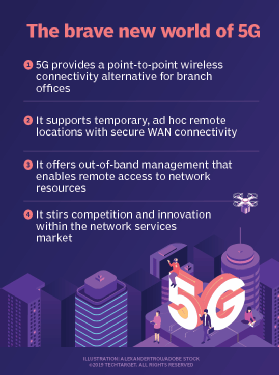
5G and SD-WAN synergy: Benefits of using them together
SD-WAN is rapidly becoming the standard technology for organizations seeking to intelligently manage and steer traffic across multiple WAN links. It can enhance the security, reliability and performance of internet connections, enabling organizations to increase their WAN bandwidth capacity while keeping costs reasonable.
SD-WAN functionality continues to evolve, extending its capabilities beyond the WAN to areas including LAN and Wi-Fi. Furthermore, native security features are advancing to reduce the attack surface alongside continuous improvement in traffic management. As telecom providers introduce comprehensive software-defined branch services, they can offer organizations end-to-end traffic visibility that spans from the user device and LAN all the way through the WAN to the cloud environment.
In addition, high-speed 5G connections provide IT organizations with another flexible WAN option to integrate into their SD-WAN architecture. 5G is valued for being simple and quick to provision, offering crucial link diversity that helps protect against physical cable disruptions, such as outages caused by cable cuts. 5G presents a cableless alternative to traditional transports, such as MPLS, DSL and broadband cable, that is often easier to purchase, deploy and manage.
A core advantage of SD-WAN is its capacity for simple, unified management of different network links for purposes such as redundancy, load balancing and traffic segmentation. Beyond its role as a primary WAN transport, 5G can also serve as an out-of-band management capability, ensuring access to network resources via external means.
The integration of 5G and SD-WAN provides a suite of advantages for modern networking, beginning with easy link provisioning and reasonable cost. This combination offers crucial connectivity diversity for both branch offices and work-from-home locations while delivering enhanced link redundancy and QoS. Organizations can employ active-active connections with performance characteristics -- specifically bandwidth and latency -- that are comparable to those of traditional MPLS. Furthermore, the combined architecture can enable better application performance through network slicing, alongside improved security, visibility and traffic management. Finally, it offers integral support for edge computing environments and more functionality for remote sites.
Downsides of 5G and SD-WAN
The primary obstacles for organizations wanting to use 5G wireless technology for SD-WAN connectivity are availability and cost. Carrier deployment schedules remain a significant concern, as many organizations might find that 5G rollout timelines don't align with their needs. The lack of consistent availability forces some businesses to hold off on adoption or explore other options while waiting for carriers to expand into their required areas of operation. However, the broadening availability of 5G SA is driving improvement in this area.
Even where 5G is available, performance can be a letdown. Customers are sometimes disappointed with signal strength because 5G signals often struggle to penetrate building obstructions, such as concrete walls. To overcome this, businesses might need to invest in a retrofit, adding external antennas to their networking closets, which can introduce an unexpected build-out expense.
The initial cost of 5G can reduce the anticipated savings. Like any new technology, high starting prices help operators offset their large capital and operational expenditures. As a result, organizations that adopt 5G early, with the goal of reducing WAN costs, might be disappointed. Many organizations are choosing to wait until increased competition among carriers drives down the cost of enterprise-grade, fixed 5G connectivity.
Another challenge is the lack of vendor consistency, as not all SD-WAN providers sell a fully unified offering that integrates 5G connectivity, which forces organizations to piece together disparate hardware and management tools. Such complexity makes deployment and long-term network management more difficult compared with using a single, cohesive SD-WAN platform.
5G and SD-WAN key use cases
Mature use cases fall into the following three categories:
- Manufacturing and automation. 5G's reliable, low-latency connections are used for factory automation, with SD-WAN steering critical operational technology traffic into a guaranteed network slice to ensure real-time control and monitoring.
- Hybrid and remote work. The 5G SD-WAN combination is a mature networking option for high-performance, secure home offices. SD-WAN devices in homes and remote locations use 5G as an always-on, high-speed connection, ensuring business-critical applications such as VoIP and video conferencing are prioritized, secured via ZTNA and dynamically routed for the best performance.
- Fleet mobility. Ruggedized SD-WAN appliances with multi-SIM 5G connectivity are becoming the standard for logistics, emergency services and connected farms, providing reliable, high-bandwidth connections on the move, with dynamic carrier switching for uninterrupted service.
Recommendations for IT leaders
As 5G services become more widespread and as carriers broaden their unlimited data plans, the role of cellular wireless in SD-WAN will shift in a positive direction. While most organizations currently use wireless only as a backup circuit during outages of primary wired connections or drops in performance, 5G is poised to become a strong, primary alternative for SD-WAN connectivity.
IT leaders should take note of the successful integration of 4G and 5G already demonstrated by SD-WAN vendors. They should consider 5G for pop-up or temporary locations and, as unlimited data plans materialize, include it as a serious option in their connectivity packages alongside traditional links such as MPLS and internet broadband.
What's next for 5G and SD-WAN?
As 5G technology expands and becomes increasingly available and reliable, it offers new possibilities for SD-WAN branch connectivity. Businesses are actively exploring how to take advantage of 5G's high speeds and low latency, particularly for real-time and latency-sensitive applications such as voice and video unified communications. Over time, remote offices can adopt 5G services as their primary connectivity link, reserving a traditional wired medium for backup or to offload data that isn't sensitive to latency.
Moreover, the 5G SD-WAN combination is expected to see far greater use in temporary and mobile scenarios. The combination provides the reliable connectivity needed for applications like freight asset tracking and setting up networks quickly for special events.
Over the next 12 months, organizations can improve their implementation of 5G with SD-WAN by following a secure, managed hybrid strategy and by integrating 5G as a high-speed link alongside wired connections while consolidating security into a single platform, such as SASE. They must actively optimize traffic steering policies to use 5G's low latency for applications like real-time voice and video, ensuring the SD-WAN fabric dynamically manages performance based on application needs rather than link type.
Finally, IT decision-makers should pilot 5G in specific use cases, such as pop-up sites or remote assets, to measure its true signal reliability and cost-effectiveness before committing to a wide-scale rollout to minimize unforeseen installation and performance issues.
Ron Westfall is vice president and practice leader for infrastructure and networking at HyperFRAME Research, where he covers topics such as hybrid cloud, AI, security, edge computing, wired and wireless networking, 5G and IoT.