Macrocell vs. small cell vs. femtocell: A 5G introduction
Macrocells, small cells and femtocells each play distinct roles in 5G, balancing coverage, speed, cost and indoor connectivity across different deployment scenarios.

Small cell technology plays a significant role in high-speed 5G networks, but small cells aren't the only base stations that provide 5G connectivity.
5G networks also use macrocells, such as cell towers, for connectivity. These larger base stations transmit low-frequency 5G signals -- below 1 GHz -- compared to small cells' high-frequency -- above 24 GHz -- millimeter wave (mmWave) capabilities. 5G femtocells typically support low- and mid-band connectivity. These devices serve the same role as wireless access points but rely on cellular technology instead of Wi-Fi to enable carriers to service small, specific locations and provide better in-home or small-to-medium-sized business cellular coverage.
Macrocell, small cell and femtocell performance differ widely -- in terms of size, coverage and cost.
Defining macrocell, small cell and femtocell
Macrocell
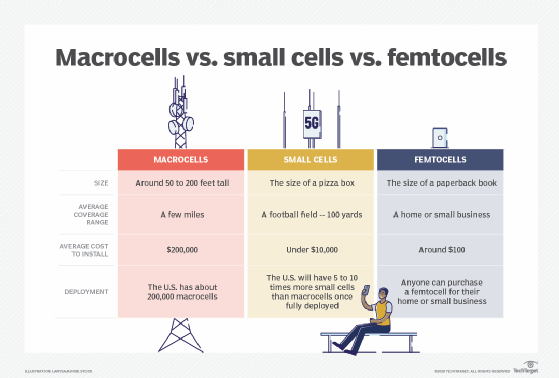
A macrocell is a cellular base station that sends and receives radio signals through large towers and antennas. Cell towers range in height from 50 to 200 feet tall and provide cellular coverage for several miles. According to the Wireless Infrastructure Association, at the end of 2024, there were approximately 248,050 macrocell sites in operation across the country.
Small cell
A small cell, as its name implies, is physically small -- around the size of a pizza box. These cellular base stations boost network connectivity in specific areas and enable companies to receive high-speed mmWave service in areas where such coverage is not available. Industry reports indicate U.S. small cell deployment will grow to 34,000 by 2027.
Femtocell
A femtocell is used to enhance indoor cellular connectivity. Unlike other cellular connectivity options, femtocells connect back through the internet to provide in-home or office cellular connectivity. Femtocells look and operate like routers. As a result, users can place femtocells near their current network hardware setups. Femtocells are accessible to anyone who wants to purchase one.
Macrocell vs. small cell technology
While both macrocells and small cells provide 5G connectivity, their signal propagation and building penetration capabilities differ greatly. Signal propagation -- the coverage radius -- is the key difference between macrocells vs. small cells. Macrocells deliver low-frequency coverage over long distances, while small cells offer high-frequency coverage from 10 to 2,000 yards.
The type of building materials used, such as for walls, dictates how well 5G signals penetrate indoor locations. Lower-frequency macrocell signals can travel far and aren't affected by walls, windows or other physical barriers. High-frequency small cell technology, on the other hand, is subject to line-of-sight limitations. However, their ability to transmit high-speed mmWave frequencies makes small cells an attractive option, despite their challenges.
Another difference between macrocells vs. small cells is cost. Macrocells traditionally cost around $200,000 to set up, while small cells cost less than $10,000. Even if carriers deploy 10 times the number of small cells compared to macrocells, the cost of small cells remains significantly less than full macrocell deployments. Carriers are also updating existing macrocells to 5G, but this transition is expected to take several more years.
Small cell vs. femtocell technology
Femtocells -- along with picocells and microcells -- are often considered types of small cells because of their size and limited coverage, but small cells and femtocells play different roles. Picocells and microcells -- the specific definitions of each still await final judgment by the wireless industry -- are commonly used in airports, hotels and malls. Femtocells, which preceded small cells, comprise a separate market due to some key differences.
One key distinction is the method through which small cells and femtocells connect back to the network. A small cell connects to a dedicated link, while a femtocell connects back to the internet. Another distinguishing factor is that a femtocell is private, while a small cell is a public network.
Femtocells are also smaller than small cells, around the size of a paperback book or smaller, and they don't have the line-of-sight restrictions that hobble small cells. If a user places a femtocell in a central location in a home or office, they should get sufficient coverage. Also, as femtocells are private, only one person's devices can connect to the femtocell, whereas anyone can connect to small cells.
Femtocells are like routers in terms of appearance, function and cost. They cost around $100 and can improve indoor coverage for locations too small to justify the investment for a full digital antenna system.
Small cell and femtocell use cases differ as well. Femtocells are to Wi-Fi routers as small cells are to Wi-Fi hotspots. This means small cells can boost cellular coverage in areas where people congregate, such as stadiums -- much like a Wi-Fi hotspot for internet connectivity.
Small cell technology expectations
Carriers continually assess macrocells, small cells and femtocells as they roll out 5G and debate how best to overcome mmWave's line-of-sight and distance limitations. Small cell technology, along with its support for mmWave, makes base stations an appealing way for carriers to fill existing coverage gaps.
At the same time, carriers need to find an answer to backhaul, which remains a major issue with small cell technology. Small cells require fiber links. Ensuring this access can be costly if carriers opt to place base stations on lampposts that lack nearby fiber connectivity or on poles that rely solely on electrical power.
While small cells appear to be beneficial hotspots for stadiums or outdoor event centers, carriers might need to consider ramping up wide-area small cell deployments. Despite the shortcomings and unknowns, small cell technology will remain an integral part of carriers' future 5G strategies.
Editor's note: This article was updated to reflect changes in small cell 5G deployments.
Dig Deeper on Networking
-
![]()
Westminster votes for mobile connectivity boost through O2 small cells
By: Joe O’Halloran
-
![]()
What are the features and benefits of 5G technology?
By: Amy DeCarlo
-
![]()
Enterprise 5G: Guide to planning, architecture and benefits
By: Chuck Moozakis
-
![]()
Indoor 5G gets a boost as small cells come to the rescue
By: Jennifer English