How big data collection works: Process, methods, challenges
Before big data can be used in analytics and AI applications, data teams must collect it from various sources. Here's how to create and manage an effective collection process.

Capitalizing on big data starts with collecting it -- a daunting task for data management and analytics teams, who typically must collect large amounts of diverse data from numerous sources. But that process is critical to the success of analytics, automation and AI applications powered by big data systems.
Well-managed big data collection efforts provide a complete picture of a company's operations, customers and suppliers, as well as information on market and economic trends. Organizations can use the various data assets to generate valuable insights and make better-informed business decisions, said Manish Goyal, senior partner and global AI and analytics leader at IBM Consulting.
For example, Goyal said combining data on customer behavior, market trends and supply chain constraints enables data scientists and AI tools to do more detailed analysis for marketing, inventory management and other uses. "The organizations getting value from AI are the ones connecting these dots and turning fragmented signals into a unified view that informs faster, better decisions," he noted.
As enterprise AI adoption increases, differentiating AI applications to gain a competitive advantage also requires proprietary data at scale, Goyal said. He called big data initiatives "the fuel that lets organizations build AI capabilities competitors can't replicate."
Useful types of big data to collect
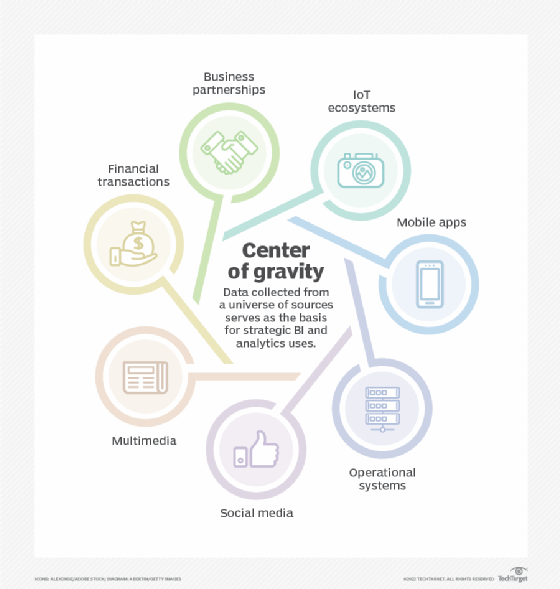
Big data comes from operational systems, websites, mobile apps, endpoint devices and customer surveys, among other internal and external data sources. Bharath Thota, a partner in the digital and analytics practice at consulting firm Kearney, listed the following examples of data types that companies commonly collect:
- Transaction data such as purchase histories and financial, inventory and logistics records.
- Behavioral data on user interactions with websites, mobile apps and digital products, including clicks, navigation paths and session duration.
- Sensor and IoT data streams with operational metrics from connected devices and machinery.
- Streaming data on purchases, credit card transactions, financial trading, inventory changes, cybersecurity incidents and other events.
- Spatial and location data for tracking geographic patterns and relationships.
- Social media data encompassing posts, comments, likes and shares.
- Unstructured content such as emails, documents, images and video files.
Realistically, no enterprise can collect and store all the available data. Data leaders must work with business executives to identify the data assets required for current and future use cases, then develop a data collection strategy that meets those needs while keeping costs and complexity under control.
Key steps in the big data collection process
To ensure consistency and repeatability, experts said data teams should implement a systematic and methodical data collection process. Thota recommended a structured sequence consisting of seven steps:
- Define the organization's business objectives and desired outcomes for big data applications.
- Identify and map relevant data sources, then evaluate data quality and accessibility.
- Design and deploy the technology infrastructure for collecting data, including data ingestion pipelines, storage systems and data processing frameworks.
- Implement data collection mechanisms with appropriate error-handling and monitoring capabilities.
- Use validation rules, anomaly detection, deduplication and data cleansing to fix data quality issues.
- Catalog data and apply metadata tags to provide context and enable users to retrieve it efficiently.
- Establish data governance processes to ensure data remains accurate and consistent.
Integrating data into a unified big data architecture is another important step, Goyal said. "Data loses value in silos," he noted. Creating a centralized data lake or lakehouse -- or connecting multiple platforms through a data fabric -- enables data science teams and AI systems to access the data they need without having to hunt across separate systems.
Common methods of collecting big data
Data collection methods vary by the data type and source. Batch processes that collect data from source systems at regular intervals are the most widely used approach. Extract, transform and load (ETL), the traditional batch data ingestion method, is favored for collecting structured data. ETL extracts data from its original location, modifies it to support planned uses and loads it into a repository.
However, ELT -- a variant that reverses the load and transform steps -- is more common in big data environments, especially for collecting unstructured and semistructured data. Alan Cecil, data analytics manager at professional services firm BPM, said loading raw data into repositories speeds up ingestion and provides greater application flexibility. The data can be analyzed as is or filtered and transformed for specific uses, he added.
Goyal said APIs and real-time streaming tools capture event data as it's generated. Change data capture is another real-time method that updates data whenever it changes in source systems. IoT devices aggregate sensor data and transmit it to a centralized platform. Methods such as web scraping and third-party data feeds are used to collect external data.
Data collection challenges to overcome
The following are some of the common challenges data leaders and their teams face in collecting big data:
- Identifying all the relevant data across an organization.
- Achieving and maintaining high data quality levels.
- Breaking down data silos and ensuring data is accessible.
- Integrating diverse data sets from multiple sources.
- Selecting and deploying the right tools for various data collection tasks.
- Having the right skills and sufficient resources for the collection work.
- Properly securing data and ensuring compliance with privacy and regulatory requirements.
Data quality is a particularly big issue. Goyal said teams often struggle to maintain data accuracy, consistency and completeness when collecting data in various formats from a wide range of sources on an ongoing basis. Data errors that aren't caught can cascade through analytics applications, dashboards and AI models, producing flawed results.
Real-time data collection further complicates efforts to validate, classify and properly secure data before it's put to use, Goyal said. To streamline those tasks, organizations are increasingly using AI to monitor data flows, detect anomalies, classify sensitive data and flag potential compliance risks, he added.
Security and privacy concerns also become more complex as data volumes continue to grow and big data use cases expand in organizations. "More data means more to protect," Goyal said. In addition, new privacy laws enacted in various countries have increased compliance obligations. As a result, data leaders must balance broad access to data with appropriate restrictions on its use, particularly for sensitive information.
That's why strong data governance policies and procedures must be built into big data collection efforts from the start, Goyal said. "Data ownership, access controls and compliance requirements shouldn't be afterthoughts, but rather part of the collection process itself."
Best practices for collecting big data
The data collection process isn't static. Data leaders should be prepared to tweak it as new business needs, use cases and data sources emerge. This includes ongoing work to identify and collect relevant data sets and remove any that are no longer needed.
Use AI tools and data management software to automate as much of the collection process as possible, experts said. Besides streamlining tasks for faster performance and increased efficiency, automated tools can uncover problems, such as data sets that aren't successfully ingested. They can also track compliance with governance and security protocols.
Thota also recommended the following best practices:
- Implement data minimization procedures to reduce storage costs and exposure to security and privacy risks.
- Use strong encryption methods when data is both at rest and in motion.
- Maintain comprehensive audit trails for accountability and forensic analysis.
- Document data lineage to track the origin, transformation and use of data assets.
- Invest in comprehensive training for data management and analytics teams.
- Stay current with evolving data regulations and adapt collection practices accordingly.
Editor's note: This article was updated in March 2026 for timeliness and to add new information.
Mary K. Pratt is an award-winning freelance journalist with a focus on covering enterprise IT and cybersecurity management.