AI in HR software is changing employee experience and HR workflows, turning automation into a broader story about rollout, trust and change management.
AI in HR software is having a profound effect on the enterprise, but not necessarily in the way you might think. The real challenge is not just what HR AI can do, but what happens once those capabilities get embedded into systems that touch employees directly.
Sure, AI is helping automate and reduce time-hungry, laborious and repetitive HR work. It can help with survey analysis, training recommendations, common employee questions, draft creation and other routine tasks that used to eat up more human time. That matters. It can make HR systems more responsive and free HR teams to spend more time on work that still depends on judgment, context, emotional intelligence and actual people skills.
But that is only the first layer. The bigger issue is that, once AI gets embedded into the systems employees use every day, this stops being just a technology story and becomes a change management story, too.
HR systems are not off to the side of the business. They sit close to benefits, policies, training, performance, self-service and other parts of working life that touch much of the workforce directly. As a result, the effect of AI in HR is broader, more sensitive and more immediate than in many other software rollouts.
Once AI gets embedded into the systems employees use every day, this stops being just a technology story.
AI in HR has practical uses, but HR still owns the answers
The practical case for AI in HR is not hard to see. It can speed up employee listening by summarizing survey responses. It can recommend training based on employee profiles and habits. It can answer routine questions faster. It can surface signals that a worker may need help or that someone is excelling. Used well, AI can improve employee experience while taking some of the drag out of day-to-day HR work.
What keeps this from being a simple productivity story is that the buck still stops with the humans. In this case, it stops with HR.
The point is simple: HR remains responsible for the answers AI gives. Therefore, AI cannot be treated as the final authority. It needs oversight for accuracy, appropriateness and policy fit, especially when the information involved is personal, employment-related and subject to governance, compliance and confidentiality requirements.
That is why the most believable version of AI in HR is not one that tries to replace HR. Instead, it is one that frees HR employees up to do more actual people work while speeding up both mundane, process-heavy tasks and some analytical ones.
The value is real. The autonomy is limited. And that limit matters.
The real question is not just what AI can automate. It is how HR introduces AI into sensitive, employee-facing systems without losing trust, clarity or control.
Why rollout, training and buy-in matter
Once AI gets embedded into HR systems, the challenge is no longer just whether the tool works, but how people absorb the change around it.
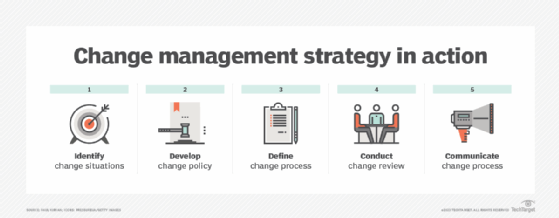
Here, change management stops feeling secondary and starts looking central to the story. It makes a straightforward point that fits this story exactly: Leaders need to communicate frequently, explain why the change is happening, involve employees in the process, provide training and test the change before broad release. That is not just good rollout hygiene. In HR, it becomes central to whether the initiative feels trustworthy at all.
AI is also starting to shape the change management process itself. HR teams can use it to draft training materials, prepare employee communications, support worker questions through chatbots, build project timelines and create presentation templates. The result is a more layered story than a simple software rollout: AI is not just part of the change; it is also becoming part of the machinery used to communicate, support and manage that change.
But that does not reduce the need for oversight. If anything, it reinforces it, because AI-generated material still needs human review for accuracy, clarity and appropriateness.
HR AI is not arriving in a vacuum
The push to embed AI in HR software is landing in workplaces that might already be dealing with other pressures. One example is low turnover, which is not always a sign of workforce health. In some organizations, it can signal stale skills, limited internal mobility, weak motivation or too little movement inside the workforce -- concerns that show up in discussions of the risks of high employee retention.
That broader context helps explain why AI in HR is not just a software functionality story. It is also a rollout story shaped by employee buy-in, communication, training and testing. AI may help HR analyze surveys, recommend training, answer routine questions and surface employees who need support, but HR still has to review outputs, protect sensitive information and stay accountable for the results.
Other pressures already shaping HR's AI rollout include employee resistance to change, the need for training and pre-release testing, accountability for AI-generated answers and recommendations, confidentiality and compliance concerns, and the challenge of fitting AI into existing HR and enterprise systems.
Buy-in matters more here than in many other enterprise software rollouts because HR software is more inward-facing and more pervasive. Other enterprise systems can deeply affect departments, teams or business units. HR systems affect nearly everyone. They also tend to deal with more personal and sensitive information than many other categories of software.
People are not just reacting to a new tool. They are reacting to changes in systems that shape benefits, policy answers, training, performance signals and parts of the employee experience that can feel deeply personal.
Training and testing matter for the same reason. They reduce the unknowns. They help employees and HR staff see how the technology will actually be used, how it can change workflows and where the limits are. Training and testing can also reduce resistance. This matters because AI in HR will only become credible if people understand not only what it can do, but what it will not be allowed to do on its own.
Embedding AI into HR systems is becoming a change management issue as much as a technology one, especially when those tools affect employee-facing workflows.
How vendors are making HR AI feel more credible
Workday adds the enterprise-software layer that makes this story more grounded.
What Workday is really arguing is that AI in HR and finance becomes more believable when it is not floating above the application as generic intelligence, but instead operating inside the software environment, rooted in trusted HR and finance data inside the system of record.
In other words, the strongest enterprise case for HR AI is not just that it can do more, but that it can work inside existing permissions, workflow logic, compliance requirements and the data foundation companies already depend on to run the business.
The system-of-record argument matters here because it suggests AI, rather than just generating answers in the abstract, is operating inside an existing business context. That is especially important in HR and finance, where "mostly right" is not good enough. There is far less room for error when the workflows touch compensation, policies, onboarding, performance and other sensitive processes tied to people's working lives.
At the same time, Workday's framing leaves a fair question unresolved: How do organizations know the data foundation is really as solid as it needs to be? How do they know the controls, integrations and surrounding processes are strong enough to keep mistakes from leaking into systems where trust is hard to rebuild once lost? That is part of why human oversight still hangs over this whole story, even when vendors make a strong platform-level case for AI credibility.
In the end, that unresolved question is what makes this more interesting than a generic "AI in HR" piece. The real question is not just what AI can automate. It is how HR introduces AI into sensitive, employee-facing systems without losing trust, clarity or control.
That is what turns HR AI into a change management story.
James Alan Miller is a veteran technology editor and writer who leads Informa TechTarget's Enterprise Software group. He oversees coverage of ERP & Supply Chain, HR Software, Customer Experience, Communications & Collaboration and End-User Computing topics.