Dynatrace AI agents draw on new observability integrations
Dynatrace rolls out AI agents grounded in a newly consolidated observability data back end and user interfaces, as enterprise AI ROI now hinges on context engineering.
Add Dynatrace to the growing list of enterprise IT vendors vying to take control of the context used to guide AI agent-based automation.
Tech analysts predict that this year and next will determine whether enterprises can achieve significant return on investment from generative AI, including AI agents, individual compute units that can collaborate independently to take actions using large language models (LLMs) and other IT automation tools. As the industry's focus shifted over the past year from generative AI models to agents, human prompt engineering with chatbots evolved into context engineering, a holistic approach to grounding groups of AI agents in the optimal set of corporate data, LLMs and tools.
"There is a lot of interest in the idea of what types of decisions a CIO or technology leadership team is willing to cede to these tools," said Stephen Elliot, an analyst at IDC. "We're going to see that more and more this year, but there's the question of whether they trust that these agents have the right information to make the right decisions. For that to happen, a certain level of reasoning and contextual history are foundational ingredients."
From manual ops to supervised autonomy
This week, Dynatrace overhauled its observability platform, adding what it described as an agentic operating system, Dynatrace Intelligence, and a set of Dynatrace Intelligence Agents. Some of these new agents act as operators supervising the others, while domain agents specialize in particular IT workflows, such as issue prevention and remediation, business observability and security operations.
You have all this information, but it's still humans that are gluing together the action, and that's really what we want to change.
Steve TackChief product officer, Dynatrace
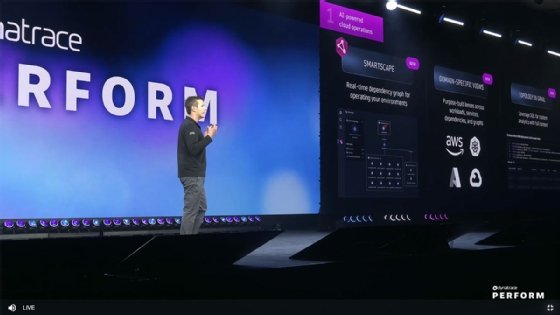
The goal with Dynatrace Intelligence is to get "from just alerts and into action" with human-supervised autonomy in the platform, said Dynatrace Chief Product Officer Steve Tack during a keynote presentation at the vendor's Perform conference this week.
"One of the common themes that we hear [from customers] is that 'We're drowning in data, but we're still starving for action,'" Tack said during the presentation. "You have all this information, but it's still humans that are gluing together the action, and that's really what we want to change."
Behind the scenes, Dynatrace also pulled real user monitoring (RUM) data into its back-end Grail data lakehouse and Smartscape knowledge graph; collapsed separate interfaces for different hyperscalers into a single view in its Clouds app; and polished its developer interface with direct views into infrastructure such as databases associated with their applications in IDE tools including VS Code or Windsurf.
Data and UI consolidation is key to enhancing AI agent context, said Torsten Volk, an analyst at Omdia, a division of Informa TechTarget.
"Context engineering is about providing the LLM with all the context and relationships needed to make deterministic decisions," Volk said. "The fact that it’s combined in a single view should be a given, as otherwise it wouldn't be useful context. Each context source Dynatrace adds -- whether it's RUM data, CMDB relationships or feature flag state -- tightens that loop and increases the range of scenarios where their agents can operate at least semi-autonomously."
Dynatrace Chief Product Officer Steve Tack introduces the new Dynatrace Intelligence agentic AI platform during a 2026 Perform conference keynote presentation.
AI agent control planes expand and overlap
As AI agents drive the unification of previously separate sets of data to create coherent context for automation, lines are blurring among what had been separate vendor domains. Observability vendors such as Dynatrace rival Datadog have begun to expand the amount of direct actions their systems can take in DevOps pipelines and IT infrastructure, rather than simply reporting on system performance and alerting on issues.
Both Dynatrace and Datadog have acquired feature management companies in the last year that further expand these "platforms of action," in the words of Alois Reitbauer, chief technology strategist at Dynatrace. Meanwhile, business intelligence and data management vendors such as Snowflake have begun adding observability features through acquisitions as well.
This increasing overlap could further complicate strategic vendor choices for enterprise IT buyers. But Dynatrace also continues to emphasize partnerships with vendors such as AWS, Google Cloud Platform and Microsoft Azure. In December, for example, it added integrations with the AWS DevOps Agent and Kiro agentic IDE. This week, it added automated issue prevention features such as customizable alerts that support workloads in Azure Kubernetes Service and Microsoft Foundry.
Another planned partnership expansion with ServiceNow will include automating incident prevention, according to a joint presentation by Tack and Pablo Stern, executive vice president and general manager of technology workflow products at ServiceNow, during the Perform keynote.
"[A feature in development] that I really love is what we call pre-flight checks," Stern said during the presentation. "We all know that change is one of the leading causes of outages or issues and incidents. Well, what if we had a better integration where we could … not only make the change, but understand what the potential risk and potential blast radius were, through an integration that could potentially help reduce and even prevent issues from happening in the environment? These are things we're working on building."
These partnership expansions indicate there is a limit to how much direct action the platform will take, said Rob Strechay, an analyst with TheCube Research and Smuget Consulting.
"Dynatrace aims to provide the intelligence layer that understands real-time system behavior, causality and risk, and determines when automation should occur," Strechay said. "This is not about controlling every aspect of an agentic workflow. There will not be one agentic control plane to rule them all. The ones that integrate and focus will be part of the best-of-breed stack."
Beth Pariseau, a senior news writer for Informa TechTarget, is an award-winning veteran of IT journalism. Have a tip? Email her.