Enterprises poised to increase their spending on AI networking infrastructure have a new option in 102.4 Tbps switching silicon to feed AI's insatiable appetite for speed and scale.
Cisco introduced its G300 AI networking chip and corresponding Nexus 9000 and 8000 switches this week as a competitive counterweight to HPE and Broadcom, which combined forces late last year. The product of that partnership, the HPE Juniper Networking QFX5250 switch featuring Broadcom's Tomahawk 6 silicon, is due to ship this quarter. Now, Cisco's alternatives -- new liquid-cooled N9364-SG3 & Cisco 8132 switches -- are set for delivery in the second half of this year.
"With ongoing supply challenges in the market, Cisco provides an alternative to Broadcom's chips and helps satisfy the need for vendor diversity, particularly among hyperscalers," said Sameh Boujelbene, an analyst at Dell'Oro Group. "Cisco also has incumbency, which matters especially for enterprise customers. … That means it has trusted support relationships, and a natural upgrade path into AI networking without customers having to introduce a new vendor."
Sameh Boujelbene
Cisco also claims that customers won't have to rip and replace hardware to keep up with the rapid pace of AI development. The G300, like the previous generation of G200 chips, supports adaptive packet processing, which means IT organizations can use new network features without having to buy new chips.
"Programmability allows a single Silicon One G300 hardware platform to serve multiple roles across front-end, back-end and scale-out deployments, reducing SKU numbers, simplifying operations and lowering development costs," Boujelbene said. "It also extends the life of existing infrastructure. ... In a rapidly evolving AI landscape, that flexibility helps future-proof investments."
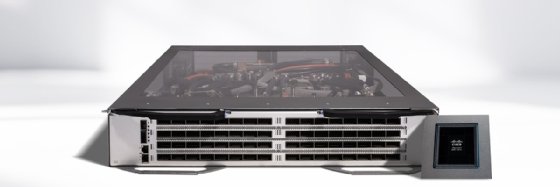
Cisco's G300 AI networking chip and high-end switches support 102.4 Tbps performance for data center scale-across workloads.
Cisco expands AgenticOps, Data Fabric
Cisco's new network hardware addresses infrastructure for AI, while an expansion this week of the AgenticOps software features included with its Nexus One operating system addresses AI for infrastructure.
New features due out over the next quarter will support autonomous troubleshooting, including root cause analysis and remediation; continuous network optimization; and trusted validation, which predicts the effects of infrastructure changes.
Here, too, Cisco faces competition from HPE, which also updated its Aruba and Juniper Mist line of AIOps products in December. HPE and Cisco have both taken steps to unify and cross-pollinate separate network management and AIOps products previously -- HPE began integrating and sharing data between Aruba and Juniper Mist AIOps tools, while last June, Cisco introduced the AgenticOps concept and its Deep Network Model for data.
Enterprises like the ability to augment what their staff is doing and allow junior team members to take on more advanced tasks. It allows cost savings and will eventually lead to self-driving networks.
Alan WeckelAnalyst, 650 Group
Cisco officials at this month's AI Summit event acknowledged a "trust deficit" among enterprises contemplating agentic automation, but analysts say that trust deficit is waning as AI agent-driven automation tools proliferate.
"Enterprises like the ability to augment what their staff is doing and allow junior team members to take on more advanced tasks," said Alan Weckel, an analyst at 650 Group. "It allows cost savings and will eventually lead to self-driving networks. While HPE, with both Aruba and Juniper, had a lead, Cisco has been closing the gap."
HPE is primarily focused on self-driving networks, but Cisco is taking a broader, more holistic approach that also supports AI security automation and advanced data management for observability based on Splunk, said Jim Frey, an analyst at Omdia.
"Cisco is broadening the AgenticOps strategy and using it as a collection point across multiple product lines," Frey said. "It started out in the campus and branch part of the business around Meraki and WiFi deployments. … Now it's added all the Catalyst products and it's moving into the data center, too, and connecting to Splunk with AI Canvas. Cisco has a pretty good broad vision of what this can do and how it can bring things together."
The next step will be for Cisco to incorporate AgenticOps into its UCS server products as well, Frey said.
Jim Frey
The Cisco Data Fabric project, which was launched last September and proposes a unified data lake and UI to drive data center AI agent automation, has also made strides over the last five months, according to Mangesh Pimpalkhare, senior vice president and general manager of Splunk Platform.
Cisco released a natively integrated AI Canvas for Splunk Platform to early adopter customers and made a new foundational AI model for time-series data available on Hugging Face late last year, Pimpalkhare said during a press briefing Feb. 5.
"There's the next evolution of that [model] … coming on February 18," Pimpalkhare said. "And then we are also making some great progress on the federated search … working with several data lakes that's on track over the next couple of months. And then last but not least, I'm really excited about our machine data lake that should be in alpha in the next two months as well."
Enterprise AI networking purchases poised for takeoff
Until now, the AI infrastructure boom has largely been driven by public cloud and neocloud providers, but enterprises are increasingly showing significant interest in AI data center updates, according to recent IDC research.
Specifically, enterprises are increasingly emphasizing the ability to scale networks across data centers rather than scaling network hardware up and out within data centers to support AI workloads, according to IDC analyst Paul Nicholson. That's where Cisco P200 chips and switches and Broadcom's Jericho4 will fit in.
"In IDC's AI in Networking Special Report in December 2025, scale-across topped the three technologies with around a third more respondents stating it was a critical capability for evaluating offerings and capabilities of data center networking vendors, in a multi-selection question," Nicholson said.
The survey of 500 respondents also found that around 90% of enterprises planned to increase the bandwidth both in and among data centers for AI workloads by 11% to 20% in the next year. But more organizations -- over one-third -- planned to expand data center interconnect bandwidth by more than 50%, a larger increase than that planned for bandwidth within data centers in the next year.
"Scale-across is contributing to this, along with inference and connecting data for AI," Nicholson said. "This is likely led by several factors -- for example, competition for data center resources, including power and cooling, cost and expansion considerations, access to remote data and sovereign requirements."
Beth Pariseau, a senior news writer for Informa TechTarget, is an award-winning veteran of IT journalism. Have a tip? Email her.


 Sameh Boujelbene
 Jim Frey