Getty Images/iStockphoto
How to ensure business continuity in data center decommission
Explore strategies for decommissioning data centers while ensuring business continuity, minimizing downtime and managing IT asset disposition responsibly.

The rising demand for data centers is driven by the need to support AI adoption and new technology innovations, such as edge, 5G and quantum computing. At the same time, enterprise leaders are decommissioning and consolidating smaller legacy data centers, primarily to cut costs. The momentum behind this trend is evidenced by a decommission market valued at $12.95 billion, with a projected 7.37% CAGR, according to Research and Markets.
Drivers of this strategic shift include increased model training and compute demands; greater reliance on cloud, hybrid and colocation services; and rising power densities, energy and security requirements. In some cases, organizations are retrofitting their facilities to meet these new deployment goals. As organizations adopt decommissioning strategies, a primary objective is to maintain business and IT ops continuity and achieve near-zero downtime.
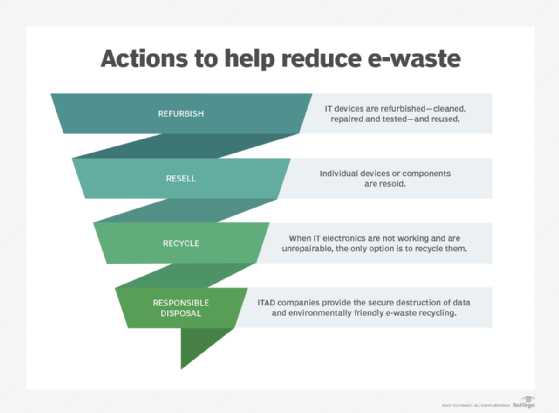
In this article, we explore the detailed planning and execution necessary to maintain consistent operational excellence and business productivity throughout the changeover. We also examine the key aspects of IT asset disposition to reduce e-waste, recover value and meet compliance requirements while responsibly managing disused IT equipment.
Maintaining alignment among business goals, assessments and planning
Decommissioning legacy systems enables previously unattainable cost savings, accelerates digital transformation and helps achieve new levels of sustainability. Each of these areas is attracting increased attention as climate and economic concerns grow more urgent. In addition to cost optimization, C-suite and IT leaders can use decommissioning to free up real estate within their facilities.
For example, an enterprise can eliminate data center maintenance, power and HVAC costs while reallocating valuable resources and expanding the physical footprint to support more pressing needs. In this way, decommissioning functions as a strategic business enabler.
Critical steps include conducting a comprehensive infrastructure inventory and identifying application dependencies. Moreover, mapping IT services to current business functions and priorities will help determine the course of action and provide an accurate picture of stakeholder engagement across business units.
Another focal point during the planning stage is strengthening cybersecurity and reducing the risk of data breaches. Organizations should prepare for potential audits and comply with privacy mandates, such as NIST, GDPR and HIPAA, by sanitizing data on legacy hard drives and backup media through certified degaussing, wiping or physical shredding.
In today's environment, enterprises are treating hardware retirement as an opportunity to offset high network egress costs and the unpredictable total cost of ownership associated with public cloud deployments. Executives view these data center consolidations as laying the foundations for hyper-efficient, modern facilities. Yet at the same time, the imperative to expand AI initiatives is making companies more reliant on remote platforms, virtual services and hyperscalers.
By aligning the decommissioning process with business goals at the planning stage, C-Suite executives and IT leaders can weigh the benefits and costs of retiring an entire facility versus retrofitting or colocation. However, in some scenarios, energy constraints and grid limitations are insufficient to support liquid cooling, high-density power connections and the thermal demands of modern AI infrastructure, making retrofitting less viable.
Still, given compressed hardware refresh cycles, such as 5 years to 7 years or 18 months to 36 months, instituting a continuous IT changeover pipeline rather than undertaking a significant one-time event remains compelling.
Sustaining business performance and operational continuity
A key objective during decommissioning is to maintain high availability across all IT ops, services and applications that support a business. To that end, a phased migration approach relocates data and suspends hardware incrementally to avoid catastrophic system outages. The process minimizes risk, enables thorough validation of small data batches and ensures the secure disposal of retired equipment.
Administrators first transfer low-risk, non-critical data to test the process. The organization can maintain operations on the older systems while synchronizing in real time to keep the new environment up to date. Essentially, IT teams ensure continuity through operational redundancy and specific failover mechanisms, such as Pilot-Light and DNS-based failover. This redundancy approach is best suited for complex, large-scale legacy systems that rely on massive datasets.
By contrast, blue/green deployment uses an identical production environment to achieve zero-downtime cutovers and provide instant rollback options. Once a "blue" environment is designated as the live system, a fully updated and tested "green" environment is deployed. Incoming network traffic is then seamlessly rerouted from blue to green using a load balancer, such as F5 Big-IP, NGINX Plus and Cloudflare Magic WAN. Enterprises can choose when to make the final switch, avoiding user interruption. If issues arise, traffic can be rerouted back to the blue environment instantly.
Data center decommissions can disrupt IT alignment, regulatory compliance and supply chain operations. Implementing communication strategies for both internal and external stakeholders will ensure that all security protocols are followed and enable internal teams to coordinate tasks seamlessly, resulting in a faster, more efficient decommissioning process.
In addition to a phased decommissioning approach and secure logistics, IT teams rely on effective change management, such as ITIL, ADKAR and Jira, to minimize operational downtime and ensure regulatory compliance. Once in place, a systematic framework helps address every aspect of the decommissioning process, from asset inventory and data management to deinstallation and IT asset disposition. IT leaders can continue to maintain operations using a hybrid operating model that relies on two or more environments, such as a legacy data center, a public cloud and a private colocation facility.
Achieving successful post-migration outcomes, optimizing business value
After establishing a new environment and securing or discarding the decommissioned hardware, IT teams should implement specific metrics to assess the new performance levels, ensuring that these measurements meet pre-migration standards. The results will help determine the overall success of the decommission and validate that business objectives have been met.
Audits ensure that current resource indicators, such as memory, CPU and storage, match the levels used to run previous deployments. These resource utilization reviews help prevent overconsumption, which can lead to elevated costs. They also ensure parity between the new and old systems and that the resulting infrastructure is well-positioned to handle future business growth.
Regarding the data center facility, IT teams should fully disconnect and remove physical infrastructure assets, such as UPS, HVAC and PDUs. Administrators can take a similar approach to dormant legacy applications that are often exposed after decommissioning. Removing these workloads entirely can help eliminate redundancy and the extra effort required to migrate and maintain them.
Another way to accelerate cost-cutting is to identify and cancel hardware maintenance contracts that have accumulated over time. These agreements may include software licenses and facility SLAs, all of which significantly increase Opex. Moreover, organizations can create and maintain a chain-of-custody record to track every hardware component from rack to recycling. IT teams can rely on this audit trail to prevent visibility gaps and unintended data exposure.
Kerry Doyle writes about technology for a variety of publications and platforms. His current focus is on issues relevant to IT and enterprise leaders across a range of topics, from nanotech and cloud to distributed services and AI.