The ethical implications of Anthropic's feud with the Pentagon
The Anthropic-Pentagon feud highlights a broader shift in AI governance, where ethical constraints, vendor policies and legal frameworks are redefining control and accountability.
AI ethics are rapidly becoming a legal and operational necessity for both the companies building AI systems and the government agencies deploying them.
This shift is evident in the recent dispute between AI vendor and research company Anthropic and the U.S. Department of War. At the center of the conflict is Anthropic's refusal to permit users to integrate its AI systems into fully autonomous weapons and domestic mass surveillance tools -- a position that has sparked both support and criticism across the industry. In response, the Pentagon attempted to designate the company a supply-chain risk and sought to blacklist it.
What began as a contract disagreement has evolved into a broader legal and ethical flashpoint, highlighting how questions of responsibility, control and acceptable use are becoming as central as performance and cost in AI deployment, especially in high-stakes environments.
How the Anthropic vs. Pentagon feud unfolded
Anthropic has long positioned itself as a proponent of ethical AI, emphasizing safety and human-centered applications through its proprietary Constitutional AI, a technical framework that guides model behavior using predefined principles. Its stance came into direct conflict with the Pentagon's efforts to integrate AI into defense systems, particularly in areas involving autonomy and reduced human oversight.
The dispute traces back to a contract established in July 2025, when Anthropic entered into a $200 million agreement with the DoW and became the first AI company to deploy its models on classified military systems. Tensions emerged in early 2026 when the DoW requested broader access to Claude, Anthropic's flagship large language model (LLM). The company declined, citing concerns over how the department could use its technology, while the Pentagon maintained that broader access was necessary for national security and operational effectiveness.
The conflict escalated following reports that the Pentagon used Claude in a January 2026 operation related to the capture of Venezuelan leader Nicolás Maduro. When the technology was reportedly accessed through an integrated platform, Anthropic sought clarification on how its systems were being deployed, raising internal concerns within the DoW about potential limits on future use. Those concerns reportedly accelerated the Pentagon's push for more expansive "any lawful use" contract terms.
The supply chain risk designation has historically been reserved for foreign adversaries.
Noah KenneyFounder and principal consultant at Digital 52
However, Anthropic stood firm. As negotiations broke down, the Pentagon designated Anthropic a supply-chain risk -- a classification typically reserved for foreign adversaries -- triggering restrictions across federal contractors and reportedly limiting use of the company's technology within government systems. Anthropic responded with legal action, alleging retaliation and constitutional violation.
In March 2026, Federal Judge Rita Lin issued a preliminary injunction blocking the government's actions, describing the Pentagon's move as "classic illegal First Amendment retaliation." The ruling paused the supply chain designation and its related restrictions, while leaving open the broader question of how far agencies can go in enforcing vendor alignment with operational needs.
"The supply chain risk designation has historically been reserved for foreign adversaries," said Noah Kenney, founder and principal consultant at Digital 520, an IT services company specializing in strategy, technology and growth for tech companies. "Applying it to a domestic company for holding an ethical position is legally unprecedented, and the judge's ruling will serve as a landmark guardrail on how far procurement authority can stretch," he added.
Andrew Borene, a former U.S. intelligence officer and executive director at Ocient National Security Solutions, said the dispute reflects how little clarity exists when vendor restrictions and government requirements diverge.
"In practice, agencies are often left with limited options: renegotiate terms, accept the vendor's constraints or move to an alternative provider," he said.
Although the case remains ongoing, the dispute has already prompted broader questions about how governments interact with private AI firms and how to define ethical boundaries when AI systems are deployed in national security contexts.
The ethical dilemma
At its core, the dispute reflects two competing approaches to governing AI. Anthropic argues that developers retain responsibility for how its systems are ultimately used, which justifies placing limits on high-risk applications such as autonomous weapons and mass surveillance. The Pentagon, by contrast, maintains that vendors should not impose constraints that could interfere with mission requirements or operational flexibility, especially in national security contexts.
Alan Heimlich, attorney and owner of Heimlich Law, a legal practice focused on government contracts and federal procurement law, sided with Anthropic's view and emphasized that procurement frameworks can't evaluate a company's ethical stance in isolation. He explained that attempts to exclude vendors on those grounds fall outside traditional responsibility determinations, which focus on financial stability, past performance and compliance history. In his view, doing so effectively shifts into rulemaking territory, which is reserved for Congress rather than individual agencies.
This isn't just a legal fight. It's a preview of the next phase of AI power.
Dr. Matt HasanCEO of aiRESULTS
Digital 520's Kenney similarly noted that disputes like this aren't common in federal procurement, while pointing out that vendor exclusion is typically tied to misconduct such as fraud, criminal activity or performance failures rather than disagreements over ethical positioning.
For companies like Anthropic, however, the trade-offs are significant. Limiting certain use cases aligns with its focus on safety and alignment, but it can restrict commercial opportunities and create tension with government customers that require broader access. At the same time, the Pentagon's position underscores the challenge of balancing national security priorities with concerns around accountability, transparency and unintended consequences.
This tension also reflects a broader shift in AI development. General-purpose models have varying ethical implications depending on their context. That has created a growing divide between developers who build in guardrails and institutions that prioritize flexibility in how they use the technology. As a result, ethical boundaries are increasingly enforced not just through principles but also through contractual terms and acceptable-use policies.
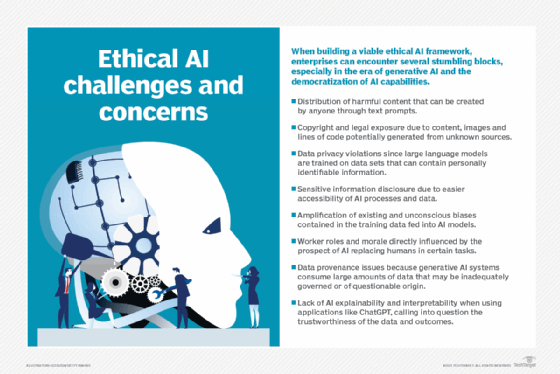
Organizations must consider several issues when establishing an AI ethics framework.
Taken together, these perspectives underscore how the Anthropic-Pentagon dispute has become a focal point for competing approaches to AI governance.
"This isn't just a legal fight. It's a preview of the next phase of AI power," said Dr. Matt Hasan, CEO of aiRESULTS, an AI consulting and software company. "Governments want control. AI companies want guardrails aligned to their own ethics. Enterprises are stuck in the middle trying to operate."
Hasan added that the underlying tension remains unresolved, noting that the ruling doesn't settle the broader question of who defines acceptable use. Instead, he said, it simply delays a deeper conflict that will emerge as organizations attempt to scale AI into critical systems while those boundaries remain contested.
The question of control
The Anthropic-Pentagon feud comes down to a question of control: Who has the authority to determine how AI systems are used after deployment? At stake is not just usage policy, but the balance of decision-making power between private developers and government institutions.
Supporters of Anthropic's position argue that developers have a responsibility to prevent misuse of advanced AI systems, particularly in high-risk domains. Critics, however, contend that enabling vendors to impose ethical constraints effectively shifts control away from democratically accountable institutions and into the hands of private companies.
"Procurement decisions must follow established legal procedures," said Heimlich, pointing to requirements under the Administrative Procedure Act that mandate formal rulemaking, public notice and opportunities for comment before agencies can impose broad new restrictions. "While agencies can set contract terms, broader regulatory control over private companies remains outside their jurisdiction and rests with Congress," he added.
As AI systems become more capable and deeply integrated into sensitive environments such as defense, healthcare and infrastructure, these tensions are likely to persist. aiRESULTS' Hasan described this as a structural shift in the industry. "Every vendor now carries an embedded moral framework," he said, noting that these constraints increasingly influence deployment decisions whether organizations explicitly account for them or not.
Implications and lessons for business leaders
The Anthropic-Pentagon dispute underscores how AI governance is becoming a practical business concern rather than a theoretical one. As organizations adopt AI more broadly, questions around vendor alignment, usage restrictions and operational risk are increasingly central to decision-making.
Many of these challenges can be mitigated by aligning with AI vendors upfront on acceptable use and deployment conditions, rather than negotiating mid-contract.
Andrew BoreneExecutive Director at Ocient National Security Solutions
Several key considerations stand out for business leaders, such as the following:
Operationalize ethical commitments. It's not enough to support responsible AI in principle; organizations need clear rules, technical safeguards and contracts to ensure users practice those values. Embedding ethics into operations helps keep systems safe and strengthens trust with customers and partners.
Include governance and alignment in vendor selection.Choosing an AI provider is no longer just about performance and price. Organizations must evaluate usage restrictions, risk posture and long-term policy direction to ensure alignment with their own needs. As Hasan noted, the biggest risk isn't performance -- it's hidden constraints that only surface when something goes wrong. If a vendor's policies don't align with an organization's operating reality, it might need to rely on multiple vendors rather than a single one to avoid disruption.
Stress-test governance. Organizations must build AI governance frameworks that withstand regulatory changes, vendor restrictions or policy conflicts. That means regularly reviewing policies, preparing contingency plans and maintaining backup options to ensure continuity.
Taken together, these risks point to the importance of defining expectations early. As Ocient National Security Solutions' Borene said, "Many of these challenges can be mitigated by aligning with AI vendors upfront on acceptable use and deployment conditions, rather than negotiating mid-contract."
A sign of what's ahead
The Anthropic-Pentagon feud is unlikely to be an isolated incident. As AI becomes more deeply embedded in high-stakes decision-making, disputes over usage boundaries, vendor control and ethical responsibility are likely to become more common. These conflicts will shape how AI is procured, governed and deployed across industries.
Procurement decisions, legal experts say, must remain grounded in established rules.
"Failure to ground procurement decisions in established legal and procedural frameworks will invite court intervention," said Heimlich, noting that vendors now have a concrete precedent to challenge exclusions they view as unreasonable. He added that agencies can't rely on policy preferences when making procurement decisions, as they must operate within defined legal authority.
Beyond the legal constraints, industry observers point to a shift in how AI providers and customers interact. Digital 520's Kenney said acceptable-use policies are now a central factor in how AI systems are deployed and governed, with providers setting firm boundaries on how users implement their technology. He noted that vendors are less willing to adjust their governance frameworks to meet individual customer demands at scale, signaling a broader shift in how providers and buyers share control and responsibility.
These shifts are already influencing how disputes unfold.
"Expect more vendors to challenge procurement decisions earlier in the process," Heimlich said, adding that ongoing uncertainty could eventually lead Congress to establish clearer standards for AI procurement.
Kinza Yasar is a technical writer for Informa TechTarget's AI and Emerging Tech group and has a background in computer networking.