
Getty Images
How business leaders can prepare for quantum-AI integration
AI completely changed the way we work, and quantum computing has the potential to upend our work completely. How can these technologies integrate to achieve further innovation?

AI deployments continue to gain momentum in every economic sector. But algorithmic complexity and processing demands require unprecedented data center expansions and enormous energy reserves, raising questions about costs and long-term sustainability.
The integration of quantum and AI (QAI) could offer further levels of computational power, energy sustainability and cybersecurity that businesses need. Quantum computing is already producing real-world use cases that surpass classical computing. By capitalizing on the synergy among quantum, AI and high-performance computing (HPC), organizations can develop competencies that take advantage of this fundamental shift in how we process information.
QAI adoption will require IT leaders and executives to create policies that span pilot project investments, infrastructure buildouts, research partnerships and workforce upskilling. Taking strategic steps now to prepare can pay dividends in the future. But business leaders must first understand the complementary relationship among quantum, AI and HPC, the benefits and challenges of QAI adoption and the key preparedness strategies and steps to QAI implementation.
QAI fundamentals
Quantum systems change the rules of computation with unique properties, such as entanglement, superposition and interference. Based on the physics of quantum mechanics, qubits can exist simultaneously in multiple states of ones and zeros (superposition) using the wave-like mechanism of interference to process problems.
Quantum offers exponential processing acceleration unmatched by standard chip technology, significantly improving large language model (LLM) inferencing and error correction. Moreover, quantum ensures high levels of successful error correction for LLMs, which are often prone to mistakes that can damage their credibility.
However, it's not a one-way street. AI improves quantum calculations by mitigating disruptions to sensitive operational hardware. Qubits are fragile and degrade easily due to environmental interference (e.g., heat, radiation and electromagnetic waves). Quantum error correction resolves these degradations, but it relies on slow decoding algorithms to achieve correct outcomes. AI can use machine learning (ML) decoder models to accelerate these real-time corrections and automate sensitive quantum hardware calibrations.
To achieve QAI, users require access to HPC. Standard HPC systems can connect quantum and AI technologies, ensuring that quantum results become actionable data that trains LLMs. Using advanced chipsets, an HPC system can run standard algorithms to analyze the quantum data and refine the results. For example, an electric-vehicle manufacturer could employ an HPC cluster and AI to create next-generation battery designs using quantum calculations.
The potential of QAI
QAI offers advanced optimization of fundamental IT and business processes, and it will affect every sector.
Achieving QAI capabilities could translate to lower AI deployment costs, as quantum uses significantly less energy than model training. The training data AI models require doubles every five months, and data set sizes double every eight months. Research from data integration platform Rivery shows that worldwide data volumes are expected to reach 181 zettabytes. That's equivalent to 1 sextillion bytes. This reliance on massive data sets for AI training has implications for enterprise operations, infrastructure investments, hardware purchases and energy consumption.
Organizations could also use AI to enhance quantum processing and generate practical results that improve industry-specific processes and meet key industry goals. Consider the following industry use cases:
The effects of QAI on IT security are also substantial, possibly rendering today's cybersecurity protocols (e.g., RSA, ECC and AES) obsolete. New cryptographic capabilities will use AI to simulate and test quantum-safe encryption algorithms, and quantum key distribution offers an airtight protocol for securing the next generation of real-world applications and IT environments.
Challenges to QAI adoption
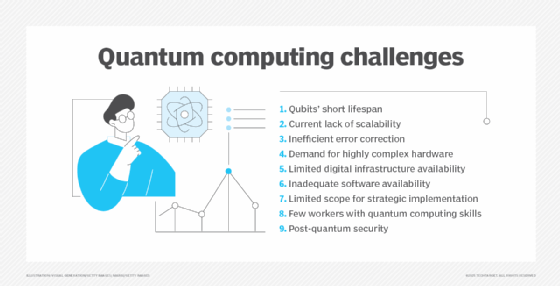
Whether it's specialized quantum hardware, technological expertise, operations, maintenance or upskilling, QAI requires high initial investment, with total cost of ownership reaching several million dollars. Still, enterprises have choices beyond the exorbitant costs of custom-built solutions by using cloud and third-party service providers to launch their AI initiatives.
QAI preparedness involves extensive research prototyping, talent acquisition and infrastructure retrofitting. Experience requires proficiencies in quantum mechanics, data analytics and ML. The relative scarcity of these capabilities has implications for research, adoption and security. It also remains to be seen whether high hardware costs and demands for expertise preclude some organizations from viable QAI adoption pathways.
Steps to QAI implementation
QAI will drive the next level of innovation in IT as it evolves from classical computing to AI-assisted quantum processing. For C-suite executives and IT leaders, there are strategic considerations for adoption on every front.
The first step should be a feasibility analysis. This identifies implementation gaps in current systems and controls. Organizations can then determine how QAI can provide competitive advantages by analyzing factors and critical benchmarks, from computational requirements and data complexity to infrastructure integration challenges. Roadmaps that include short- and long-term objectives should cover potential use cases and key milestones.
Next, launch small pilot projects to help understand quantum's potential and limitations without making significant upfront investments. Moreover, quantum-as-a-service platforms can offer accessible, scalable quantum compute resources to test use cases and gain real-world experience.
Businesses interested in building their own quantum systems will need to partner with academic institutions, research startups and OEMs. Enterprise leaders can leverage the collective expertise of these organizations to drive innovation. Collaborations are also instrumental in streamlining technology transfers, adding new skills and meeting industry-specific goals.
Finally, workforce development should focus on improving quantum literacy and hiring candidates with relevant skills. Internal promotion of training programs and certifications will help motivate personnel to specialize in applying quantum principles and develop the competencies to address relevant business and security concerns.
Kerry Doyle writes about technology for a variety of publications and platforms. His current focus is on issues relevant to IT and enterprise leaders across a range of topics, from nanotech and cloud to distributed services and AI.