Enterprise software is still organized by category. That is not going away.
ERP is still ERP. HR software is still HR software. Customer experience software still has its own buyers, vendors, budgets and use cases. Collaboration and communications platforms still have a different history from finance, supply chain or payroll systems. End-user computing still has its own management, security and experience problems.
Those categories matter.
They help companies buy software, assign budgets, manage vendors, support application portfolio management, define coverage areas and decide who should own which platforms. They also help editors, analysts, consultants and buyers make sense of a very crowded market.
But categories are becoming less reliable as management boundaries.
That is the shift.
The work does not always stay inside the category that owns the application. A customer issue may touch CRM, billing, inventory, service, communications and analytics. An employee change can affect HR, payroll, identity, access, collaboration tools, endpoint policies and reporting. A finance process might depend on ERP data, procurement status, supplier risk, approvals, automation and a dashboard used by people outside finance.
The software category can still describe where a system sits. It does not always describe where the work goes.
The software category can still describe where a system sits. It does not always describe where the work goes.
That is also why hidden dependencies keep legacy systems alive. The formal category might say a system is obsolete, but the business could still depend on the data, reports, workflows or handoffs around it.
That is why enterprise software strategy is becoming harder to manage by category alone.
This is not only an AI story. It was already happening because of enterprise application integration, cloud platforms, shared data, workflow automation, security, compliance, digital experience and pressure to prove ROI. AI accelerates the issue because copilots, agents and generative features need trusted data, permissions, context and controls from more than one system.
AI may not be the only reason the boundaries are blurring.
It is one reason the blur is harder to ignore.
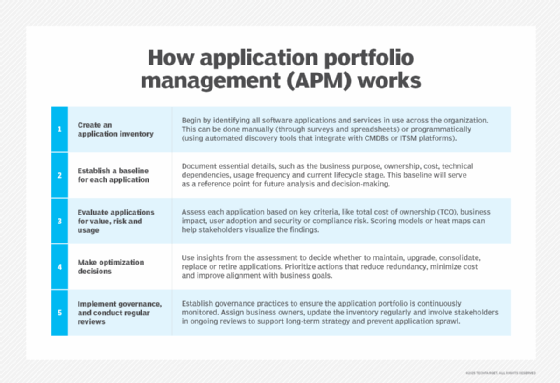
Application portfolio management gives enterprises a way to inventory software, assess ownership, cost, risk and usage, and make decisions across systems rather than by category alone.
The stack is not flat, but the management problem is wider
It is tempting to describe this as the flattening of the enterprise software stack.
That phrase gets at something real, but it can also mislead.
The technical stack has not disappeared. Companies still have infrastructure, platforms, databases, applications, integration layers, security tools, endpoints and user-facing systems. Those layers still matter to architects and IT teams.
The better point is more practical: Enterprise software risks are spreading across categories faster than management models are changing.
A company may buy a tool for one function, but the risk might surface elsewhere. CRM automation often requires ERP inventory data. Workforce workflows typically depend on identity and access rules. Collaboration platforms can become the place where approvals, records, files and AI summaries show up. Desktop or mobile devices serve as the control point for applications, security policy and employee experience.
That does not make all enterprise software one thing.
It does make category-only thinking less useful.
The old model assumed that each major software area could be managed mostly within its own lane. ERP handled core business records and transactions. HR managed employee processes. CX owned customers. Collaboration handled communication. EUC controlled endpoints and access. Security and compliance applied across all of them, but often as separate control layers.
That model still exists.
It just does not describe enough of the work anymore.
The business process crosses the category line. So does the data. So does the user experience. So does the risk.
Sometimes that is useful. Sometimes it is marketing. Sometimes it is both.
For many enterprises, ERP still holds some of the most important operational and financial data. It may define products, suppliers, orders, inventory, invoices, revenue, cost and planning assumptions. If that data is wrong, incomplete, fragmented or poorly governed, problems can ripple into other software categories.
That matters more as AI moves closer to the work.
An AI assistant, automation or agent may live inside a CRM, HR, service, collaboration or analytics tool. But if it needs ERP data to answer a question, recommend an action or trigger a workflow, the quality of the answer depends on data and context outside the visible application.
The user may think they are working in one system. The answer depends on several.
That is where the system-of-record claim becomes less about vendor positioning and more about practical governance.
If ERP is the trusted record for a decision, then the company needs to know what that means. Which data is trusted? Which process created it? Which system owns it? Which permissions apply? Which workflow is already acting on it? Which exceptions should block action?
If ERP is not the trusted record for that decision, the company still needs an answer.
The point is not that every enterprise process should return to ERP. That would be too simple. The point is that shared data foundations matter more when software starts acting across categories.
AI does not remove that problem. It exposes it.
Collaboration tools are becoming work surfaces
The category blur is also visible in collaboration and communications software.
These tools used to be easier to describe. People sent messages, held meetings, shared files and made calls. That still happens, but collaboration platforms are now closer to the work itself.
Sales approval may occur in a chat thread. Service escalations move through team channels. Project decisions now live in a meeting summary. Finance questions get answered by a bot pulling from multiple systems. A manager experiences HR, operations, IT support and customer issues through the same collaboration interface.
That changes the role of the platform.
The collaboration tool is no longer only where people talk about the work. It can become the surface where work is found, summarized, routed, approved and remembered.
That is useful.
It is also risky if governance remains tied only to the underlying application categories.
Who owns the record when the discussion happens in one place and the decision is stored somewhere else? What happens when AI summarizes a meeting that affects a customer, employee or supplier process? Which retention, access and compliance rules apply when work crosses from a system of record into a communication layer?
Those are not only collaboration questions. They are enterprise software questions.
The same is true for end-user computing. The desktop, browser, mobile device and unified endpoint management environment increasingly shape how users reach applications, enforce policies, protect data and experience AI features in daily work. The desktop matters less as a destination and more as a control point.
That is another sign that software categories still exist, but the operating problem crosses them.
Categories still help, but they do not contain the work
Enterprise software is not becoming category-free.
The categories still help. They give people language, ownership and structure. They help buyers compare products and leaders assign accountability. They also reflect real differences in data models, workflows, user needs and vendor ecosystems.
But the work is increasingly cross-category.
The data is cross-category.
The user experience is cross-category.
The risk is cross-category.
That does not mean companies should stop managing ERP, HR, CX, collaboration and EUC as distinct software areas. It means they also need a management layer that understands what happens among those areas. Leaders still need to know which application does what -- but equally important is understanding what happens between applications.
That is where more enterprise software risk now lives.
The next step is governance. If the work crosses categories, then ownership, controls, data rules and ROI questions must follow. That is why cross-category governance is the next software challenge.
James Alan Miller is a veteran technology editor and writer who leads Informa TechTarget's Enterprise Software group. He oversees coverage of ERP & Supply Chain, HR Software, Customer Experience, Communications & Collaboration and End-User Computing topics.