Once software work crosses categories, governance must follow the work. That might sound obvious. It is not, however, how many enterprise software environments are managed.
Applications are still bought, funded and owned by category. ERP, HR, CX, collaboration and end-user computing each have their own owners, while data, security, compliance and AI often sit elsewhere in the organization.
That structure is necessary.
It is also incomplete.
The problem is not that categories have disappeared. The problem is that work, data, risk and value increasingly move between them. That is why enterprise software is harder to manage by category. The categories still describe the systems. They do not always describe the outcome.
An employee change can touch HR, payroll, identity and access management, collaboration tools, endpoint policies and reporting. A customer issue can affect CRM, billing, inventory, service, communications and analytics. An AI assistant might appear in one application but depend on data, permissions and workflow context from several.
If governance stops at the application boundary, it will miss where the risk is moving.
A company can tolerate some category-by-category governance when systems mostly hold their own data, workflows and decisions. But privacy, compliance and governance become harder to separate when tools summarize, recommend or act across systems.
The same questions keep returning.
What data is the system using?
What context does it have?
Who gave it permission?
What rule is it following?
What should it not do?
Who owns the outcome?
Those questions do not belong to one software category. They cut across ERP, HR, CX, collaboration, analytics, EUC, security and data management. They also cut across roles. CIOs, CFOs, CHROs, COOs, CCOs, CISOs, legal teams, business systems leaders and line-of-business owners may all have a piece of the answer.
That is why AI decision trails matter. It is not enough to know that AI produced a recommendation, a summary or an action. The company needs to know what information shaped it, what system supplied the data, what policy applied and what human checkpoint existed.
An agent that can act across systems needs more than access. It needs boundaries. It needs context. It needs rules for when to move, pause, escalate or wait. It needs clear ownership when the action crosses from one business function into another.
That is not a narrow AI issue.
It is a cross-category enterprise software issue that AI makes harder to postpone.
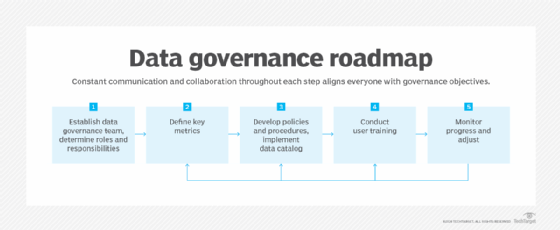
Cross-category enterprise software strategy depends on shared governance practices, including defined roles, common metrics, policies, data catalogs, training and ongoing monitoring.
ROI also cuts across the categories
The same shift applies to ROI.
Software ROI is often measured within the category where the money was spent. Did the CRM improve sales or service? Did the HR system improve employee processes? Did the ERP project improve finance, supply chain or operations? Did the collaboration platform improve productivity?
Those are reasonable questions.
They are not always enough.
A system can create value in one category while incurring costs elsewhere. A new workflow might reduce manual work in one function but increase reconciliation in another. A new AI feature may look efficient until teams spend more time checking the answer, cleaning data, managing permissions or resolving exceptions. A better user interface might hide more complexity underneath.
The leak often appears in the handoff. It appears when teams rekey data, verify reports, reconcile dashboards, chase approvals, fix incomplete records or explain why one system says something different from another.
A category-level ROI model might miss that.
The business does not experience software value only inside the application where the budget lives. It experiences value in the movement of work across systems.
That is why enterprise software governance must connect application decisions to process outcomes. Buying a better tool matters. So does knowing what other tools, teams, data sources, workflows and controls have to make that tool useful.
The more connected the environment becomes, the less useful it is to ask only whether one category delivered its own benefit.
The better question is whether the connected process works better.
Category ownership still needs a second layer
None of this means enterprise software categories are dead.
They are not.
Companies still need categories for sourcing, vendor management, budgeting, ownership, skills, roadmaps and accountability. ERP, HR, CX, collaboration and EUC are not interchangeable. They have different histories, buyers, data models, risks and operating requirements.
The mistake is treating those categories as if they fully contain the problem. They do not.
The more practical model is category ownership plus cross-category governance.
Category ownership answers one set of questions: Who owns this platform? Who manages the vendor? Who understands the roadmap? Who supports users? Who funds it?
Without category ownership, everything becomes vague. Without cross-category governance, every important problem becomes someone else's dependency.
Cross-category governance answers a different set of questions: What data moves between systems? Which process crosses functions? Which controls apply across tools? Which AI features depend on shared data? Which reports require multiple sources? Which handoffs create risk? Who owns the outcome when work spans more than one category?
Both layers are needed.
Without category ownership, everything becomes vague. Without cross-category governance, every important problem becomes someone else's dependency.
That is the trap that enterprise software leaders must avoid.
Governance must follow the outcome
Enterprise software governance is becoming more difficult as the operating environment becomes increasingly connected.
AI makes that visible, but it did not invent the problem. Integration, cloud platforms, shared data, collaboration tools, security requirements, compliance mandates, cost pressure and user experience expectations were already pushing work across system boundaries.
AI raises the stakes because it can summarize, recommend, route or act based on context from more than one place.
That creates a different kind of governance question.
Not just: Who owns the application?
Also: Who owns the outcome?
The answer may vary. Sometimes it belongs to IT. Sometimes, to business systems. Sometimes, to finance, HR, operations, customer service, security, legal or data governance. Often, the answer spans more than one of those groups.
That does not mean every decision needs a committee. It means the organization needs a model before the exception arrives.
Which cross-system workflows need shared governance? Which data domains require primary data management and common definitions? Which AI-enabled actions need human review? Which reports should become trusted sources? Which decisions require an audit trail? Which teams can approve changes that affect another category?
Those questions are practical because they sit where enterprise software problems increasingly appear.
Between systems. Between owners. Between the application category and the business outcome.
The future is not category-free. Categories still help companies manage complexity. But the next governance problem is not confined to a single category.
It is the work that moves across them.
James Alan Miller is a veteran technology editor and writer who leads Informa TechTarget's Enterprise Software group. He oversees coverage of ERP & Supply Chain, HR Software, Customer Experience, Communications & Collaboration and End-User Computing topics.