Orchestration is becoming enterprise AI's real test
Vendors can ship agents. The harder challenge is orchestrating how they work across applications, workflows and human handoffs without creating more risk.
Agents are easy to announce. Orchestration is harder to prove.
Shipping agents is one thing. Making them work together across systems, handoffs and live operating environments without creating more risk, duplication or confusion is something else entirely.
That is where the next enterprise AI test is starting to take shape. The issue is no longer just whether vendors can build agents. It is whether those agents can operate across real workflows, follow common rules and hold together in the mixed environments most enterprises actually run.
Orchestration starts to look like architecture
AI orchestration is starting to look less like a feature and more like an architectural control layer.
As multi-agent systems spread across workflows, applications and even corporate firewalls, scale quickly becomes more than a model problem. Once that happens, security, compliance and performance consistency can no longer live within each agent. They must hold together across the environment those agents move through.
That is why the idea of a policy-enforcement layer matters. It offers a way to apply business rules and compliance requirements across agents and workflows without rebuilding the same control logic repeatedly. It also hints at a deeper shift in enterprise software itself.
If agents are going to operate at scale, applications might increasingly have to be built less around screen-by-screen user journeys and more around modular services, APIs and workflows that agents can call as easily as people can use them.
What orchestration must do now
Orchestration is starting to matter because it sits where several enterprise requirements intersect. It must help agents follow common rules, move across workflows, hand off to humans cleanly and operate inside live systems without creating more inconsistency. That makes it less of a narrow AI capability and more of a control layer that touches policy, operations and software design all at once.
Seen that way, orchestration is not just about agent-to-agent communication. It is about holding together the larger environment those agents move through: applications, workflows, permissions, compliance requirements and human decision points.
That is why the term keeps widening. It has to.
Salesforce spells out the operating layer
Salesforce keeps returning to the same operating language: context, control, observability and orchestration. That is a more practical way to frame the problem than simply saying enterprises need better AI governance. It suggests that the real challenge starts after the agent is built, when it must run in a live environment, follow a structured process and avoid breaking down under more complex instructions.
Salesforce's language also broadens what orchestration actually means. It is not just about agents managing other agents. It is about agents coordinating with human processes and handoffs across systems like Slack, HR, IT and accounting. That is a useful distinction.
Building agents is a narrow end in itself. Running an agentic enterprise is broader. It depends on how agents, applications and people interact across the stack, not just on what any single model can do in isolation.
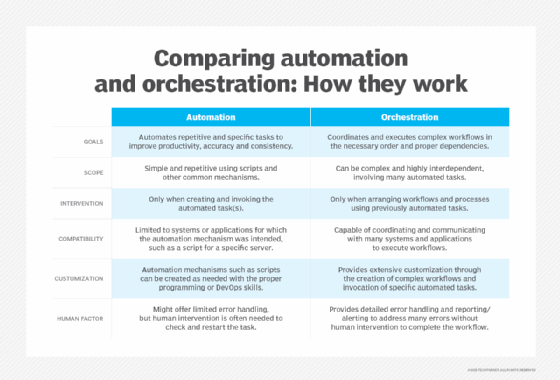
This comparison helps explain why orchestration is becoming a bigger enterprise AI issue than automation alone: It coordinates complex workflows, dependencies and cross-system execution.
Orchestration gets real in the contact center
Orchestration gets easier to picture in the contact center. Bringing voice, automation, CRM data, AI agents and digital channels into a single system shows where orchestration starts to matter in practical terms: cross-channel context, automated resolution, human escalation and cleaner handoffs inside a real operating environment.
It also makes the point in a realistic way: this is not really a rip-and-replace story. Organizations can layer the platform alongside existing contact center environments and see which parts of the broader vision can actually be lit up.
That is probably closer to how orchestration will play out across enterprise software more broadly. It will not arrive in perfect greenfield conditions. It will have to prove itself inside existing, layered, often messy environments.
The buyer problem is now universal
More broadly, orchestration is not just a vendor-positioning issue. Buyers are already dealing with AI overload, agent sprawl and single-source-of-truth questions in multi-vendor shops. They are also trying to figure out how to link different AIs together, reduce redundancy and turn all the AI talk into practical business value. That makes orchestration a present-tense enterprise problem, not a future one.
That could be the most important shift of all.
Building agents is a narrow end in itself. Running an agentic enterprise is broader.
The real buyer problem might not be choosing one AI tool. It could be figuring out how to make the multiple AI tools already chosen by the enterprise -- or chosen for it by the software vendors it uses -- work together without creating more fragmentation.
In that sense, orchestration is less a story about individual products than a story about a universal enterprise problem now surfacing across the stack.
The real differentiator
That is why orchestration is becoming the make-or-break layer.
Vendors are getting better at shipping agents. The harder challenge now is making those agents, systems and workflows work together in a way enterprises can actually trust.
Can agents follow the rules? Can they move across systems cleanly? Can they hand off to humans at the right point? Can they operate in live environments without multiplying risk or confusion? Those are no longer side questions. They are fast becoming the main event.
James Alan Miller is a veteran technology editor and writer who leads Informa TechTarget's Enterprise Software group. He oversees coverage of ERP & Supply Chain, HR Software, Customer Experience, Communications & Collaboration and End-User Computing topics.