Blockchain HR technology: 6 use cases impacting human resources
Blockchain is a mystery to some in HR and a godsend to others. Either way, it's here and gaining ground. Here's a look at the biggest ways blockchain could change HR.
By all accounts, blockchain is barely making a scratch in HR, but it still has the potential to play a role in the long-term future of work. Blockchain adoption by functions such as finance and payroll could eventually influence the technology decisions of other departments, including HR.
Besides this steady encroachment of blockchain in closely related functions, interest in blockchain HR technology has been building for quite some time. Companies, especially large ones, are looking for ways to modernize the HR function, including securing employee data and facilitating the exchange of information with less reliance on manual processes.
However, blockchain could be set back by the emergence of AI and machine learning in HR applications. As vendors go all in on this promising technology, the desire to incorporate blockchain could fade once again.
Top use cases for blockchain in HR
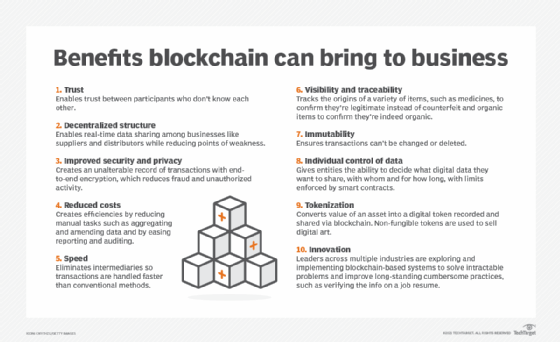
A blockchain is a distributed, shared digital ledger technology in which transactions are verified and recorded in a way that makes it virtually impossible for someone to tamper with the information. That means people who don't already know each other can share data and conduct transactions, including financial ones, without an intermediary. The main benefits are trust, privacy, security, data integrity and transparency.
According to the benchmarking organization APQC, the top three adoption drivers of blockchain in HR are the need to increase transactional transparency, increase transaction speed by reducing clearing and settlement time, and automating or simplifying business processes.
Here's a list of advantages and disadvantages of using blockchain in HR:
1. Payroll. This is perhaps the strongest use case, since payroll is closely tied to finance, and managing money is a strong point of blockchain. Blockchain can streamline the payroll process by automating and securing payments to employees. It offers a more secure option for employees to be paid, and they can use it to pay other expenses. The payroll data can also be securely shared with finance.
The most significant issue is most employees aren't set up to receive payments in this fashion, with the exception of early adopters, such as employees who prefer to be paid in cryptocurrency. Many people rely on traditional banks to receive money and make payments. Consequently, moving to blockchain would add an extra step and complexity for employees. Furthermore, traditional HR payroll software and bank transfers to employee bank accounts are quite secure and used on a regular basis with few problems.
2. Recruitment. Candidates could use blockchain to tokenize their identity and provide virtual credentials, such as college transcripts, training certificates, resumes and work histories that recruiters and hiring managers could trust had not been tampered with. Chasing down and securely transmitting documentation and confidential information is an important part of a recruiter's workload that blockchain HR technology could streamline significantly. Organizations often hire outside companies to perform background checks and verify information, another recruiting expense that could be reduced by blockchain verification. While this HR application of blockchain is still nascent, universities have begun providing students with records in blockchain format.
There are a couple of big roadblocks to making this work for HR. The first, and most significant, is that few recruitment platforms are built with blockchain. Second, few candidates use blockchain, and therefore, companies that want to rely on the technology would reduce their candidate pools significantly. The alternative is that candidates can use blockchain when they have it and traditional methods when they don't, but this might make the recruitment process more complex.
3. Employee data. Personal information can be encrypted and stored on a blockchain, providing immutability and a secure governance system for private information. However, as with educational records, the veracity of information stored on the blockchain depends heavily on the methods and honesty of whoever creates the initial record. Therefore, some experts say, it is more realistic for blockchains to be the database of record for employee data going forward than a reliable repository of past information. With this approach, there's little advantage in using blockchain to store employee data compared to a traditional HR system. In fact, it could be a disadvantage because blockchain introduces a new technology for people to learn without providing all the benefits.
4. Contract management. The smart contracts that blockchain enables can transform paper contracts into immutable, transparent digital contracts. Employers can use them to enforce the terms and penalties outlined in agreements with employees and contractors. The most significant advantage of using blockchain for contracts is that this use case is popular outside of HR and one that is well understood.
Improving the speed and efficiency of benefits administration is another potential use of blockchain's contract management features.
"Blockchains also can be used to execute benefits, events or payments," wrote HR expert Riia O'Donnell in a post on HR Dive. "When an employee becomes eligible for health coverage, [blockchains] could be used to initiate the benefit; when a probationary period is satisfied, the blockchain can trigger an increase in wages. It could even be used to administer employee contracts, like non-competes."
One disadvantage, already mentioned above, is that using blockchain technology is still foreign to many people. Most employees and contractors would prefer using a standard contract format because they know how it works. And while using two methods -- blockchain and traditional contracts -- is an option, it creates an unnecessary burden from a contract management perspective.
5. Personal blockchains. While blockchain seems destined to be pinned to HR's internal functions, an unexpected opportunity could develop in the coming years.
A very different and significant use of blockchain in HR will come from employees themselves, according to the APQC report, which predicted that employees will control personal blockchains that "encompass their entire professional identity, including academic transcripts, credentials, work history, employee review data and training."
Employers would need permission to access and add to an individual's private blockchain. Employees could provide access keys to employers and then rescind the keys when they leave the organization to maintain control over their personal records. Blockchain HR technology used in this way would effectively function as "value passports" that employees could take anywhere and continue to build throughout their careers, according to the report's authors.
"HR would be able to verify employee data within hours or even minutes rather than days, which would reduce costs and cycle times for processes like onboarding and recruiting," they wrote.
The challenge for HR departments relying on personal blockchains is that they might still want to verify the data that's provided. People might game the system and record information that is exaggerated or simply not true. Also, from an employee perspective, the employer might record information about them that they do not want, such as disciplinary or termination data.
6. Anonymous feedback. Employees are often reluctant to provide constructive feedback about their employer or manager for fear of reprisal. Despite companies promising confidential processes, someone is often able to see where the feedback originated. On the other hand, when feedback is provided anonymously on external sites, it's almost impossible for a company to confirm it was done by an actual employee. Blockchain can facilitate employment verification before anonymous feedback is provided. The feedback also stays anonymous and can't be deciphered.
While this makes for a more robust and transparent feedback loop, it is not a strong reason to invest in a blockchain system given the cost, training and maintenance required for a function that isn't mission critical.
Challenges for blockchain adoption in HR
Given the advantages, what do HR experts think is holding back adoption of blockchain in HR?
A few broad but significant issues are slowing adoption, such as a lack of vendors offering HR blockchain systems, the hesitancy of HR to take the lead in a new technology and the overall lack of blockchain standardization in organizations.
Beyond these broad opposing forces lie other obstacles and resistance. The operational risks can be broken down into the following four categories:
1. Cybersecurity. Blockchain is still vulnerable to data breaches during transmission, which poses risks to HR professionals who deal with confidential information.
2. Compliance risk. Blockchain still lacks regional regulatory standards, which exposes organizations to financial losses and legal penalties for failing to respect employee data rights and comply with legal frameworks, such as the European Union's GDPR. For example, GDPR specifies that employee data can only be retained for as long as it is legally required or needed for business reasons. Since blockchain stores the data in perpetuity, it is not possible to delete the data when it's no longer required.
3. Counterparty risk. Third-party vendors must often be enlisted to facilitate blockchain transactions. The trust provided by a blockchain is thus extended to those vendors' applications and websites, which might not be as secure as the blockchain.
4. Data privacy. For HR, the biggest internal risk factor is the human component. Employees might not yet feel it is safe to store personal information on a distributed ledger, and it can be difficult to explain the technology to some employees to gain their trust. Also, employees might not want information entered by their employer being attached to their employment profile indefinitely. Many people want to control their work history because it affects their ability to find new employment and earn promotions.
The bottom line on blockchain in HR
While blockchain packs a lot of promise for employers and employees alike, it is still very much in its infancy.
"Blockchain has the potential to radically transform the HR function, touching everything from benefits administration to control over sensitive employee data to the way that HR transactions are carried out," said Elissa Tucker, APQC's principal research lead for human capital management.
Nevertheless, "in spite of these benefits, blockchain is still an emerging technology for HR, with few HR leaders reporting that their HR function was already using blockchain," she said.
Eric St-Jean is an independent consultant with a focus on HR technology, project management and Microsoft Excel training and automation. He writes about numerous business and technology areas.
Pam Baker is the author of eight books and hundreds of technology articles published in leading online and print publications. She is also a speaker and industry analyst and a member of the National Press Club, the Society of Professional Journalists and the Internet Press Guild.