8 best practices for a bulletproof IAM strategy
IAM systems enable secure access to applications and resources. But to benefit from IAM -- and avoid a security failure -- teams must know which best practices to follow.

As with many cybersecurity initiatives, it is not enough to deploy an identity and access management technology with a default set of configurations. IAM is complex, and the number of identity-related cyberthreats that organizations must confront is rising. AI-powered attacks, the explosion of machine identities and increasingly sophisticated phishing techniques have considerably raised the stakes.
Let's look at eight specific IAM best practices for this essential component of cybersecurity.
1. Adopt a zero-trust architecture
The concept of implied trust, in which users are trusted because they have logged in, isn't going to work well in the long run. The zero-trust security model is based on the basic idea that all access should be continuously verified. It validates every access request through multiple security checkpoints, including identity verification, device validation and policy enforcement. Zero-trust principles must also extend beyond human users to nonhuman identities (NHIs) and AI workloads.
To implement zero trust, consider the following recommendations:
-
- Create a complete inventory of resources, users, devices and data flows.
- Use microsegmentation techniques to clearly define security boundaries and trust zones.
- Set up real-time alerting systems to quickly identify errors and outliers.
- Evaluate CAEP -- the Continuous Access Evaluation Protocol, or Continuous Access Evaluation Profile when referring just to the specification -- support to enable real-time session revocation when user or device context changes mid-session, not just at the point of login.
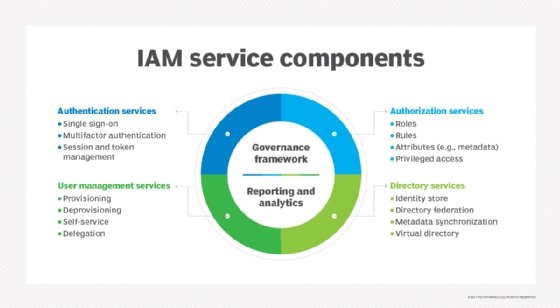
2. Deploy strong MFA
Authenticating with a username and password in an IAM deployment isn't strong enough nowadays. Attackers can compromise passwords through phishing, social engineering and other methods.
MFA adds a layer of security by requiring users to provide multiple forms of verification to prove their identity before gaining access to resources, typically combining something they know, something they have and/or something they are.
AI-powered attacks have significantly tightened the requirements for MFA. Adversary-in-the-middle (AiTM) phishing proxies now intercept one-time passwords and session tokens in real time, defeating SMS, authenticator app and push-based MFA. NIST's updated Special Publication (SP) 800-63-4 guidelines now specify that MFA deployments should include a phishing-resistant option.
To implement MFA, consider these recommendations:
- Use phishing-resistant authentication methods, such as passkeys, which replace passwords with device-bound cryptographic credentials.
- Use hardware security keys for privileged accounts.
- Deploy biometric authentication where appropriate.
- Avoid SMS-based authentication when possible.
3. Enforce strong password policies
While inadequate on their own, passwords remain part of the IAM effort. That makes it critical to enforce strong password policies.
Effective policies impose requirements for password creation, management and maintenance to ensure accounts are not easily compromised. Security teams can set specific requirements for credential creation and management, including minimum length, complexity and checks against known compromised passwords. An IAM system should automatically validate all new passwords against these policies while managing the full password lifecycle.
While passwords remain necessary for most organizations, momentum is building toward passwordless authentication. Passkeys, now supported across Apple, Google and Microsoft platforms, are worth evaluating as part of an IAM strategy.
Recommendations for password policies include the following:
- Set a minimum length. NIST SP 800-63B-4 recommends 15 or more characters.
- Check passwords against compromised password databases.
- Define password-expiration policies based on risk.
- Evaluate passkeys as a longer-term alternative to passwords.
4. Limit access permissions
The principle of least privilege (POLP) is a security policy that limits user account permissions to only those resources and actions absolutely necessary for a worker's job functions. By provisioning account access precisely, an organization can minimize its attack surface. POLP works by granting access rights to the minimum required levels and is commonly deployed and enforced with role-based access control (RBAC).
Deprovisioning of access permissions is equally critical. Orphaned accounts belonging to former employees or retired systems that were never revoked are a persistent and commonly exploited attack vector.
POLP must also extend to NHIs, including service accounts, API keys and AI agents, which are a major -- and often-overlooked -- attack surface.
To implement POLP, consider the following recommendations:
- Document required access for each role.
- Consider attribute-based access control as well as RBAC for different types of environments.
- Adopt privileged access management to ensure that only the right accounts get privileged access.
- Automate deprovisioning workflows tied to HR systems to revoke access immediately when an employee departs or changes roles.
- Inventory all machine identities and NHIs, including service accounts, API keys and AI agents.
- Consider cloud infrastructure entitlement management tools to identify and remediate excessive permissions across cloud environments.
- Enforce credential rotation for machine identities and NHIs, and scope AI agent permissions to the minimum required.
5. Monitor and audit
No security system works effectively with a set-it-and-forget-it approach. An IAM system needs continuous monitoring and auditing. These practices not only ensure things work as expected, but are also typically necessary to meet compliance requirements.
Continuously collect and analyze security events and access activities in real time and use automated systems to detect anomalies and potential incidents. Many modern IAM monitoring platforms now incorporate AI-driven behavioral analysis to identify threats that rules-based detection might miss. Systems maintain detailed audit trails and generate alerts based on predefined security rules, behavioral analysis and compliance rules.
Monitoring and auditing recommendations include the following:
- Configure comprehensive logging across all systems.
- Implement SIEM and user behavior analytics technologies.
- Add identity threat detection and response tools, a dedicated category for detecting and responding to identity-based attacks.
- Schedule regular compliance audits.
6. Promote security awareness and training
Conduct regular security awareness training that includes instruction, simulations and assessments to help staff and users understand their role in maintaining organizational security. Training can involve interactive modules, simulated attacks and real-world scenarios. Measure the effectiveness of training through assessments, behavioral changes and security metrics.
To implement security training, consider the following recommendations:
- Implement gamification elements to make the training more interesting and engaging.
- While general security awareness is great, create IAM-specific training materials.
- Include AI-driven threat scenarios, such as AiTM phishing attacks that bypass traditional MFA methods and AI-generated phishing lures that closely mimic legitimate login pages.
- Monitor training effectiveness over time and gather user feedback to help improve the training program.
7. Harden the IAM environment
If IAM components are at risk, the entire cybersecurity program can collapse. Security teams need to be diligent about digital authentication and preventing bad actors from accessing valuable data.
To harden IAM defenses, consider the following recommendations:
- Configure firewalls to protect access.
- Deploy encryption for data.
- Conduct security scans to look for known software misconfigurations.
- Update systems with the latest software patches.
8. Conduct penetration testing
Conduct regular pen tests against IAM infrastructure. This method, whether done using internal resources or through a third party, applies an adversarial approach to identify a system's weaknesses. Results feed into a continuous improvement cycle for security controls and configurations.
To benefit from pen testing, consider the following recommendations:
- Schedule regular tests so it's not a one-time exercise.
- Prioritize findings to address critical issues.
- Track the remediation process and validate fixes.
These best practices will strengthen an organization's IAM architecture and help it reap the benefits of effective access management.
Sean Michael Kerner is an IT consultant, technology enthusiast and tinkerer. He has pulled Token Ring, configured NetWare and has been known to compile his own Linux kernel. He consults with industry and media organizations on technology issues.
Editor’s note: This article was updated in 2026 to reflect changes in IAM best practices.