
Getty Images/iStockphoto
Salesforce rolls out Agentforce Health AI agents
Agentforce Health updated to automate more processes.

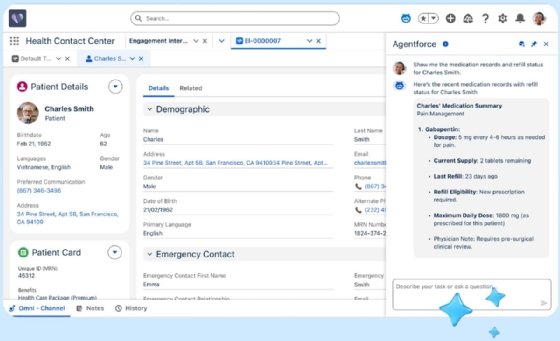
Salesforce Agentforce Health added a passel of agents that serve as tactical tools to address frontline healthcare workers' biggest time-wasters: data entry, data lookup and data summarization.
A short list of the agents includes the Referrals and Assessment Agent, which tracks insurance approvals for specialists; the Electronic Health Record (EHR) Read-Write Agent, which locates, corrects and summarizes patient data for frontline workers, such as physicians and contact center agents; and Rural Health Agent, which enables telehealth for public health agencies, with an eye toward compliance with Centers for Medicare and Medicaid Services rules that govern reimbursements.
Some of the agents are available now. More are planned for June and October.
Also included with the Agentforce Health release are integrations with EHRs, including Athenahealth. Furthermore, Salesforce forged several partnerships, including one with Viz.ai, a care-coordination platform that, among other things, flags findings on medical images that humans didn't spot but might require follow-up evaluations.
As Salesforce continues to deploy more healthcare-focused agents, it will zoom in on tactical agents that automate tasks healthcare providers now spend time doing manually -- and that take them away from face-to-face patient interactions, said Amit Khanna, senior vice president and general manager of Agentforce Health at Salesforce.
"How do we remove workload, bureaucratic processes?" Khanna asked. Discussing Agentforce Health's roadmap, he argued that AI "listening" to both contact center calls and clinician-patient interactions at the point of care enables it to handle documentation requirements and route them to the next steps.
Healthcare workers reluctantly cozy up to AI
Clinicians' attitudes toward technology at the point of patient care have changed a lot in the last 25 years, said Jennifer Eaton, research director for Value-Based Healthcare IT Transformation Strategies at IDC.
At the turn of the millennium, most nurses and doctors were working from paper charts. Then came EHRs, which brought two-way data sharing among patient caregivers, but also time-consuming data-entry headaches that made many healthcare workers wish for the good old days of paper and clipboards.
AI has the potential to create efficiencies that will address some of the issues EHRs have created. Healthcare workers might have been wary of electronic data systems at first, but they now are embracing AI as technology that will lighten the burden of data entry as it captures and analyzes conversations with patients and fills out EHR data fields, Eaton said.
Everyone -- healthcare providers and the rest of us -- might have AI trust issues as we watch it hallucinate along the way to improving itself. But the latest generation of healthcare workers is cozying up to AI, unlike its predecessors, thanks in part to the rapid evolution of health IT during and after the COVID-19 pandemic.
"[They're thinking], if I can use AI to plan my vacation and I can chat with AI to help me figure out what's wrong with my credit card statement, why can't I use AI in other aspects of life -- including potentially saving some time in my 12-hour shift?" Eaton said.
First things first: Data readiness
Salesforce rebranded Health Cloud as Agentforce Health last year. Health Cloud had been one of the company's earliest forays into vertical customization of its CRM. Salesforce has kept up with its development, including its transformation into an agentic-ready platform.
Salesforce customer Paramjit "Romi" Chopra, M.D., founder and CEO of MIMIT Health, a Chicago-area specialty group, has been working on Agentforce Health for years. He also launched a systems integrator, CIMSS Innovative Solutions, to provide services to other healthcare entities adopting Salesforce.
Chopra, an influencer who has helped shape the features and functionality of what is now Agentforce Health, said that agentic AI can be a catalyst to drive efficiency, and that MIMIT is all in on using the Salesforce platform to accomplish that. MIMIT ties compensation to productivity -- so, while AI agents aren't pushed on employees, most of them quickly see how using agents can save time and enable them to hit goals.
For many healthcare providers, though, preparing patient data so that AI can be deployed is a common barrier to adoption, Chopra said. That, along with identifying use cases for AI, is the work that needs to be done before AI can reach its potential for an individual healthcare organization.
"You start by looking at, 'What's a process that I waste so much time on?'" Chopra said. "We map that flow and then say, 'Okay, do you have the right data for this? Yes, it's clean, yes.' And then, 'How long does it take to do it -- one person, one hour?' And then, 'Okay, now how do we put an agent on it?'"
Don Fluckinger is a senior news writer for Informa TechTarget. He covers customer experience, digital experience management and end-user computing. Got a tip? Email him.
Dig Deeper on Customer Experience
-
![]()
CVS Health tackles tactical agentic AI rollouts for healthcare
By: Don Fluckinger
-
![]()
Salesforce productizes its own customer service AI agent for users
By: Don Fluckinger
-
![]()
Agentforce Operations tackles workflow orchestration
By: Don Fluckinger
-
![]()
Salesforce releases Agentforce dev tools, updates Agent Fabric
By: Don Fluckinger