How GenAI deployments are redefining everyday work routines
GenAI deployments are making dramatic strides in boosting employee productivity, strategic analysis, software development cycles and customer service -- but not without risks.

Generative AI's rapid evolution and widespread deployment in businesses increased AI's ability to understand context, synthesize new content and take actions in ways that were impossible just a few years ago.
A 2025 report by Bain & Company revealed that 95% of U.S. companies surveyed have adopted GenAI; production use cases have doubled, with software code development the top use case and IT the fastest growing in adopting the technology. The survey also found that more than 80% of GenAI use cases meet or exceed business expectations, and about 60% of satisfied GenAI users see meaningful business gains. A report by the Nielsen Norman Group noted that GenAI tools can increase user throughput by as much as 66% in everyday tasks.
Human employees are also changing how they interact with GenAI, approaching AI technology as a human-machine collaboration rather than as a replacement. Even employees displaced by GenAI systems can reskill to work alongside AI systems. Forward-thinking businesses will find value in providing AI training and recognizing employees who exhibit strong AI utilization and collaboration skills. Businesses will find that the enhanced capabilities of GenAI can boost productivity without necessarily adding staff.
But GenAI still requires guardrails, comprehensive security and strict adherence to governance and compliance strategies. Business leaders must understand the capabilities of GenAI in the workplace while considering the impacts and risks that GenAI poses to businesses and the workforce.
This article is part of
What is GenAI? Generative AI explained
GenAI's key business benefits
GenAI is finding significant traction as a platform to broadly improve essential business functions across an organization, including employee productivity, business outcomes, customer experiences and product innovation.
Productivity
GenAI can boost productivity by automating routine tasks, speeding the creation of new content and assisting in making decisions. It's adept at repetitive, time-consuming tasks such as data entry, scheduling and reporting, freeing up employees to spend time on more complex strategic projects.
Entry-level workers benefit most since GenAI can close the skills gaps and assist inexperienced employees with difficult tasks. GenAI automation accelerates workflows, enabling employees to operate at even faster speeds, completing more diverse tasks than the worker's experience level might otherwise support.
Analysis and decision making
GenAI's ability to gather and process vast amounts of data and establish a clear contextual understanding of its meaning can drive critical analytics and assist businesses in tactical and strategic decision-making. GenAI analyzes structured and unstructured data, combining traditional data sources such as database files with text, images and video, to uncover insights, spot opportunities and identify anomalies that human analysts could miss. Support for natural language queries lets humans make mission-critical business decisions by asking questions in plain language text.
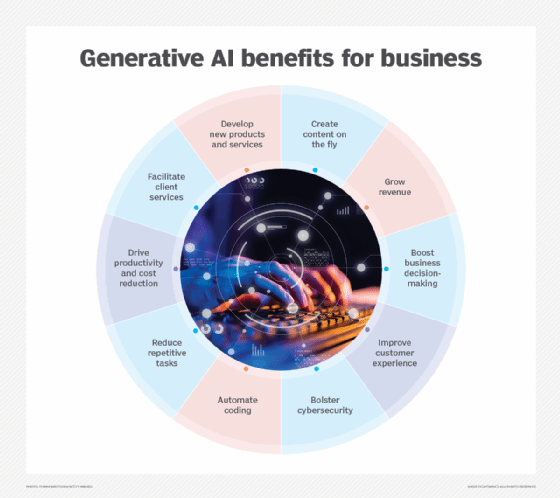
GenAI also synthesizes data so business decision makers can run scenarios and test cause-and-effect relationships between business parameters -- for example, measuring the effect of a marketing campaign on sales revenue. This capability enables GenAI to play a key role in strategic planning, risk analysis, resource allocation to mitigate risks and ensuring alignment of business goals. In addition, the speed and accuracy of analytical results can help business leaders accelerate important decisions and quickly adjust them for shifts in strategy.
Customer experience
GenAI's 24/7 availability and its ability to analyze extensive customer history, preferences and past transactions can create highly personalized interactions at lower business costs, strengthen brand loyalty, improve customer service and increase sales. GenAI can support human-like conversation, understand spoken context as well as human emotions and help users with common support requests like order tracking and billing.
GenAI analysis of customer behavior and history can be so accurate that sales conversion rates can improve by 23%, according to a 2026 report by Emarketer. GenAI can also summarize issues, provide suggestions to human agents when unusual customer issues arise and use successful interactions to create content like knowledge articles or troubleshooting guides.
Software development
Most enterprises rely on software to operate their business through websites and mobile apps to interface with customers, or they use sophisticated back-end systems to run vital business workflows. Businesses must develop, test, deploy, monitor and refine these systems over the entire software lifecycle. GenAI can accelerate the development cycle by 20-50%, PwC reported.
GenAI provides a capable assistant for code generation, debugging, testing, documentation, deployment and monitoring. Tools like GitHub Copilot can create code, translate code between different programming languages, identify coding errors, suggest corrections and offer optimizations for faster and better performing code.
GenAI can synthesize data for extensive testing, including outlying and edge cases, resulting in more reliable and error-free code. It can produce varied documentation, such as technical data and use cases, and update that documentation as the software develops. GenAI can then provision resources and deploy the software to production, connecting appropriate tools for monitoring, alerting and reporting.
GenAI use cases in business
GenAI is an extremely versatile and adaptive technology with strong capabilities for the following business functions:
- Content creation. GenAI models can be trained on vast data sets of content, enabling them to write text, produce images, generate videos and compose music. An AI system can't imagine or intuit anything new because it's constrained by the content it is taught or has access to. But it can synthesize content, tone and style to deliver essentially new content on demand through human prompts.
- Synthetic data generation. The data AI systems use to train and test on often contains sensitive or personally identifiable information, which can subject a business to compliance risk. GenAI can analyze real-world data sets and create synthetic data that's true to the statistical behavior or characteristics of the original data but without the sensitive content. It can also create new data to enhance or supplement an existing real-world data set.
- Software code creation. Every business seems to produce apps that require software development resources. GenAI can translate plain-text descriptions of software functionality into operational code that users can debug and test, accelerating the software development cycle and time to market.
- User personalization. Employees, business partners, customers and users often exhibit unique preferences and usage patterns. GenAI can process extensive information about past visits, purchase habits, search histories and other behaviors. These analytics enable GenAI to provide comprehensive personalization about new products, usage and suggestions that enhance the user experience, build brand loyalty and generate more revenue.
- Contextual understanding. GenAI is adept at translating human input into actionable output. It can establish and understand context and how complex ideas relate. Contextual understanding lets GenAI ingest and understand vast amounts of data, enabling an AI system to reorganize and summarize complex ideas far faster than humans.
- Content alteration and transformation. The combination of contextual understanding and content creation lets GenAI change, adjust or transform data -- for example, adjust lighting to create a more dramatic image or alter the tone of text to suit user needs.
- Simulation. GenAI can access vast amounts of data and perform analytics that enable detailed what-if scenarios. Such simulations can be extremely powerful when assessing ways to mitigate business risk.
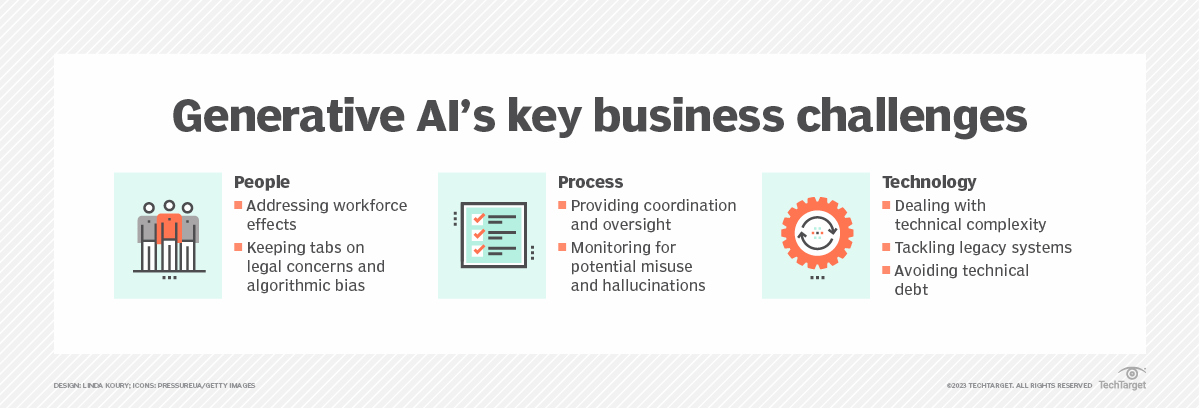
GenAI risks in business
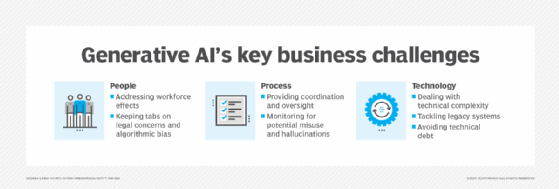
GenAI's potential benefits are compelling, and its impact on today's enterprise is undeniable, but the technology also poses significant risks that business leaders should consider carefully when planning and implementing a GenAI platform, including the following:
- Data privacy and data security. GenAI doesn't inherently treat data as private or secure. The twin issues of privacy and security remain prevalent in any AI project. Data privacy demands that sensitive or personal data remain tightly controlled and protected. Business leaders must consider whether GenAI should even access and use some real-world data without first anonymizing or synthesizing the sensitive data elements first. Data security ensures that only authorized users can access data and the systems that process it. Strong access control must ensure only authorized users can make GenAI requests that access secured data.
- AI outcomes. As with any AI, sometimes GenAI simply gets things wrong. Hallucinations, repeating or utilizing misinformation, and reliance on limited or biased data sources can yield undesirable outcomes. Business leaders must consider the legal, reputational, compliance and business impacts of GenAI mistakes such as incorrect strategic recommendations or inaccurate medical diagnoses. Well-developed machine learning models combined with ample high-quality data and thorough testing can help mitigate poor AI outcomes, but the risk of errors and omissions is always present.
- Intellectual property. IP issues involving data ingestion and generative outputs is a rapidly evolving risk of all AI systems, especially GenAI platforms. Legal systems around the world are debating the legality of using copyrighted works without permission to train an AI model, as well as legal ownership of resulting generative outputs. If a business trains a GenAI model using copyrighted works, can that business legitimately claim copyright ownership of GenAI's output? Another IP issue concerns GenAI models sharing outputs that incorporate IP from the business. Developers might need to restrict or redact some IP content from the output to protect IP.
- Governance and compliance. GenAI doesn't provide innate data governance or adherence to regulatory compliance obligations. The onus is on the GenAI developer to incorporate guardrails or guidelines that govern how AI is used. Effective programming, policies and training can ensure the GenAI system functions in accordance with business goals while maintaining prevailing regulatory compliance requirements.
- Human employment. AI's impact on human jobs will only accelerate in the coming years. Although AI can create new kinds of jobs, the use of AI and GenAI systems is also eliminating others, posing a dilemma for businesses. Increasing reliance on AI systems could eventually erode human knowledge or abilities: Will anyone understand a particular business workflow when an autonomous, adaptable GenAI system handles it over time? Employers must also consider the fate of employees displaced by growing AI use and how to upskill them.
Stephen J. Bigelow, senior technology editor at TechTarget, has more than 30 years of technical writing experience in the PC and technology industry.