How to improve the contact center experience for customers
Customers expect contact center interactions to be fast, seamless and personal, but improving the experience requires balancing automation, self-service and human support.

Customer service can still be an exercise in frustration for many consumers, particularly when automation creates barriers rather than resolving problems. At the same time, organizations that answer questions quickly, resolve issues effectively and balance automation with human support can turn contact centers into a competitive advantage.
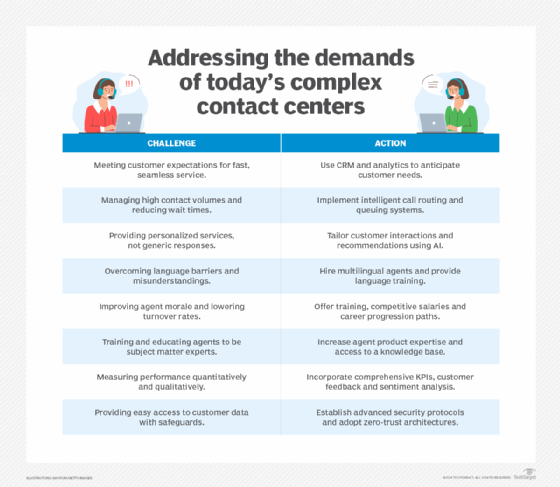
One-dimensional call centers built around predefined scripts are being supplanted by multichannel contact centers that support voice services, mobile apps, IVR systems, live chat, messaging, social media, video and websites.
Successful businesses use a customer-first approach while also investing in AI and automation to support an omnichannel strategy. These enterprises offer a positive contact center experience by providing accessible information and customer support 24/7. They also focus on customer service metrics, agent training and incentives to improve response times, resolution quality and personalization.
What is the contact center experience?
In simple terms, the contact center experience reflects how customers perceive service quality across all interactions with a company's support systems and communication channels. These interactions can include calling a customer service team member or using the customer self-service (CSS) capabilities in the company's mobile app. It all depends on the communication technologies and other touchpoints supported by the contact center's purpose. Contact centers could be dedicated to inbound customer service and support, outbound sales and marketing, multichannel support or omnichannel communications.

For high performance contact centers and their teams, consistency and service quality across channels remain critical for customer satisfaction. Positive customer experiences can yield a higher customer satisfaction score for products and services, brand loyalty, word of mouth advertising and promotion of a company's product on social media instead of damaging customer feedback.
Many queries still start in voice or are escalated to voice to resolve customer issues. Despite growth in digital channels, voice remains a critical point of escalation when customer issues become complex or emotionally charged.
Plus, the general wisdom that older generations prefer phone calls while younger people use digital communications to interact with customer support hasn't always held true, according to industry research. In surveys, younger people have reported they're likely to call a business to resolve problems that can't be addressed using CSS options. They also expect a higher level of live phone support, especially in premium service segments, such as financial services.
Automation and service bots are not going to completely eradicate contact centers and their agents. The phone, as in voice calls, should remain an important communication channel. Organizations that find the right mix of human and machine-assisted operations should be positioned to lead their markets.
Customers from all generational demographics accepted live chat, messaging and email as important for customer service communication. Email offers convenience to consumers, according to researchers, but even with email response management systems, it's harder for companies to analyze and measure results.
Importance of a good contact center experience
Creating a successful contact center experience requires meeting customer needs while managing cost, trust and operational complexity. It's important to monitor changes in customers' behaviors to advance channel strategies, instead of focusing solely on technology trends.
Consumers are particularly sensitive to automation that makes it harder to reach a human agent. Understandably, just a couple years ago, most consumers would shun AI-assisted customer service. And even though AI customer service has made some inroads, customers are still skeptical.
By now, most customers have some familiarity with AI. They've used OpenAI's ChatGPT or similar tools to find information for their service and support issues, but they may have concerns about a company's use of AI for customer service.
Customers are also migrating from traditional search engines to other media platforms. Google is still the No. 1 third-party tool, but customers are increasingly using YouTube and other platforms such as Reddit and TikTok to find user-generated content to help resolve their customer service issues. Businesses should consider adjusting their media strategies to monitor and engage with third-party platforms where customers increasingly seek support and validation.
Improving the contact center experience
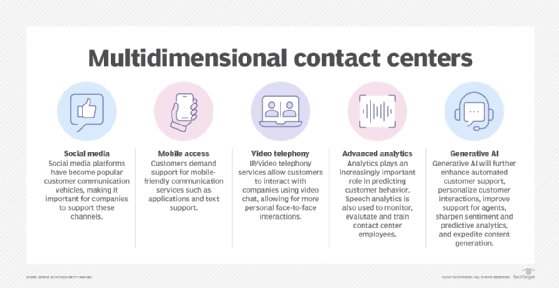
Improving the contact center experience is as much an organizational challenge as a technology initiative. Businesses need to think about their customers' willingness to use new customer service and support tools in their contact center, along with the readiness of the internal organization to implement them. In addition to a significant investment in AI technologies, companies will have to consider integration with legacy systems, training for contact center agents and potential legal risks.
Investment and wider adoption of technologies such as generative AI by many businesses could take years. Meanwhile, some high-profile missteps have shown potential downsides.
The British Columbia Civil Resolution Tribunal, for example, found in favor of an Air Canada passenger, who claimed that an AI chatbot provided inaccurate information regarding the airline's discount policy on bereavement fares. The passenger used a screenshot of the text interaction to prove to the court that the chatbot hallucinated by claiming the passenger had 90 days after travel to receive the bereavement discount, when in fact the airline's discount policy doesn't allow for refunds after travel has already occurred. Even though the AI chatbot provided a link to the correct policy, the court awarded the plaintiff a refund and court fees.
The case highlighted how AI errors can quickly become customer trust and legal issues, even when correct information exists elsewhere.
Businesses will have to build trust around the use of generative AI and what to disclose to customers. The EU's Artificial Intelligence Act, with most of its provisions coming into operation by 2026, requires users to be informed that they're interacting with a machine. That level of transparency is not yet mandated in the United States on the federal level.
Gartner research has shown that customers who start by using CSS options, even if they require assistance to resolve an issue, are more likely to use self-service in the future. Mobile apps and IVR present opportunities to create better CSS options.
While the cost per contact is typically lower with self-service than with human agents, failed containment quickly drives costs higher as customers switch channels. The key is to get customers to adopt those tools. Containment is indeed a challenge as businesses often struggle to keep customers in a channel to address the issue. Once they switch channels, the cost increases.
Consumers who started their customer journey in a mobile app, according to Gartner, reported the highest self-service success rate, followed in descending order by online account portals, customer community forums, online request form, social media, chatbot or virtual customer assistant, and websites (FAQs or help articles). Moreover, most customers who used the mobile app for customer service reported the highest level of customer satisfaction.
Research further showed that IVR is underutilized by companies as a self-service option. These systems can support inbound IVR for customer-initiated calls and outbound IVR for marketing and sales. While the majority of customers use the phone for problem resolution, few attempt to use IVR with little success, meaning businesses could invest in better IVR systems to increase self-service success.
Across channels and technologies, the central challenge is not whether to automate, but how to do so without eroding trust or continuity.
AI's influence on the contact center experience
The transition from on-premises to cloud-based contact centers has accelerated over the past few years. Businesses are investing in new platforms and tools to increase operational efficiency and customer personalization. Adoption of contact center as a service (CCaaS) and other technologies like CRM and workforce management that support multichannel interactions has intensified, along with executive and board-level scrutiny.
Contact center agents handle customer communications across multiple channels, often fielding phone calls, text messaging, email and social media. These roles require knowledge of technology in addition to listening, problem solving and oral communication skills. Customer interaction data is sometimes siloed and not easy to access across channels. If a problem isn't addressed in one channel, the customer must repeatedly make the same requests, leading to customer and agent frustration.
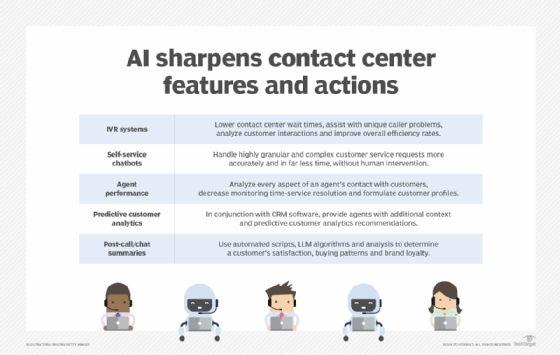
Many companies want to automate a large percentage of agent workflows and move repetitive tasks and customer conversations to GenAI and virtual agents. Cloud providers with large-scale data centers, such as Amazon, Google and Microsoft, have developed AI platforms. Amazon Bedrock, Google Cloud Vertex AI and Microsoft Azure OpenAI work with their respective CCaaS technologies as well as third-party platforms.
Amazon upgraded its CCaaS platform, Amazon Connect, with GenAI functionality. Virtual assistant Amazon Q, for example, is designed to understand customer intent through voice and text interactions and can suggest next actions to contact center agents. The agents can use the AI virtual assistant to ask questions in Amazon Connect and respond to customer queries without searching multiple data sources. The AI can summarize customer contact information and help unify information in Amazon Connect Customer Profiles, including data from third-party software such as Salesforce and Adobe Analytics.
Many executives see AI as a golden ticket for customer service. There's a common belief that AI could cut costs by reducing headcount in the contact center, but that's not quite reality.
Improving the contact center experience requires more than adding new channels or deploying AI tools. Organizations must balance speed with empathy, automation with transparency, and efficiency with trust. Contact centers that approach customer experience as a system -- rather than a collection of technologies -- are better positioned to deliver consistent service, build loyalty and avoid the hidden costs of failed automation.
Kathleen Richards is a freelance journalist and industry veteran. She is a former features editor for TechTarget's Information Security magazine.
Editor's note: This article has been updated to reflect changes in the contact center experience and business executives' involvement in contact center buying strategies.