8 contact center challenges and how to address them
Modern contact centers face persistent challenges around customer expectations, staffing and data access. Addressing them requires more than incremental operational fixes.

Contact centers sit at the intersection of customer experience, brand trust and operational efficiency. As customer expectations rise and AI becomes embedded in service operations, the challenges facing contact centers have grown more complex -- and more consequential.
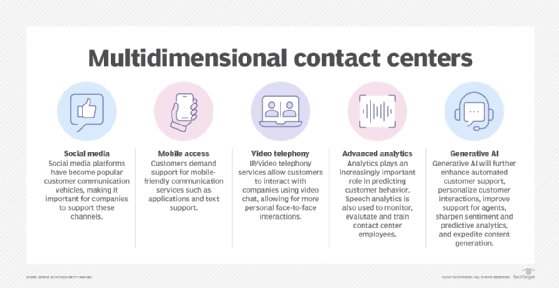
Customer service has moved beyond single-channel support, with contact centers now expected to manage interactions across voice and digital channels while maintaining consistency, context and speed. Contact centers have evolved beyond mere call-handling hubs into sophisticated, multichannel engagement centers that play a vital role in shaping customer experiences. With the advent of digital transformation, contact centers now integrate various communication platforms, including phone calls, email, chat, social media and video conferencing.
The commercial landscape for businesses and customers is rapidly changing, driven by technological advancements, evolving customer expectations and the increasing importance of personalized service. Enterprises are under pressure to deliver consistent, high-quality customer interactions over different modes of communication, while managing costs and maintaining operational efficiency.
Customer interactions now span multiple channels, yet customers expect consistent context, personalization and responsiveness regardless of how they engage. This complex environment necessitates a strategic approach to managing contact centers, addressing inherent challenges and using technology to enhance customer service capabilities.
Key contact center challenges and remedies
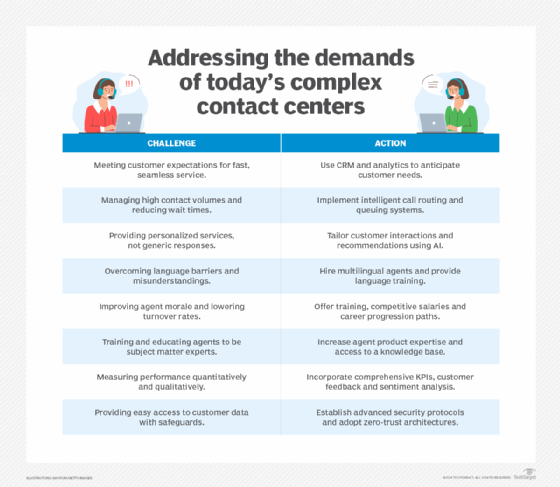
Providing different modes of interaction is among the many challenges for modern contact centers. Other issues include agent attrition, increased customer expectations, ever-growing customer queues, generalization of content, barriers to understanding and security.
1. Meeting customer expectations
Customers expect quick, personalized and seamless interactions across all channels. They also expect an interaction in one channel to be consistent with the experience they've had in other channels. They increasingly demand high levels of service and are less tolerant of delays, repeating their information and impersonal responses.
Advanced CRM systems and AI-driven analytics can help understand, contextualize and anticipate customer needs, enabling more personalized and consistent interactions. Regularly updating service protocols to align with customer feedback is equally important.
Meeting these expectations increasingly depends on how well organizations unify customer data and govern AI-assisted interactions across channels, not just on agent performance alone.
2. High contact volumes and longer wait times
Managing the high volumes of customer contacts, especially during peak times, can lead to long wait times and customer dissatisfaction. When customers call into contact centers of certain businesses, the first response they might typically get is a recording, "We're currently experiencing high call volumes" -- at least during normal business hours. This kind of experience, exacerbated by limited staffing and inefficient call routing, frustrates customers.
Implementing intelligent call routing and queuing systems can optimize resource allocation and reduce wait times. Most new systems enable contact center agents to work from home, which increases the flexibility of companies deploying agents globally. Self-service options, such as chatbots and automated responses, can reduce contact volumes, but they also raise expectations for the quality and efficiency of the interactions that reach live agents.
Chatbots can handle routine types of interactions, like password resets, quick orders and simple questions, but complex situations that require empathy and understanding are still best left to humans. Improvements in machine learning and AI can also help mitigate high contact volumes and wait times and provide customers with other ways to resolve their queries independently.
3. Personalization shortfalls and content generification
Generic responses and interactions usually fail to meet customer expectations for personalized service. This lack of personalization inevitably results in decreased customer satisfaction and loyalty.
Using customer data and analytics to tailor interactions and recommendations can improve personalization, but doing so effectively requires strong data governance and consistent context across channels. Training call center agents to express empathy and use customer information effectively during their interactions is especially important. New large language models can improve the quality of agent responses by combining the specifics of customer data with best practices in knowledge bases.
4. Language barriers
Contact centers often serve a diverse, global customer base. Language barriers can impede effective communication, leading to misunderstandings and frustration. Any enterprise that aspires to be global must deal with this issue. Even companies that see themselves as local will become global when they put their presence on the web.
Hiring multilingual agents and providing language training can bridge communication gaps. Additionally, real-time translation services and AI-powered language tools have come a long way and can facilitate smoother interactions.
5. Agent attrition
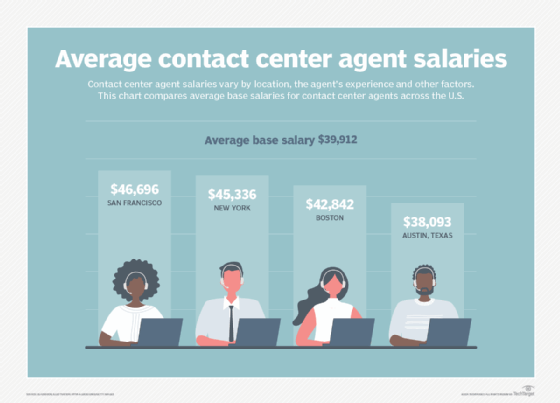
High turnover rates among contact center agents pose a significant challenge. Increased job openings and competition for talent in good economies can only make this problem worse. Attrition is usually costly, impacting operational efficiency and the quality of customer interactions. Factors contributing to high attrition include job stress, lack of career advancement opportunities and inadequate compensation.
In many environments, tool sprawl and cognitive overload also contribute to burnout, making technology simplification as important as compensation and career development.
Good customer service is vital to retention and brand loyalty. Implementing comprehensive training programs, offering competitive salaries and creating clear career progression paths can help reduce attrition. Providing a supportive work environment and recognizing agent contributions also play a crucial role in retaining talent. Technology has made it possible for more agents to work remotely, enabling companies to find the best qualified representatives wherever they're located.
6. Lack of subject matter expertise
Agents often face complex queries requiring specialized knowledge. As the "first line of defense" in resolving customer inquiries, it's often difficult, if not impossible, for contact center agents to achieve mastery or even appear to be knowledgeable in all aspects of company products. The result could be incorrect or inadequate information conveyed to the customer.
Continuous training and access to a centralized knowledge base can empower remote work agents with the necessary information to handle complex queries effectively. Encouraging collaboration and knowledge sharing among agents can also enhance overall understanding.
7. Quantitative and qualitative performance metrics
Accurately measuring and analyzing contact center performance is essential for continuous improvement. Traditional metrics often don't fully capture the quality of customer interactions or agent performance since measuring customer satisfaction can often be subjective.
Adopting a comprehensive set of KPIs that include quantitative and qualitative metrics can provide a more accurate picture of performance. Incorporating customer feedback and sentiment analysis into performance reviews can also provide valuable insights and a more holistic view of contact center effectiveness.
8. Data access vs. protection
Contact centers store and handle sensitive customer information, making data security a foundational requirement for customer trust rather than a secondary compliance concern. As the types and frequency of interactions increase, breaches are becoming more frequent and consequential, leading to significant financial and reputational damage. More sophisticated deep fakes are rendering voice recognition ineffective as a method of customer verification.
Implementing comprehensive cybersecurity measures, including encryption, multifactor authentication, and regular security audits, safeguard customer data. Sensitive customer data can be better protected through advanced security protocols, security tools such as system scanners with data loss prevention, and fraud detection. Most companies need to adopt zero trust architectures and principles, and agents need to be trained on data protection protocols. It should be standard practice to have a culture of security awareness, including periodic companywide security training.
Across these challenges, AI increasingly acts as both a solution and a source of new complexity, raising the bar for data quality, governance and trust in contact center operations.
Build on flexibility, scalability and humanity
Addressing contact center challenges requires more than incremental tooling changes. As customer expectations rise and AI reshapes service interactions, contact centers must balance efficiency with empathy, automation with oversight, and data access with security. Organizations that approach these challenges strategically -- rather than tactically -- are better positioned to turn their contact centers into long-term assets rather than ongoing cost centers.
Editor's note: This article has been updated to reflect the changing nature of modern contact center challenges.
Jerald Murphy is senior vice president of research and consulting at Nemertes Research. He has more than three decades of technology experience, including neural networking research, integrated circuit design, computer programming, global data center designing and CEO of a managed services company.
Dig Deeper on Customer Experience
-
![]()
Bland co-founder: Human parity is the wrong benchmark for voice AI
By: Adrian Bridgwater
-
![]()
Contact center monitoring best practices for CX leaders
By: Scott Sachs
-
![]()
10 strategies to improve contact center agent performance
By: Sarah Amsler
-
![]()
Call center vs. contact center: What's the difference?
By: Tim Murphy