The AI bias playbook: Mitigation strategies for CIOs
From prioritizing data management to having a governance-first mindset, the C-suite can use the AI bias mitigation strategies in this playbook to limit AI bias risk.
Many in the AI space are aware of AI hallucinations -- an AI system's tendency to give confident, yet incorrect, answers. But who knows another leading cause of model inaccuracy -- AI bias -- and what to do about it?
As AI's usability increases across domains and use cases, concerns about inaccurate outputs and actions are high. A 2025 report from the Pew Research Center found that 55% of both U.S. adults and AI experts are highly concerned about AI making biased decisions. The same study found that 66% of adults and 70% of AI experts are highly concerned about AI providing inaccurate information.
With nearly a third of U.S. consumers concerned about AI's potential for bias and error, issues like AI bias are becoming a boardroom priority. From a technical perspective, AI bias means that an agent might not choose the right path, or a model might make a misaligned or inaccurate decision. AI bias can have serious business consequences, from costly mistakes to ethical plunders.
With their hands in almost every sector of the business, the CIO is uniquely positioned to consider discussions on AI bias mitigation as part of grander governance efforts. By prioritizing data knowledge, collaboration and a governance-first mindset, CIOs can champion an anti-bias culture for their enterprise AI strategy.
The risk profile of AI bias
Since generative AI became mainstream in late 2022, experts in the field have been sounding the alarm on a slew of AI issues. Alongside discussions of energy use and malicious use, AI bias is a serious concern that's increasingly being discussed in the boardroom.
AI exacerbates data problems.
Mike MeyerCIO at Clari/Salesloft
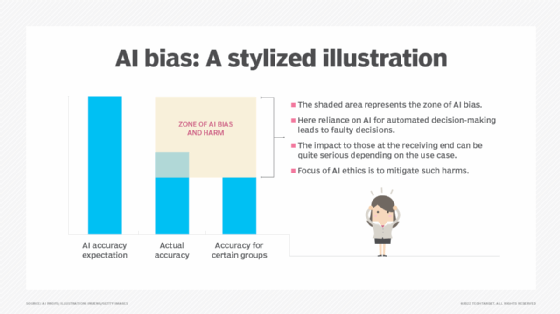
Bias occurs when an AI system produces a result, decision or action that doesn't represent real-world data or situations. AI bias -- sometimes referred to as machine learning bias in instances specifically related to ML models -- can have serious consequences, from inaccurate model output to ethical issues that put a business and its customers at risk.
For instance, a recent research study found that leading AI models trained to identify skin cancer lacked diversity in their training data sets. In particular, they had more data from patients with fair skin tones than from patients with black and brown skin tones. This leads to significant drops in model accuracy when tested on darker skin tones -- meaning more missed diagnoses for patients of color, a catastrophic AI bias.
So, why does AI bias happen? Among many reasons, two prevalent sources are algorithmic bias and data bias. Algorithmic bias occurs when a model's algorithms are inaccurate. For example, if a model collects and codes data inaccurately, it can learn patterns that don't accurately reflect the real world it's designed to operate in. This happened when Amazon's AI hiring tool learned to favor male-dominated keywords, resulting in lower scores for female applicants.
Closely related to algorithmic bias is data bias, which occurs when training or input data is skewed, unrepresentative or distorted. Data bias and the lack of comprehensive data can lead the AI model to make inaccurate or discriminatory decisions. This was the case with the AI models trained to detect skin cancer. It was also the case with Amazon's AI hiring tool, where the model was primarily trained on male resumes and lacked sufficient data to simulate the real world, making it predisposed to decisions favoring male applicants.
While discriminatory AI models like these raise clear ethical questions and often make headlines, many other models are biased in more subtle ways. They might not pose the bad publicity risk that biased cancer detection or hiring tools do, but they can cause harm just the same.
AI bias, whether it arises from data or algorithm issues, can occur in any use case and data set. Even systems that don't primarily deal with human-facing use cases can have misrepresentative data that increases a model's proclivity to produce inaccurate output. Given that, AI bias should be a concern for everyone developing and using AI models and algorithms.
"AI exacerbates data problems," said Mike Meyer, CIO at Clari/Salesloft, an AI-driven revenue orchestration company. "What we really see is an aperture that is not wide enough. You get a siloed view of the data because you're only looking at it through maybe one lens."
Therefore, most AI bias mitigation focuses on data bias, Meyer said. When teams don't have the complete picture of their data, it can be challenging to determine whether it's representative. If a model's data is limited, incomplete or conflicting, it risks producing inaccurate answers.
"If you have some kind of AI chatbot, for example, you end up getting very confident answers from the chatbot," he said. If the underlying data is either confusing or limited … then what you're going to get is a very confident wrong answer that potentially somebody's going to take action on."
AI bias happens when systems produce inaccurate output based on biased input.
Why AI bias is becoming a boardroom topic
2026 will be a year of AI governance efforts. Businesses are increasingly using AI, building out pilot projects and introducing costly, high-priority initiatives. Heightened risk profiles, growing regulations and a need to build brand trust are pushing companies to develop robust governance strategies. AI governance can include oversight mechanisms, ethical priorities, responsible AI guardrails, data management, transparency, explainability and more.
As part of these broader governance mandates, AI bias mitigation is part of the conversation, given that it's an inherent feature of AI. In a recent blog post, Jesse McCrosky, principal architect for generative AI at consulting firm Egen, explained this nuance and priority."There is no such thing as unbiased data, and no such thing as unbiased AI," he wrote in the post.
"AI is biased, because it learns from us and we are biased," he explained. "The solution isn't to eliminate bias -- that's impossible. The solution is to figure out who might be harmed, how badly, and what we can do about it."
There is no such thing as unbiased data, and no such thing as unbiased AI.
Jesse McCroskyPrincipal architect in generative AI, Egen
Identifying harm and developing AI bias mitigation strategies can be done through AI governance, McCrosky said. In fact, it's the optimal path to ensuring AI bias is handled correctly, and business leaders have a responsibility to include it in the conversation.
"We tend to think about [AI bias] in operational terms," said Chris Campbell, CIO at DeVry University. "In a university environment like ours, where we're really focused on workforce mobility and access, these small distortions that you can get from AI can be a real problem."
AI bias is more of a creeping concern rather than a big, splashy problem. "They're small things that compound over time," Campbell said. They occur for a variety of reasons, including historical data patterns, data ingestion issues and anomalous events.
These small issues tend to aggravate agentic learning and action, Campbell said. Therefore, he treats AI bias as part of their enterprise governance strategy.
Treating AI bias as part of governance efforts can help a business's bottom line. Mitigating AI bias not only enhances a business's ethical profile but can also lead to more accurate systems. Accurate systems mean businesses avoid the costs associated with model mistakes and failures.
"If you're not mitigating bias in the data that's feeding these AI applications, you are going to wind up with system implementations or initiatives that fail," Meyer said. "If your data is incomplete, conflicting or improperly structured, then what you would likely end up with is an AI solution that's just parroting data that's incomplete."
AI bias from a regulatory and compliance perspective
While the U.S. regulatory landscape is fragmented, state AI and data regulations often include provisions to mitigate AI bias. Other areas of the world have regulatory structures, such as the EU AI Act, that global enterprises must comply with.
"Regulation and compliance are inseparable from the AI bias conversation, especially in financial services," said Aaron Momin, CISO at consulting firm Synechron. For instance, existing U.S. fair lending laws don't distinguish between human and AI-driven decisions. That means AI is held to the same level of accountability.
Meyer said that because managing bias from a compliance perspective is a concern, his business's AI council involves legal and security teams to ensure alignment with prevailing regulations.
Mark Sherwood, CIO at Wolters Kluwer, a global information, software and services provider, shares this need for regulatory compliance. There are different risk profiles for different parts of the world, he explained. Therefore, legal and privacy teams must be part of every AI bias conversation.
The CIO's role in mitigating AI bias
Like any aspect of AI governance, mitigating AI bias isn't an easy fix, nor is it the job of one person or team. Instead, it requires planning, oversight and collaboration. CIOs are well-positioned to organize AI bias mitigation efforts.
"One advantage is that CIOs have interactions with every single organization across the company," said Mark Sherwood, CIO at Wolters Kluwer. By playing a role across teams and functions, they can check the pulse of different teams' needs and capabilities regarding AI bias mitigation strategies.
"A CIO's role is always about connecting the dots to how to best leverage technology, AI or otherwise, to the outcomes and the mission of the organization they're working in," Campbell said. "That is a CIO's superpower."
AI has to scale opportunity. If it scales inequity, that's not a technical issue, it's a leadership issue -- and CIOs have to sit in that leadership chair.
Chris CampbellCIO at DeVry University
When it comes to AI, accountability is also increasingly becoming a C-suite metric for success. CIOs and other executive business leaders have a responsibility to develop and deploy accountable and responsible AI. This means managing the harm of bias among other governance concerns.
"AI has to scale opportunity," Campbell explained. "If it scales inequity, that's not a technical issue, it's a leadership issue -- and CIOs have to sit in that leadership chair."
Taken from personal experiences in the C-suite, these three AI bias mitigation strategies can help foster an anti-bias culture as part of enterprise AI governance efforts.
1. Prioritize data management
Because data bias is a leading cause of model bias, prioritizing data management is a logical approach to mitigating bias. By ensuring data quality, businesses can feel more confident that training or input data is representative and the model's propensity to produce biased results is reduced.
"If your training data is flawed, your AI model will reflect and amplify those flaws," said Aaron Momin, CISO at consulting firm Synechron. "In financial services, historical data often carries embedded biases from decades of human decision-making."
Therefore, managing data is crucial. It starts with identifying the AI initiative use case and having a complete picture of what data it needs to be representative, diverse and undistorted.
"There are so many opportunities for bias to creep in," Sherwood said. That's what makes prioritizing data quality essential. Businesses must identify which data is used to train specific models and where it comes from, and assess their confidence in the quality of that data.
"Organizations need to understand where their data resides, who has access to it and how it was curated before it ever touches a model," Momin added. "That means conducting thorough data audits, ensuring diverse and representative data sets and building data lineage tracking into the AI development lifecycle."
2. Cultivate cross-team collaboration
As part of the effort to eliminate AI bias, CIOs should focus on something they do best: aligning teams to cultivate substantial cross-functional collaboration. Collaboration is key to effective bias management, as so many teams and stakeholders play a role in mitigation.
"When we looked at building out this governance team, we needed to have representation from all these different groups," Sherwood said. "We really need to have everybody in the organization there, because IT ends up touching every aspect of the company."
CIOs and other C-suite executives, such as CISOs, play an essential role in fostering that collaboration and leading by example. They're uniquely positioned to do this, given their reach into many sectors of the business.
"I work closely with data science teams, legal and compliance, risk management and business line leaders because each brings a perspective no single team can replicate," Momin said. "In practice, that means establishing shared accountability for AI outcomes, creating clear escalation paths when bias is detected and ensuring that human oversight is built into every AI deployment as a design principle."
The need for AI literacy and human oversight
When users are literate in AI, they understand its proclivity to hallucinate or produce biased output. That means they're more skeptical, which is a good thing.
"Understanding how [AI] works helps mitigate against automatic assumptions that it's right," Campbell said. This combats any prevailing assumptions that AI has authority -- an important aspect of mitigating AI bias when it inevitably arises. AI-literate people are better equipped to catch bias issues through human-in-the-loop strategies.
"Automated systems can flag statistical anomalies, but humans are still required to interpret business context and determine whether an output is biased or reflects a legitimate pattern," Momin said.
3. Govern from the start
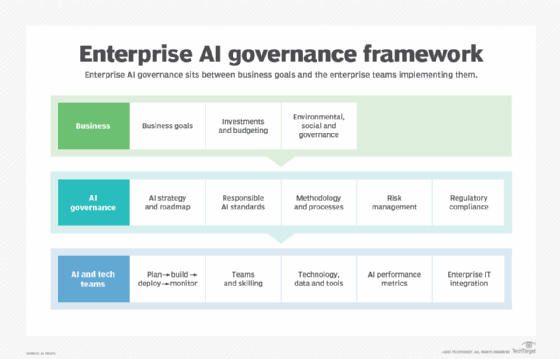
AI governance is a highly business-specific endeavor; each enterprise's AI governance framework is unique. However, implementing governance from the outset can help mitigate bias, among other important governance concerns.
"Governance has to start before the development starts," Sherwood said. This means assessing risks at the early design stage rather than relying on issue correction post-deployment. Governing at the start ensures that every AI initiative has a clear use case and the proper data management practices in place.
AI bias mitigation strategies are often embedded within the business's broader AI governance framework.
Meyer also emphasized that governance is needed from the start, adding that asking the right questions is essential. "It can't be the IT team in a vacuum," he said. Any AI initiative needs to solve a business issue or goal from the get-go.
"We always want to make sure that there's a problem that needs solving or there is a situation that needs enhancement versus looking at some tool that's looking for a problem to solve," Campbell added. "That's a big part of our governance."
When AI initiatives have clear use cases, it's also easier to assess their risk profiles. For example, informational tools are often a lower risk than those that help humans make decisions, Campbell said. Higher-risk cases, such as those involving decision-making agents, need AI bias mitigation efforts to ensure models are clear, predictive and assistive.
"The challenge I see with a lot of organizations is that they rush to deploy AI without putting guardrails in place," Momin said. "A strong AI governance program that treats bias as a core risk category needs to be integrated into enterprise risk management and model risk management from day one, not bolted on after deployment."
Olivia Wisbey is a site editor for Informa TechTarget's AI & Emerging Tech group. She has experience covering AI, machine learning and software quality topics.