AI-specific KPIs can indicate model performance, customer satisfaction and overall business value. Explore these 25 AI KPIs to elevate the management of any AI initiative.
Key performance indicators are objective measurements that track actual business performance against intended business objectives. Unlike metrics that answer what the business is doing, KPIs measure how the business is doing. Leaders across all types of businesses use KPIs to guide and support strategic outcomes.
AI has created not only new business opportunities but also new management challenges. As AI takes its place as an engine of modern business, KPIs must also evolve to provide strategic oversight on AI performance and its effect on the enterprise. Therefore, executive decision-makers must carefully examine and reevaluate their choice of KPIs for AI.
Why businesses need AI-focused KPIs
Why add AI KPIs when a typical business already relies on so many KPIs? While KPIs such as customer retention and conversion rate are well-proven for many businesses, they fail to capture AI's unique value and its effect on business outcomes and risks.
For example, existing KPIs often fail to capture the savings, revenue and goal alignment that AI supports, mistaking operational efficiencies for strategic alignment. Current KPIs can also miss the complexities of AI platforms, such as compute costs and data drift. AI KPIs increasingly relate to business outcomes and ROI, strategic alignment, ethics and risks, efficiency, costs, UX and adoption.
How to select the right AI KPIs
There are many AI KPIs to choose from -- the trick is selecting the right KPIs to meet business needs. A balanced KPI dashboard covers technical, financial, operational and business measures to form a comprehensive assessment.
A basic methodology for selecting KPIs for AI includes the following practices:
Align goals. Understand what the AI tool or system is doing for the business. This might involve providing faster customer service or generating greater revenue. Technical KPIs that strictly evaluate model performance have their place, but the business also needs metrics that directly align with business goals and outcomes.
Use SMART measures. Consider the most objective KPIs that meet SMART criteria -- specific, measurable, achievable, relevant and time-bound. Overlook the overly broad KPIs that rely on assumptions or are not directly applicable to AI and the business.
Use limited KPIs. More isn't always better. AI systems can involve many KPIs, but it's rarely necessary to implement and monitor every possible KPI to oversee an AI system. Business leaders can focus on up to seven or eight AI KPIs to support business decisions.
Involve AI performance. AI performance is everything. Prioritize KPIs that track AI performance and ensure outcomes do not degrade over time. That way, the AI development team can address and remediate any early warnings of performance issues.
Review KPIs periodically. Regularly review AI KPIs to ensure they remain relevant to evolving business needs. Sometimes, KPI formulas might need to be updated. In other cases, a KPI might need to be replaced with a more meaningful metric.
A balanced KPI dashboard covers technical, financial, operational and business measures to form a comprehensive assessment.
Stephen J. BigelowSenior Technology Editor, Informa TechTarget
25 AI KPIs to consider
Divided into five categories, the following sections focus on KPIs for specific areas of enterprise AI: models, systems, operations, utilization and business value. Leaders can explore the following menu of AI KPIs to identify which metrics are best for their business needs.
1. AI model KPIs
Models sit at the heart of every AI system, representing algorithms that learn, process, collaborate and reason. If the model fails, the AI fails -- and the business is jeopardized. Applying KPIs to AI models is necessary to ensure the quality and reliability of AI output. Although AI model KPIs are often seen as more infrastructure-related than strategic, they provide a firm foundation for other AI KPIs.
AI model KPIs include the following:
Accuracy. How many predictions or conclusions does the model get right? Accuracy is the overall correctness of a model, often measured as the percentage or ratio of the total correct predictions / total predictions.
Precision. Precision measures the correctness of positive predictions by generating a percentage of the total true positives / total predicted positives. In effect, precision focuses on reducing false positives and is valuable when false positives pose a risk.
Recall. AI classification models use recall to measure the model's ability to find all corresponding positive instances within a data set. It is the percentage of actual positives correctly identified, calculated as [true positives / (true positives + false negatives)]. High recall can be a critical factor when missing a positive case has severe consequences.
F1 score. F1 score is an AI KPI that measures a classification model's accuracy by calculating the mean of precision and recall. The KPI is typically approached using a relationship such as 2 * [(precision * recall) / (precision + recall)]. A higher percentage represents greater model accuracy. F1 score is useful for imbalanced data sets where one type of data dominates.
AI model latency. This KPI measures the time an AI model takes to process a request and generate a response. Latency is typically experienced as a delay, and low latency is critical for a good UX.
Accuracy versus precision
The relationship between accuracy and precision cannot be overstated. While accuracy measures overall correctness, precision reports the quality of the positive results. For example, a medical diagnostics AI model might screen for cancer. High accuracy means most patients were correctly identified as either healthy or sick, whereas high precision means that when the model identifies cancer, there is a high probability that the patient actually has cancer.
2. AI system KPIs
AI system KPIs focus on the operational aspects of the overall AI system, ensuring the cohesive platform runs reliably, efficiently and at scale to support the business's needs. AI system KPIs provide details on the deployment, reliability and utilization of the AI platform and its infrastructure.
AI system KPIs include the following:
Number of AI models deployed. This KPI measures the number of models currently in use. More models can strain performance and governance, so monitoring the number of AI models deployed across the AI platform can offer insight into the platform's capacity and organizational effect.
Percentage of pipelines automated. This KPI measures the percentage of automated workflows. It's the ratio of total automated AI pipelines / total manual and automated AI pipelines. Higher ratios mean more AI pipelines are automated. This measurement helps leaders understand the manual effort required for AI development and deployment and where additional AI automation investments might be needed.
AI system uptime. This KPI shows the percentage of time that an AI system is available and operational. Higher uptime percentages indicate greater AI system reliability and availability. Typical AI systems can often approach 99.99% uptime.
Request error rate. This KPI measures the percentage of requests that result in errors and is calculated using total request errors / total requests. Error measurements identify wasted compute resources and costs, and provide a deeper understanding of AI system challenges such as user errors, resource quotas and data issues.
Hardware utilization. This KPI can gauge the percentage of time that compute hardware --especially accelerators such as GPUs, TPUs and NPUs -- is actively processing data. If this measure is too high, there are likely bottlenecks or errors. If this measure is too low, powerful hardware is likely underutilized, resulting in unnecessary costs.
3. AI operations KPIs
Every business relies on a wide range of processes and workflows to achieve its intended outcomes. KPIs for AI operations provide metrics for key processes and help business leaders understand the benefits and drawbacks of an AI system.
For example, an AI personal shopper tool might enhance visitor engagement and result in more items in a buyer's cart, but the time that a cart stays open -- an unfinished sale -- might increase. Consequently, AI operations KPIs are highly dependent on the specific industry, context and intended outcomes.
AI operations KPIs include the following:
Contact containment rate. Containment is an AI system's ability to handle incoming customer contacts without human intervention. Containment rate is the percentage of contacts completed successfully without human agents, measured using completed AI contacts / total contacts. This KPI measures the AI system's effectiveness and provides early warning when additional training or updates are required.
AI handle time. This KPI is the average time AI systems spend addressing customer contacts or performing other business processes, providing a tangible measure of productivity, efficiency and improvement. Smaller AI handle times can suggest improvements in knowledge or performance, while longer AI handle times might trigger retraining or other AI system updates.
Click-through rate. CTR tracks the number of visitors who select a product, service or other content displayed by the AI system. A higher CTR means visitors find the AI system's results meaningful, and this typically corresponds to higher revenue. A lower CTR indicates the AI system's results are less meaningful, suggesting the need for additional refinement.
Time-on-site. TOS measures the time a customer spends on an application or website. It's perhaps the most direct measure of customer engagement and satisfaction. For example, greater TOS while using media -- such as PDFs, images and videos -- might reveal successful AI engagement. However, greater TOS might also suggest declining relevance of results: Customers are trying harder to find what they need, which can suggest an AI problem. KPI context is critical here.
Revenue per visit. RPV measures the revenue generated per unique visitor. Greater RPV suggests the AI system is more effective at engaging the visitor, delivering meaningful results and monetizing the visit. Lower RPV might indicate declining AI relevance and engagement. RPV is typically evaluated alongside other KPIs, such as CTR and TOS.
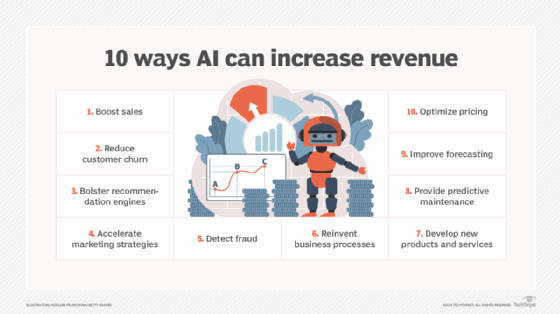
AI has the power to help increase revenue. Can your business properly measure it?
4. AI utilization KPIs
AI systems are practically worthless if users ignore them -- either because they are not fully aware of an AI system's capabilities or because the AI system does not perform as expected. A variety of utilization KPIs can help business leaders understand AI adoption in daily workflows across an enterprise.
AI utilization KPIs include the following:
AI adoption rate. This KPI represents the percentage of active users for an AI service or tool. It is measured as the number of active AI users / total number of possible AI users. Low adoption rates require detailed investigation to determine the underlying reasons.
AI usage rate. This KPI measures how often users employ the AI system per day, week or month. Higher usage rates might indicate that users use the AI system more often, whereas low usage rates might indicate user resistance or a poor perception of the AI's usefulness. User feedback is essential for understanding poor usage rates. In some cases, raising awareness of the AI tool and providing more employee training can help boost adoption and usage rates.
Session length or activity. This KPI represents the average time a user spends interacting with the AI system or tool. Similarly, this KPI can be adapted to gauge user activity per session, such as the number of queries. Both variations highlight the amount of user engagement. Short durations or light activity per session might indicate low AI system value and are often reinforced by other KPIs, such as low adoption and usage rates. Conversely, upward trends in session length and activity can suggest improving user engagement.
Query size. This KPI measures the average number of words per user query needed for a user to elicit a meaningful AI response. Small queries can suggest effective AI performance but are usually reinforced with longer session lengths and higher usage rates. Longer queries might indicate less effective AI performance, but they might also suggest that users are increasingly sophisticated in their queries. Context is everything here, and this KPI is often used together with session length and other user satisfaction factors.
UX feedback. AI systems can learn and refine behavior, typically depending on user feedback. AI systems can include various feedback mechanisms, such as star ratings, to indicate users' opinions of AI output. Feedback is also usually shared with AI developers and business leaders and can drive further AI development and refinement.
5. AI business value KPIs
Business leaders are increasingly under pressure to demonstrate the value of AI systems to investors and stakeholders. AI business KPIs can help paint a clearer picture of an AI system's value.
AI business value KPIs include the following:
AI system productivity. This generic KPI measures any meaningful productivity improvement involving AI systems, such as time saved with an AI tool or time required to handle calls with AI. Generic measures can provide a ratio of productivity with AI / productivity without AI.
AI cost savings. This generic KPI that can be applied to any business process or service involving AI systems. It can represent almost anything, such as the cost per customer support call or the cost per transaction. AI cost-savings metrics can involve more complex calculations than other KPIs. For example, a cost-savings KPI can be calculated for employee hiring and onboarding with AI, involving time and multiple business processes.
AI innovation. KPIs can help measure the role of AI in designing, developing and marketing new products or services. As with cost savings, an innovation KPI can be highly intricate and involve many factors specific to the business. For example, an AI system involved in document processing might drive the development of a powerful new knowledge base, leading to new business opportunities, cost savings and improved asset quality.
AI customer experience (CX). This KPI is a broad, overall measure of customer satisfaction and brand loyalty. Measuring AI CX can involve many factors and vary depending on the business's specific goals. It is often distilled using other measurements available, such as customer adoption and utilization KPIs.
AI ROI. Perhaps the most complex and vital AI KPI is ROI: [(investment gain - investment cost) / investment cost] * 100, which yields an ROI percentage. Investment gains can result from greater productivity, higher revenue and other factors. Investment costs can include operating the AI, providing data and building machine learning models. Consequently, ROI KPIs are typically the result of a cross-disciplinary team involving business, technical and finance leaders. Further, the ability to track each element of the ROI calculation over time can help the business refine ongoing efforts to maintain an optimal ROI.
Stephen J. Bigelow, senior technology editor at TechTarget, has more than 30 years of technical writing experience in the PC and technology industry.