How AI is reshaping the software build vs. buy decision
AI is making custom development more accessible, but it also shifts governance, integration responsibility and long-term cost back onto the enterprise.
Due to the growing popularity of AI-enabled development, the market for AI coding tools is getting increasingly crowded. Organizations can choose from context-aware integrated development environments (IDEs) and editors like Replit and Google Antigravity, autonomous coding agents such as Claude Code, coding assistants like GitHub Copilot and Sourcegraph Cody, and generative AI (GenAI) platforms such as ChatGPT. Together, these tools are making custom development faster, easier and more accessible.
These benefits notwithstanding, this modern development approach also presents several limitations and challenges.
This article explores how AI lowers development barriers for three categories of enterprise software. It also unpacks the limitations of AI-assisted development and provides guidance to help organizations navigate the tradeoffs between building custom software and buying ready-made suites.
UCC: Build or buy?
A unified communications and collaboration (UCC) platform integrates multiple communication capabilities into a single, centralized, cohesive ecosystem. This eases business collaboration and enables seamless communication mobility for remote or hybrid teams.
Where custom AI shines
AI tools accelerate UCC software development by automating coding, testing, debugging and even providing documentation so that companies can launch messaging, video calling, virtual whiteboards and other features much faster compared with traditional development approaches. With AI assistance, developers can easily create custom collaboration workflows, integrations, automations and features tailored to the needs of specific organizations. They can also use GenAI tools and AI agents to build custom chatbots, test and debug the platform and even prepare user documentation.
Where suites win
While AI is changing how organizations build, customize and optimize UCC platforms, readily available UCC platforms like Microsoft Teams and Zoom also offer several advantages, including prebuilt integrations to accelerate organization-wide UCC deployment and ease platform scalability.
Another advantage of buying a UCC suite is that UCC vendors manage all code updates. This lowers the customer firm's maintenance costs and reduces its operational complexity. Vendor-led maintenance can also help keep integrations and connections functional, relevant and reliable as connected systems evolve, though customers still need to govern configurations, APIs and custom workflows.
Popular UCC products include Microsoft Teams, Cisco Webex, Zoom Workplace and Slack.
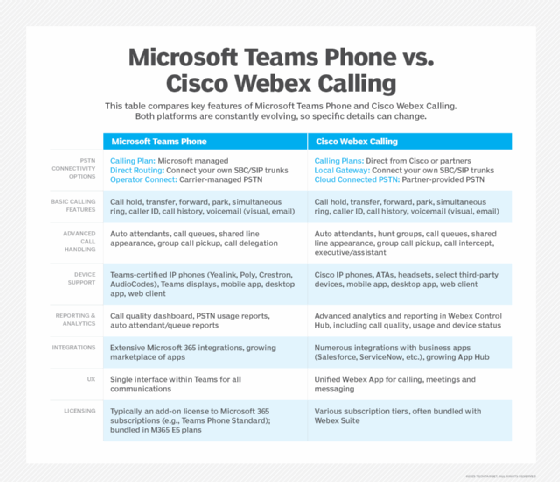
Microsoft Teams and Cisco Webex are two popular collaboration platforms with integrated support, analytics and auto attendant features.
What to consider
AI tools can generate code for UCC platforms much faster than human developers. However, AI-generated code might contain inefficient logic that introduces latency and degrades user experience. AI tools can also create "buggy" or insecure code. A 2026 IOActive report found that 31.6% of the AI-generated code samples it tested were fully vulnerable, with exploitable security flaws. The finding underscores the need for human review, secure development practices and security testing before AI-generated code reaches production.
AI-generated code can also be difficult to maintain over time if development teams lack visibility into how the code was produced. Dependence on proprietary AI development environments and intellectual property theft are some of the other risks of AI-assisted UCC development.
Of course, purchasing a commercial UCC product also involves certain tradeoffs between benefits and drawbacks.
For one, its features might not fully align with an organization's unique workflows or operational requirements. They could also face integration challenges when connecting custom workflows to other enterprise systems, such as CRM or ERP. Also, as business needs evolve, maintaining and updating custom features can increase long-term costs.
Vendor lock-in is another significant drawback. Depending on a single UCC vendor limits an organization's flexibility. Migrating to a different vendor or product can also be costly. Off-the-shelf UCC suites also require ongoing governance to ensure compliance with data privacy and security standards.
ERP and SCM: Build or buy?
ERP and supply chain management (SCM) platforms are critical for enabling organizations to unify core processes, streamline operations, reduce costs and respond more effectively to business disruptions.
Where custom AI shines
AI enables companies to build custom modules and interfaces for ERP and SCM systems, particularly when standard systems do not address their specific business needs. AI simplifies the creation of automations and workflows within ERP and SCM, reducing manual development effort and operational costs. AI tools can also ease the integration of advanced demand forecasting tools and capabilities such as intelligent inventory optimization, anomaly detection and automated reporting.
Lenovo offers one example of how AI can support supply chain planning and disruption response. A May 2026 NC State University Supply Chain Resource Cooperative case study described Lenovo's in-house AI-powered supply chain platform, iChain, which uses corporate data and external signals to support risk sensing, planning and decision intelligence. In it, Jack Fiedler, Lenovo's senior vice president of global supply chain, described how the hardware supplier used AI to monitor geopolitical events and anticipate potential logistics disruptions, such as airspace closures, so that teams could develop mitigation plans earlier.
Where suites win
While AI is transforming ERP and SCM development, it also has several limitations.
Building enterprise platforms internally -- even with user-friendly AI tools -- requires substantial, expensive human expertise across a wide variety of areas, including infrastructure, cybersecurity, governance and code maintenance. Another problem is that generic AI models lack visibility into firms' unique configurations, module interactions and master data hierarchies unless they are securely grounded in internal code, documentation and system context. This visibility gap could limit the system's reliability. It could also lead to data corruption and hinder cross-system decision-making.
AI-generated ERP/SCM architectures might contain security vulnerabilities, logic inconsistencies or governance gaps. Without rigorous human oversight and secure development controls, AI-generated code can introduce authorization gaps, injection risks, hardcoded credentials or other vulnerabilities into production environments. Finally, AI tools could generate obsolete or incorrect code, making it harder to maintain a reliable system in the long term.
Without rigorous human oversight and secure development controls, AI-generated code can introduce authorization gaps, injection risks, hardcoded credentials or other vulnerabilities into production environments.
Organizations can avoid these problems by investing in commercial ERP/SCM suites.
Mature, enterprise-grade ERP and SCM suites from reliable vendors are designed with industry-specific best practices baked in. These products reduce implementation timelines and risk. They also integrate numerous core processes and features into a centralized platform to reduce data silos and improve workflow coordination. Additionally, most vendors offer ongoing support in the form of system monitoring, continuous quality checks and security patches, so organizations don't need to maintain large, expensive in-house maintenance tools and teams.
Popular ERP platforms include SAP Cloud ERP, Oracle Fusion Cloud ERP and Microsoft Dynamics 365 Finance, while SAP Integrated Business Planning, Oracle Fusion Cloud SCM, Microsoft Dynamics 365 Supply Chain Management and Blue Yonder are major SCM or supply chain planning options.
What to consider
Off-the-shelf products might not fully align with an organization's unique operational workflows or integrate well with its legacy systems, so organizations might need to build, update and manage custom-built components. These activities require specialized, hard-to-find talent that can increase operational costs.
Another challenge: If the workflows and modules are not properly maintained or integrated with core systems, the organization's technical debt could increase. Poor integration -- especially in combination with weak governance -- can also create security or compliance issues, increasing the risk of data loss and compliance violations.
CX: Build or buy?
Customer experience (CX) platforms collect and analyze customer feedback, behavioral signals, service interactions and journey data to help organizations reduce friction in customer journeys and deliver more personalized, consistent experiences.
Where custom AI shines
GenAI- and agentic-AI powered development tools are increasingly transforming how organizations build CX platforms. AI tools reduce the time and effort required to launch, enhance or modernize them. Organizations can also incorporate advanced capabilities into the platforms, such as intelligent routing, real-time customer insights, personalized recommendation engines or sentiment analysis dashboards. Additionally, developers can use AI to improve customer engagement across digital channels by setting up automated chatbots.
Vodafone offers one example of AI-enabled customer care development. Using Microsoft's GenAI tools, the company developed SuperTOBi and SuperAgent to improve customer self-service and help customer care agents respond to complex queries more efficiently.
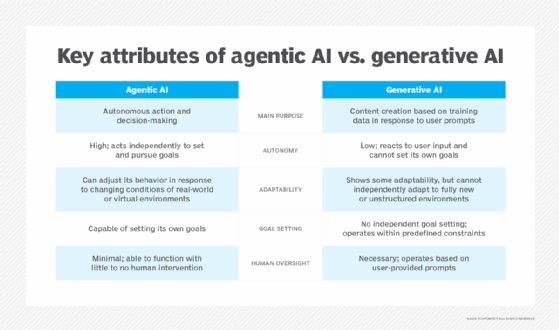
Advances in both agentic AI and GenAI are transforming the development of CX platforms.
Where suites win
While AI can be a game-changer for CX platform development, relying heavily on AI tools can create several problems for organizations, including security and compliance risks. CX AI systems often need access to large volumes of customer interaction data for grounding, personalization, evaluation or fine-tuning, which raises privacy, security and governance requirements. Without strong security guardrails, human oversight and governance, this data is vulnerable to manipulation and theft, opening up serious compliance and legal liabilities for organizations.
AI-generated code might also contain hidden security vulnerabilities or flawed logic that could affect the platform's reliability. Additionally, AI-generated code might not properly connect with other enterprise systems, such as CRM or marketing automation. Integration gaps can lead to incomplete or outdated customer records or broken workflows, resulting in fragmented or inconsistent CX and potentially damaging customer trust and brand reputation. Lastly, AI-generated CX architectures could be difficult and expensive to troubleshoot and maintain, particularly in complex enterprise environments with dense integrations and evolving requirements.
CX suites can help organizations avoid the challenges of AI-assisted development. Commercial products provide prebuilt integrations, eliminating the need for costly custom development and enabling seamless syncing of data across all departments, business systems (e.g., CRM, ticketing systems) and communication channels.
Many platforms also provide numerous mature capabilities out of the box, such as customer journey orchestration, sentiment analysis, predictive recommendations, analytics, personalization, workflow automation and chatbots. These capabilities enable organizations to better understand customers and meet their CX expectations -- without significantly increasing implementation timelines, cost or risk. Additionally, CX platforms from established vendors typically include security, privacy and compliance controls that can help organizations meet regulatory obligations. However, customers still need to configure, govern and document how customer data is processed.
Popular CX platforms include Zendesk, Qualtrics CustomerXM, Salesforce Service Cloud and Adobe Experience Cloud.
What to consider
Significant human effort and expertise might be needed to integrate custom CX offerings with some business systems. Also, customization can be limited by vendor architecture, licensing models and integration constraints, preventing organizations from tailoring the system to their unique workflows or customer segments. Thirdly, organizations might incur additional costs to scale custom features to handle increased customer data and traffic, add third-party digital channels, and maintain and update the platform.
Lastly, they might have limited control over how the platform processes sensitive customer data. In-house governance weaknesses could make it difficult to manage data privacy and ensure compliance with stringent regulations such as GDPR.
Which approach is better?
To choose the right paradigm, leaders need to carefully weigh the benefits of each against its tradeoffs in governance, integration, staffing, technical debt and ongoing costs. It's equally important to ensure that build vs. buy decisions align with broader business objectives and operational realities.
Organizations pursuing AI-driven innovation can realize significant benefits. However, AI also shifts governance, integration responsibility and long-term cost management back onto the enterprise. The key to low-risk AI-enabled development is to adopt a strategic approach that balances opportunity with risk. By doing so, organizations can create successful, AI-forward operating models.
Rahul Awati is a PMP-certified project manager with IT infrastructure experience spanning storage, compute and enterprise networking.