As AI tools summarize, score, route, recommend and move work forward, enterprises need records that show what the AI shaped, what humans reviewed and who owned the final decision.
AI tools do not have to make the final decision to shape the decision.
That is becoming one of the more important accountability problems inside enterprise software. AI can summarize interviews, score assessments, route work, recommend next steps, flag exceptions, draft responses and move tasks through workflows. In many cases, a person still makes the final call. But that person may be making the call based on information AI selected, summarized, ranked or presented.
That creates a different kind of recordkeeping problem.
Traditional audit trails can show that something happened: a user logged in, a system generated a recommendation, a workflow advanced or an approval was recorded. But AI-supported decisions often require more than that. Enterprises need to know what evidence was available, what the AI did with it, what the human reviewer saw, what the person accepted or questioned and who owned the final decision.
That is the difference between an audit trail and a decision trail.
Hiring shows why the record matters
Hiring is one of the clearest places to see the issue because the stakes are obvious.
AI tools can now support recruiting in ways that go well beyond scheduling interviews or organizing applicant information. They can conduct interviews, analyze candidate answers, generate transcripts, summarize responses, score assessments and package information for recruiters or hiring managers to review.
AI does not have to make the final decision to become part of the decision path.
That can help with high-volume hiring. Recruiters trying to fill warehouse, retail, restaurant, contact center or logistics roles often need to move quickly. Candidates may move on if the process drags. A tool that screens, summarizes or organizes information faster can have real operational value.
The usefulness is real, especially in high-volume recruiting. But it also moves the accountability problem closer to the interview itself.
If software conducts the interview, summarizes the transcript or scores an assessment, the employer must be able to trace the path. What did the tool ask? What did the candidate actually say? What did the software highlight as important and what disappeared into the summary? What did the recruiter check before moving the candidate forward? What did the hiring manager rely on when making the call?
A decision trail should answer those questions before someone has to reconstruct them later.
Those questions are not only legal or compliance questions. They are hiring quality questions. If an employer cannot reconstruct the decision path, it also cannot easily tell whether the process was fair, useful or working as intended.
A dashboard is not enough if no one can explain how the dashboard shaped the decision.
An audit trail is not the same as a decision trail
Enterprise systems already generate logs. They record activity, permissions, approvals, timestamps and system events. That still matters. But AI creates a layer of influence that ordinary logs do not always capture well.
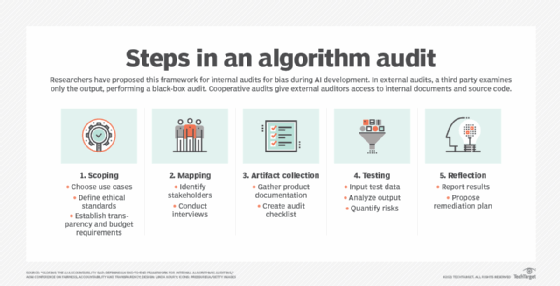
That is also why algorithm audits are becoming more relevant to enterprise AI. An algorithm audit can help examine how a model, rule set or AI-supported process behaves. A decision trail extends that logic into daily operations by preserving the evidence, AI output, human review and ownership behind a specific business decision.
Algorithm audits can help organizations examine how AI systems behave, but AI-supported decisions also need trails that show what evidence was used, what the AI produced, what humans reviewed and who owned the final decision.
An audit trail can show:
What happened.
When it happened.
Which user or system performed the action.
Whether the action was approved.
Whether the action was completed.
A decision trail must show:
What evidence was available.
Which data sources the AI used.
What the AI summarized, scored, classified, ranked or recommended.
What uncertainty or exception the system surfaced.
What the human reviewer actually saw.
What that person accepted, rejected, edited or escalated.
Which rule, policy or business context applied.
Who owned the final decision.
That distinction matters because AI often affects the middle of the decision rather than its end.
In many cases, the last step will still belong to a person. The recruiter moves the candidate forward. The manager signs off. Finance approves the payment. The service leader decides how to handle the exception.
But that person may no longer be seeing the full picture. They might be seeing the version the software presented to them: the summary, the score, the recommendation or the shorter list of options.
The final action might still be human, but it may no longer start from the raw record.
Agents make the path harder to see
The same problem becomes broader as AI agents move into enterprise workflows.
An AI agent might make work feel simpler for the employee. It might reduce clicks, move information between systems, summarize a record, trigger a next step or draft a response. From the user's point of view, the work might look cleaner.
Underneath, it may be more complicated.
An agent-supported workflow can touch multiple systems, use several data sources, create additional checkpoints, wait for approvals, route exceptions and split what used to be a visible human process into many smaller automated steps. That can still be efficient. Agents can handle granular work faster and more consistently than people can in some settings.
But the business still needs to know what happened.
Which systems did the agent touch? Which data did it use? Which step did it execute? Which rule did it follow? Where did it wait for approval? What happened when the process hit an exception? What did a person review before the work moved forward?
Those are decision-trail questions.
They matter because agentic process automation can make work look simpler to the user while the organization still has to understand the data sources, task execution, monitoring and feedback underneath.
Dashboards and logs are only part of the answer
Vendor tools can help.
Dashboards, testing environments, observability features, approval checkpoints, governance controls and authentication requirements can all make AI-supported work easier to monitor and restrict. They can help organizations see what agents are doing and place boundaries around higher-risk actions.
But those tools do not solve the whole problem.
A dashboard can show that an agent completed a step. It cannot prove that the agent should have completed that step. A checkpoint can pause a workflow for review, but the reviewer still needs to know what they are approving. A log can show that a recommendation was generated, but not necessarily whether the right evidence or policy shaped it.
That is where AI oversight can become thinner than it looks.
If the process is vague, the record will be vague. If ownership is unclear, the approval may not mean much. If the reviewer does not understand the evidence behind the recommendation, human oversight can become a rubber stamp.
A decision trail is not just a longer log file. It is a way to preserve enough of the decision path so that people can understand, challenge and improve the process later.
This is also where agentic AI governance becomes more than a policy topic. The practical question is whether the organization can see what the agent did, what data it touched, what controls applied and what record is left behind.
Elements of an effective AI decision trail
The original source data or evidence that informed the decision.
The prompts, instructions or workflow triggers used.
AI-generated summaries, scores, recommendations or classifications.
Indicators reflecting confidence, uncertainty or exceptions.
Any human modifications, comments or overrides.
Documentation of approval and escalation actions.
Applicable policies, business rules or compliance requirements.
The final decision and decision owner.
Records preserved for audit, review or regulatory requirements.
Context makes the trail useful
A useful decision trail needs more than data access.
AI systems can retrieve data, summarize information and generate recommendations. But raw access to information is not the same as business context. An agent may need to know which system is the source of truth, which definition applies, how fresh the data is, which region or policy governs the action and whether the user is allowed to see or act on the information.
That is where the trail must carry business context, not just the AI output.
Take a customer record. In one system, the account looks active. In another, there may be a compliance hold, a regional restriction or a contract term that changes what the company is allowed to do. The same kind of thing happens with suppliers, candidates and payments. The data might be available, but its meaning depends on where the work is being done and which rule is supposed to apply.
That is ordinary enterprise software messiness. AI does not remove it. It can just move through it faster.
Rules, context, permissions, systems of record and clear escalation paths make the decision trail useful instead of just more documentation.
A decision trail must show enough of that context to explain why the AI output made sense -- or why it did not. That is where context engineering fits the decision-trail problem. AI needs data, but it also needs source-of-truth logic, policy context, permissions and escalation paths that make the output usable.
A decision trail should make enough of that context visible.
The goal is not to document every internal calculation or turn every AI output into a courtroom exhibit. The goal is to preserve the practical evidence someone would need to understand how the decision formed. That includes the data used, the AI output, the human review, the policy context and the final owner.
Visibility becomes part of accountability
The decision trail also depends on visibility.
AI is increasingly embedded inside approved applications, browsers and everyday workflows. That means organizations may not always be dealing with an obvious separate AI tool. They might be dealing with AI behavior inside software that is already sanctioned, already deployed and already part of the way people work.
That changes the oversight problem. Enterprises need to know where AI is active, what work it is shaping, what data it can reach and whether the organization has enough control once those features are in use.
That is also why CIOs need better control of AI agents before they become part of everyday work. They need to know where agents are active, what systems they can reach, who owns them and what record exists when they act.
Accountability requires more than just observability. Visibility alone does not ensure accountability. However, without clear visibility, the decision trail starts with missing information.
The final decision still needs an owner
AI decision trails are not only about protecting the organization if something goes wrong. They are also about operating quality.
If no one can reconstruct how a decision formed, the enterprise cannot easily tell whether the AI helped. It cannot see whether the tool surfaced the right evidence, whether people understood what they were reviewing, whether exceptions were handled correctly or whether the process should change.
That is why the final decision still needs an owner.
AI can summarize, score, route, recommend and move work forward. But someone still must be responsible for the result. That responsibility cannot rest solely on the model, the dashboard or the vendor's feature set. It must be visible in the operating process.
The more AI enters enterprise workflows, the more important that visibility becomes. AI does not need to be the final decision-maker to create accountability questions. If it shapes what people see, what they consider and what they approve, it has already become part of the decision path.
Enterprises should design that record before the decision is challenged, not after.
James Alan Miller is a veteran technology editor and writer who leads Informa TechTarget's Enterprise Software group. He oversees coverage of ERP & Supply Chain, HR Software, Customer Experience, Communications & Collaboration and End-User Computing topics.