Enterprise AI is moving beyond experimentation as organizations deploy AI agents for practical tasks and begin confronting governance and orchestration challenges.
Enterprise conversations about artificial intelligence have changed noticeably over the past year. For much of the last two years, discussions focused largely on what AI might eventually be able to do. Organizations experimented with pilots, tested different models and explored how generative tools might fit into existing workflows.
Increasingly, however, enterprise leaders are asking a different question: What outcomes can AI actually deliver? That shift reflects a broader transition from experimentation toward operational deployment.
AI value is emerging in narrow operational tasks
One place this change is becoming visible is in the deployment of AI agents designed to automate specific tasks inside enterprise workflows.
In healthcare environments, for example, Salesforce has positioned its Agentforce platform around agents that handle work like data entry, information lookup and summarization. These are not broad general-intelligence systems attempting to replace workers. Instead, they are narrowly focused tools designed to reduce time spent on repetitive administrative tasks.
That pattern is appearing across industries. Organizations are finding that the most practical value from AI often comes from delegating well-defined tasks that previously required manual effort. This trend is visible in the growing use of AI agents inside enterprise workflows.
Organizations are no longer simply asking what AI can do. They are beginning to determine how it should operate.
Enterprise AI is moving beyond experimentation
The shift toward measurable outcomes is also visible in broader enterprise conversations around AI adoption.
Industry analysts and IT leaders increasingly describe the current phase of AI as the transition from experimentation toward real operational use. Organizations are beginning to ask how AI capabilities can improve productivity, reduce operational costs and generate measurable returns.
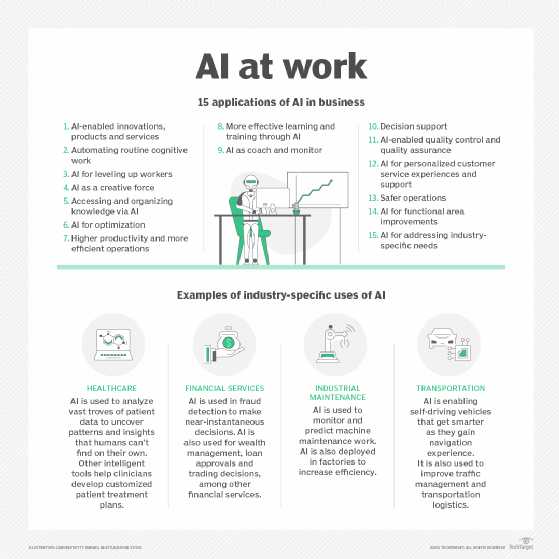
As enterprise AI adoption moves beyond experimentation, organizations are applying AI to operational tasks such as automation, decision support and workflow optimization.
As AI begins to move into real workflows, however, a new set of challenges emerges. Organizations must decide how much autonomy to grant AI agents, what permissions those systems should operate under and how they should interact with existing enterprise infrastructure.
These questions are becoming more pressing as employees begin experimenting with personal AI tools designed to assist with everyday work tasks -- a trend that reflects broader governance pressures shaping enterprise AI. Some analysts have described these systems as "AI second brains" -- tools that can organize knowledge, analyze information and help workers make decisions more efficiently.
The challenge for enterprise IT teams is balancing flexibility with control. Restrict AI usage too heavily, and employees might resort to unsanctioned tools, creating shadow AI environments that bypass governance controls. Allow too much autonomy, on the other hand, and organizations risk creating fragmented systems where multiple agents operate without clear coordination.
In many environments, the first deployments focus on work that consumes time but requires relatively little judgment, such as documenting interactions, retrieving information, summarizing conversations or routing tasks to the next step in a workflow.
These types of tasks appear across multiple enterprise systems, including customer experience platforms, collaboration tools and healthcare systems.
Because the work is repetitive and well-defined, organizations can introduce AI into existing workflows while limiting operational risk. Over time, these smaller deployments could become the foundation for broader automation.
Enterprise AI becomes an architecture problem
The next phase of enterprise AI adoption will likely depend less on advances in model capability and more on how organizations integrate the technology into existing infrastructure. That includes defining governance policies, managing permissions and designing architectures that enable AI systems to operate safely within enterprise environments. In that sense, the challenge of enterprise AI is gradually shifting away from experimentation and toward architecture.
Organizations are no longer simply asking what AI can do. They are beginning to determine how it should operate.
James Alan Miller is a veteran technology editor and writer who leads Informa TechTarget's Enterprise Software group. He oversees coverage of ERP & Supply Chain, HR Software, Customer Experience, Communications & Collaboration and End-User Computing topics.