
matrosovv - stock.adobe.com
Enterprise AR and VR: Building the UC business case
Enterprise VR and AR enable immersive collaboration, virtual training and improved CX, but also require careful consideration of business goals, costs and industry needs.

The first widely adopted use of augmented reality in unified communications was the use of virtual backgrounds during video conferences during the COVID-19 pandemic. People were not comfortable sharing the look of their personal spaces in work-related meetings.
Nearly a decade ago, enterprise augmented and virtual reality were anticipated to be the next big thing in unified communications (UC). However, practical results did not match expectations. Generative AI and agentic AI scaled faster. In comparison, VR and AR in UC were limited to a few meeting features.
UC uses cases for enterprise AR and VR
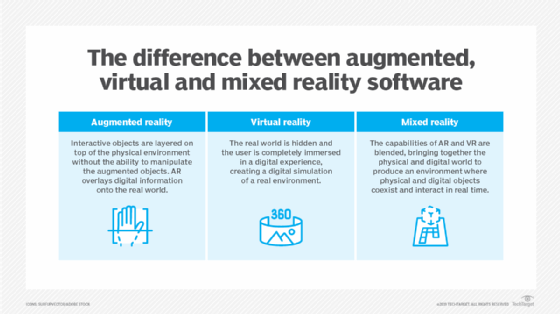
The integration of VR and AR, where digital and physical objects coexist in a virtual space, is known by many terms, including mixed reality, extended reality and metaverse. AR and VR features on UC platforms enable employees to attend hybrid meetings from their VR headsets in addition to more traditional hardware, such as laptops and mobile devices. Additional use cases for enterprise VR and AR include the following.
1. Advanced training. Many large-scale enterprises have successfully implemented pilot programs for VR training, resulting in significant reductions in training times and costs. They have now rolled out full-scale VR and AR training programs for new and existing employees.
VR and AR training modules are deployed on UC platforms to manage collaboration, communication and spatial meeting data. Examples of AR and VR training include pilots learning to fly aircraft, doctors practicing surgeries and virtual teams working for disaster management.
2. Reduced expenses. Remote-first companies, startups, and geographically dispersed teams with limited physical resources can implement VR and AR projects. VR and AR training and collaboration eliminate the need for travel, reducing associated costs such as flights and accommodations.
Net-zero corporate initiatives include replacing mass in-person events with immersive conferences on UC platforms. For UC decision-makers, implementing VR and AR can result in a significant reduction of their organization's carbon footprint.
3. Safety. Instead of entering unsafe areas and using heavy machinery, some UC platforms allow VR and AR to import, manipulate and review digital twin models. IT decision-makers in such industries invest in VR and AR experiences to enable their staff to perform collaborative work on 3D virtual sites, ensuring safety and security.
For example, the U.S. Department of Energy uses immersive technology to implement digital twins and virtual simulations for employee training, cross-department collaboration and public outreach.
4. Real-time collaboration. VR and AR on UC platforms support immersive, real-time collaboration capabilities through spatially anchored information in 3D meeting spaces, such as office holograms or digital avatars. Users can perform advanced design, annotate live video fields and markup 3D objects.
VR versions of people can digitally walk, spend time with colleagues and co-create digital assets in 3D meetings. The virtual 3D workspace remains accessible even when no users are present. Accenture, for example, created the Nth Floor enterprise metaverse as a virtual workspace for employees to meet, collaborate and learn.
5. Better customer experience. Integrating AR and VR with UC can improve CX by providing an immersive experience for software and product demos for B2B customers. In B2C spaces, AR and VR enable customers to virtually test products, such as clothing, makeup and furniture.
Challenges to consider
IT leaders shouldn't integrate AR and VR with their UC platforms without carefully considering the effect on business goals and employee collaboration needs. VR and AR are resource-intensive and consume significant enterprise bandwidth. While pilot programs are promising, issues with scale can lead to low employee engagement and budgetary concerns.
1. Limited use cases. VR and AR use cases in enterprises are industry-specific. VR and AR features in UC platforms support a wide range of immersive and collaborative experiences in high-risk industries, including mining projects, construction sites and nuclear projects.
2. Lack of business model. Most enterprises lack business models that define the need for VR and AR integration with UC services. For example, VR and AR in UC can support industries that need remote field assistance and operation guidance. But an IT company building tech products would not prioritize spending its budget on VR and AR features.
3. Lack of everyday value. Agentic AI can perform tasks without human interference. It is what most enterprises need, irrespective of the industry. VR and AR are just virtual avatars of real-life people. Enterprises do not need them to integrate into their day-to-day business activities. However, agentic AI is flexible enough to operate in any business process.
4. High costs and uncertain ROI. VR and AR run on dedicated hardware that can cost anywhere between $1,300 and $3,500 per user. A full-scale enterprise deployment could cost as much as $100,000. VR and AR immersive experiences rely on real time 3D modeling and rendering, which is also expensive.
IT buyers must also invest in infrastructure upgrades, like GPUs, servers and 5G-enabled hardware, to support VR and AR capabilities. AR and VR content development, with its complexity and limited mobile processing capabilities, increases costs. Hardware maintenance and hiring expert staff add to the Opex bill. If employees aren't satisfied with the quality of the AR/VR experience, enterprises risk not achieving ROI.
5. Employee push-back. AR and VR adoption requires effective change management. Using AR and VR is more complex compared to traditional collaboration tools, which can hinder adoption. In addition, prolonged use of a VR headset can lead to health issues such as motion sickness, headaches and fatigue.
6. Security issues. VR and AR bring additional governance, device management and privacy risks to UC and collaboration services. VR and AR devices capture and process spatial, visual and behavioral data that, if left unsecured, could lead to data exposure, identity spoofing and unauthorized access.
Future enterprise outlook
While video games have driven the popularity of VR, the AR market is expected to grow significantly as more industries, like retail and e-commerce, adopt the technology. This is partly driven because AR adds to real-world environments, rather than placing users in entirely virtual environments.
AR hardware, like smart glasses, is more cost-effective than VR headsets. AR glasses can help people perform job duties while on the move, such as enabling hands-free navigation and communication for frontline workers.
The growing popularity of AI, particularly spatial AI, will help drive the adoption of VR and AR for UC services. Enterprise use cases could create opportunities for UC vendors to develop enterprise-specific features that support immersive remote collaboration, holographic workspaces, 3D visualizations and meeting simulations.
Venus Kohli is an engineer turned technical content writer, having completed a degree in electronics and telecommunication at Mumbai University in 2019. Kohli writes for various tech and media companies on topics related to semiconductors, electronics, networking, programming, quantum physics and more.