Part of:How the finance function can improve its operations
3 strategies for better finance-IT collaboration
Lack of communication between a company's finance and IT departments can cause problems with organizational goals and decisions. Learn how to improve finance-IT collaboration.
Finance and IT leaders often approach technology decisions from different starting points. Finance leaders may focus on cost, controls, forecasting and return on investment, while IT leaders may focus on architecture, security, data, integrations and long-term support.
But finance-IT collaboration is now critical to digital finance strategy, cloud ERP governance, automation, AI initiatives and enterprise software investments. When the CFO and CIO do not work together, organizations can approve technology that does not deliver value, delay projects that finance needs or underfund systems that carry operational and compliance risk.
The CIO-CFO relationship should help translate business needs into technology priorities, funding decisions and measurable outcomes. Finance-IT collaboration works best when both groups share accountability for business outcomes, not just project completion.
Here are three strategies CFOs and CIOs can use to improve the finance-IT relationship.
1. Create IT-finance teams
Cross-functional IT-finance teams can improve decision-making because each department brings expertise the other group needs. Finance understands budgets, controls, reporting requirements and business value. IT understands systems, integrations, security, data quality and technical constraints.
These teams should have clear goals and decision rights. For example, one group might focus on ERP software modernization, another on automation in finance, and another on data governance or reporting. The team should define the business problem, expected value, affected systems, risks, timeline and post-implementation metrics before a project moves forward.
In one example of this approach, Jim Durham, CIO of Denver-based Solar Panels Network USA, and the company's CFO created teams responsible for goals and objectives that applied to both departments.
Shared teams can help emphasize the common ground between finance and IT and make collaboration more concrete than occasional budget meetings or project updates.
Assigning one person in the finance department to become an expert on IT operations, or placing an IT employee on the finance team, can work well, said Dave Roberson, president of RoseRyan, a finance and accounting advisory firm located in Campbell, Calif.
"Or you could have a finance person on the IT team and vice versa," he said.
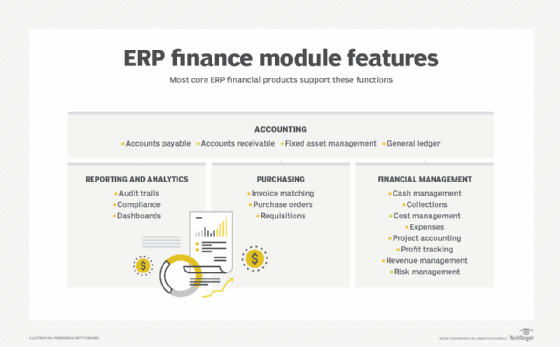
ERP finance modules often connect accounting, purchasing, reporting, analytics and financial management functions that require finance and IT collaboration.
Finance-IT collaboration works best when both groups share accountability for business outcomes, not just project completion.
2. Increase understanding of the other department's operations
CFOs and CIOs may not realize how much they misunderstand the other group's needs, constraints and vocabulary.
Technology spending can be difficult for finance to evaluate when costs are spread across cloud subscriptions, SaaS licenses, managed services, cybersecurity tools, ERP platforms, data projects and implementation partners. IT leaders, meanwhile, may not fully understand finance priorities such as close timelines, audit requirements, forecasting accuracy, working capital, procurement rules or budget cycles.
Technology can be one of the largest expenses for a company, said Khalid Kark, who was global CIO research director at consulting firm Deloitte when he was originally interviewed. However, the technology environment's complexity and the use of external technology providers can obscure IT's true operations and needs. In turn, CFOs may find it easy to say no to IT investment requests.
Finance leaders and IT leaders should work to understand the other department's priorities before a major budget decision or system change. IT can do a better job explaining technology value, risk and technical debt in business terms, while finance can help define the financial model, funding tradeoffs and success metrics for tech investments.
Questions CFOs and CIOs should answer together
Before approving a major finance technology project, CFOs and CIOs should agree on the business problem, the data and systems affected, the expected financial return, the security and compliance risks, the implementation owner, the change management plan and the metrics that will show whether the investment delivered value.
3. Invite IT and finance members to brainstorm strategies
The CFO and CIO should ask employees in both departments how to improve finance-IT collaboration. Employees who work directly with systems, data, approvals and reporting often know where processes break down.
For example, IT employees may suggest ways to make the yearly technology budget more accurate and easier to review. Finance employees may identify manual work, reporting gaps or approval delays that could be improved with automation, better integrations or clearer ownership.
These conversations should lead to a prioritized list of improvements, not just general feedback. CFOs and CIOs should decide which ideas need funding, which require process changes and which should become part of a broader digital finance strategy.
The benefits of finance-IT collaboration
Improved finance-IT collaboration can benefit the enterprise by connecting technology decisions to financial, operational and risk goals.
Better technology investments
Finance leaders can contribute an important perspective to tech investments.
The single biggest benefit of a strong CIO-CFO partnership is financial discipline -- that is, more transparency and accountability -- for tech investments, Kark said. Many organizations spend too much time building business cases without later tracking whether the investments delivered value, Kark said.
CFOs can hold people accountable for delivering value, Kark said. IT can help define realistic timelines, integration risks, support needs and architecture requirements. Together, finance and IT can evaluate total cost, expected business value, implementation risk and long-term operating costs.
Improved data quality and reporting
Finance depends on accurate, timely data from ERP, procurement, HR, customer and operational systems. IT often owns or supports the systems, integrations and data pipelines that make that information available.
A stronger finance-IT relationship can improve financial reporting, forecasting and decision-making because both groups can work from shared definitions, cleaner data and more reliable workflows.
Improved information security and compliance
With IT's help, the finance department's security practices will likely improve.
The need to protect sensitive data has never been greater, said Thomas Vick, senior regional director at Robert Half, a human resources consulting firm. Finance and IT can address the risks posed by cybercriminal activity and compliance demands.
Finance and IT should work together on access controls, segregation of duties, audit trails, data retention, third-party risk and incident response. This is especially important when financial data moves through cloud ERP platforms, reporting tools, automation software or AI-enabled workflows.
Better budget decision-making
When the CFO and CIO work together frequently, difficult budget conversations will likely become easier.
If the finance and IT departments already have a strong working relationship, the CFO and CIO will likely be more able to fairly allocate funds and make hard decisions that will benefit the company overall, said Shoma Meyer, who was vice president of finance and accounting at SPR, a digital technology consultancy located in Chicago, when she was originally interviewed.
Finance-IT collaboration can also help leaders make better tradeoffs across cost, risk and business value. That matters when organizations must decide whether to modernize an aging system, move finance to the cloud, add automation, strengthen security or delay a project because the business case is not strong enough.
Finance and IT do not need to agree on every technology request. The goal is to make disagreement productive. When CFOs and CIOs share context, define success metrics and keep accountability after implementation, they are more likely to fund technology that improves the business rather than only adding cost or complexity.
Editor's note: This article was originally published in 2022 and was updated to reflect current finance-IT collaboration, digital finance, cloud ERP, cybersecurity and technology governance considerations.