Supply chain traceability faces challenges, like data fragmentation and poor visibility, that complicate compliance with regulations on sustainability and human rights.
Increasing consumer demand for transparency on products' origins and creation processes, combined with an evolving regulatory landscape, force organizations to better understand their supply chains.
While this exercise can be daunting, it can also produce significant results, including better business continuity, resilience and security, and improved sustainability. However, only 9% of organizations follow new laws related to environmental concerns and human rights, according to the October 2024 study "Supply chains: Still vulnerable" from McKinsey & Company. In fact, 30% of respondents conceded they were behind or significantly behind on complying with these regulations.
This is problematic on several levels, as supply chain traceability doesn't just result in more sustainable operations. It's also good business, according to Stefan Seuring, professor of supply chain management at the University of Kassel in Kassel, Germany.
A lack of knowledge about and compliance with supply chain traceability requirements can pose significant challenges for organizations. These include the following:
Data fragmentation.
Poor visibility.
Sourcing.
Inconsistent standards.
Limited resources.
Security.
Verifying supplier network data.
1. Data fragmentation
Modern supply chains are multi-tiered, involving hundreds, sometimes thousands of suppliers, sub-suppliers and logistics partners. But most organizations only have visibility into their Tier One suppliers, said Abe Eshkenazi, CEO of the Association for Supply Chain Management, a trade organization for supply chain professionals based in Chicago. This makes it very difficult for organizations to track various aspects of the supply chain, such as environmental impact, labor practices and sourcing of raw materials.
2. Poor visibility
It's a risk if you don't know what's going on.
Stefan SeuringProfessor of supply chain management, University of Kassel
Data fragmentation results in poor supply chain visibility, Eshkenazi said. If businesses lack adequate knowledge of their Tier 2, Tier 3 and extended suppliers, they will struggle to substantiate sustainability claims. When organizations have deep visibility into their supply chains, they can better respond to disruptions, economic challenges, environmental events and social risk.
"If you do not [have visibility], then you have an economic problem in your supply chain. It's a risk if you don't know what's going on," Seuring said. "Some of the things that the regulations demand are, basically, what an informed supply chain manager should know anyway."
New sustainability regulations force organizations to gain this deeper visibility into their supply chains, according to Kevin Lawrence, director analyst of sustainability technology at Gartner. But, as many organizations have fallen behind with these regulations, they can't benefit from them.
"Supply chains, historically, have been very opaque," Lawrence said. "These regulations are trying to pry that opaqueness open to provide a lot more transparency into what's happening in the supply chains."
3. Sourcing
Geopolitical pressure and the current tariff landscape are prompting organizations to frequently adjust their sourcing strategies to manage costs. This further complicates supply chain traceability, Eshkenazi said.
"If I know who my partners are -- and I can communicate with them effectively -- then I can get the information," Eshkenazi said. "If that continues to change in terms of where I am sourcing from and what their capabilities are, it makes it extremely difficult."
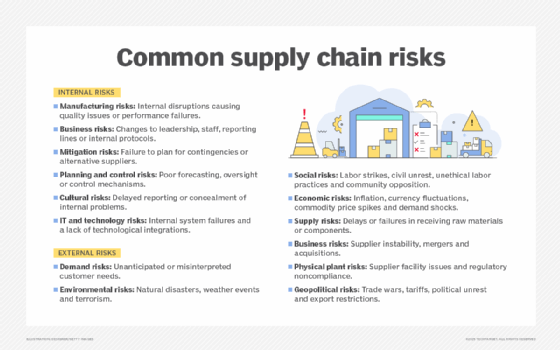
Many supply chain risks come from traceability challenges, and vice versa.
4. Inconsistent standards
Global companies must also comply with regulations and standards that vary depending on the country or region to which they apply. So, these global companies must align with differing global standards for supply chains, in addition to aligning these strategies within their organizations.
Traceability isn't just a technical problem, Eshkenazi said; it's also an organizational one.
"Traceability means collaboration across your organization, IT operations -- functions that traditionally work in silos," Eshkenazni said.
5. Limited resources
Another traceability challenge lies in the extended supply chain, which encompasses vendors that follow Tiers 1, 2 and 3. These businesses typically create smaller components. For example, in the aerospace industry, these companies would manufacture gaskets and washers.
Many companies in the extended supply chain are small to mid-sized, Eshkenazi said. They lack the resources or technology to provide traceability data to enterprise-level partners. To address this challenge, many large businesses are expanding their tech investments to include their SMB suppliers. However, this can increase costs for them, which may require cuts elsewhere.
6. Security
While integrating smaller supply chain partners with enterprise systems may solve the data issue, it creates a new and significant problem: Security.
"[When] you're integrating all your partners, you're opening up your exposure to cybersecurity [and] ransomware attacks because the small and medium-sized organizations don't have the same protocols and security that you do," Eshkenazi said.
This requires organizations to put more resources toward cybersecurity initiatives. If they already lack resources, then this may also require cuts elsewhere.
7. Verifying supplier network data
To ensure the accuracy of what suppliers say about their operations, organizations must implement a verification method.
For example, some organizations use geolocation and satellite intelligence to monitor supplier claims around raw material provenance, according to Lawrence. But in many cases, businesses rely on supply chain risk management platforms that aggregate supplier data. These platforms can alleviate some of the burden on suppliers and the primary companies requesting this information.
How businesses are succeeding at supply chain traceability
Digital product passports, which incorporate blockchain technology, near-field communication chips and QR codes, can trace materials from the metaphorical farm to the finished product. This can build consumer trust, Eshkenazi said, as they would gain more information on how their purchases are produced.
In automotive manufacturing, some carmakers use AI-powered platforms to trace minerals like cobalt, lithium and nickel across supplier networks. For cold chain industries, such as food and beverage and healthcare, organizations use IoT-based sensors with cloud visibility.
Technology is only one part of the equation. People with critical thinking skills and real-world experience are the other.
"Our vaccines … need to be traced, managed and tracked all along the supply chain. The same goes for food," Eshkenazi said.
These organizations approach supply chain traceability as a strategic capability rather than a reporting obligation, according to Eshkenazi.
While technology is helping some companies make significant inroads into supply chain traceability, organizations must ensure they don't fall victim to tunnel vision. Technology is only one part of the equation. People with critical thinking skills and real-world experience are the other.
"If you have data systems that are much more powerful, but you don't have the talent to understand the information, that's not a good combination," Eshkenazi said. "A winning combination is the investment in technology with talent to leverage the technology."
Carolyn Heinze is a Paris-based freelance writer. She covers several technology and business areas, including HR software and sustainability.