Part of:Strategic environmental sustainability fundamentals
5 business sustainability trends for 2026
Regulatory shifts and tech advances are shaping business sustainability trends for 2026, including AI, climate risk, data centers, circular economy and ROI.
Business sustainability in 2026 requires an approach that goes beyond compliance to offer tangible results.
Emerging technologies, climate risk and data center energy requirements are shaping sustainability strategies for 2026. Organizations are also shifting from broad, compliance-driven commitments to more actionable, ROI-focused initiatives, said Anuj Shah, head of responsible investing at the consulting firm Grant Thornton Stax.
Key business sustainability trends to watch in 2026 include the following:
Organizations often struggle to gain clear sustainability insights because reporting requires them to collect and analyze vast amounts of data from disparate sources. However, generative AI can rapidly process large datasets and generate actionable insights to streamline the reporting process. It enables organizations to navigate sustainability data more intuitively, improve decision-making and increase transparency.
"As little as three years ago, I used to do a type of workload for clients that would take my firm about four weeks. I can now do that exact same analysis with AI in 30 seconds," Shah said.
2. Climate risk
Climate risk -- the potential harm or negative effects from climate change -- is a top priority for organizations in 2026, as physical hazards, including hurricanes, wildfires, floods and rising sea levels, increasingly threaten operations and supply chains. Organizations face mounting challenges, including difficulties securing insurance in high-risk regions, such as Florida and Hawaii. These pressures are driving demand for advanced AI tools that can assess and manage climate-related risks more effectively, said Abhijit Sunil, senior analyst at Forrester Research.
Understanding climate risk has become especially important for infrastructure projects, such as the creation of data centers. When organizations understand and evaluate long-term exposure to physical threats, they can protect these critical assets and maintain uninterrupted operations over decades.
Beyond identifying inherent risks tied to a specific location and its climate, AI can help organizations calculate residual risk -- the level of risk that remains after mitigation -- at all levels of operations, said John Armstrong, CTO at Worldly, a company that offers sustainability measurement software. Traditionally, measuring residual risk involved long delays, as organizations had to wait months or years to see the effects of their efforts. However, AI can forecast outcomes in advance to accelerate risk calculation.
3. Clean energy for data centers
Despite AI's ability to analyze sustainability data and predict risk, it requires a significant amount of energy to operate -- much of which is powered by harmful fossil fuels. In response, sustainability and business leaders are reevaluating how to power data centers in a manner that minimizes their environmental effects.
Organizations are investing both inside data centers and across the broader energy ecosystem, Sunil said. For example, more data center operators are adopting technologies like liquid cooling to improve power usage effectiveness and reduce energy consumption. Organizations are also procuring more renewable energy and purchasing renewable energy certificates -- market-based instruments that prove producers have generated clean power -- to meet their clean energy targets. Tax incentives and the need for a reliable energy supply, especially to meet AI's growing demands, drive these efforts.
At the same time, many organizations have recognized the need to move beyond the experimental phase of AI, Sunil said. In 2026, organizations will begin shifting away from rapid AI experimentation as they develop more practical and stable AI use cases. This shift will help them manage data center power demand more effectively.
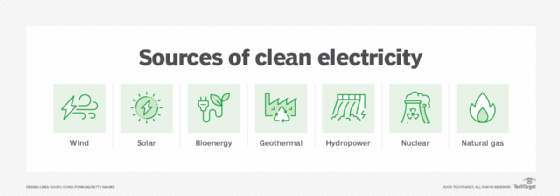
Many data center operators are investing in clean energy to power AI.
4. The circular economy
The circular economy -- an economic model that emphasizes recycling and reuse -- is gaining momentum as a component of business sustainability in 2026, Sunil said. It involves strategies to increase the use of recycled materials, design products for reuse and implement take-back programs for responsible end-of-life treatment for devices.
Beyond environmental benefits, circular economy practices help organizations cut costs, improve supply chain resilience and meet growing consumer demand for sustainable products. Many sectors, including electronics, consumer goods and infrastructure, are actively advancing circular initiatives and adopting emerging tools, such as product lifecycle assessment and carbon footprint tracking software.
More companies are making circular economy claims than net zero or carbon footprint reduction targets.
Abhijit SunilSenior analyst, Forrester Research
These tools measure embodied carbon -- the total greenhouse gas emissions associated with a product's materials and manufacturing -- and analyze material flows, which track how resources move through production, use and disposal. Understanding these factors helps organizations identify opportunities to reduce waste and emissions, which lie at the heart of the circular economy.
"More companies are making circular economy claims than net zero or carbon footprint reduction targets, because it includes a wide spectrum of things that companies can do," Sunil said.
5. More focus on ROI
Organizations face increasing pressure from investors, private equity owners and stakeholders to demonstrate tangible financial returns from their sustainability initiatives. Therefore, organizations must directly link environmental and social sustainability efforts to business performance metrics, such as cost savings, revenue growth, risk reduction and long-term resilience.
Regulations like the EU's Corporate Sustainability Reporting Directive require organizations to make dozens of environmental, social and governance (ESG) disclosures -- most of which do not directly link to ROI, including total greenhouse gas emissions and recycling rates. As a result, many organizations treat sustainability as a check-the-box compliance exercise.
However, in 2026, organizations will increasingly go beyond compliance to link sustainability projects to ROI, Shah said. For instance, organizations are identifying smaller sets of outcome-oriented metrics, such as energy cost savings or revenue from sustainable products, that reflect value creation.
Several factors are driving this trend, Shah said. In the U.S, political polarization has fueled skepticism and pushback against ESG and sustainability efforts, prompting organizations to emphasize measurable business benefits to justify their programs.
Meanwhile, in Europe, the EU is rolling back regulations due to concerns about bureaucratic burdens and costs. For instance, in November 2025, the European Parliament voted to significantly narrow the scope of sustainability reporting. Dynamics in both the U.S. and EU converge in a shared call for sustainability to move from checkbox compliance to demonstrable value.
"We have this highly politicized environment in the U.S, but we also have this deregulation environment that's happening in the EU, and both parts of the world are saying that we need to focus on value," Shah said.
Tim Murphy is site editor for Informa TechTarget's IT Strategy group.