Getty Images
Pegasystems adds vibe coding to Blueprint app builder
Pega Blueprint combines conversational code with drag-and-drop feature editing.

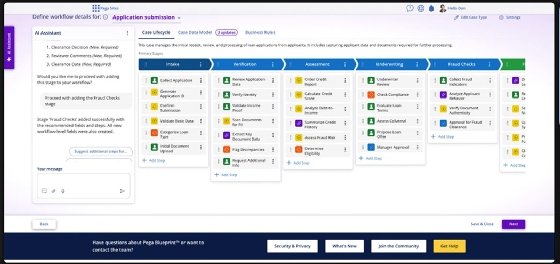
In its latest update to Pega Blueprint, Pegasystems added vibe coding.
Vibe coding is the catch-all term for when a large language model (LLM) turns a plain-language prompt into an application, workflow shortcut or other software tool. Pega Blueprint, introduced two years ago, is the company's generative AI app builder. The latest version combines LLM prompting and drag-and-drop tools, enabling frontline users to build apps with IT-managed data governance and security controls.
While Wall Street and vendors debate the existence of a "SaaSpocalypse" in which vibe-coded apps replace traditional SaaS cloud products, AI coding tools certainly are disrupting DevOps processes at many companies. But people who claim the SaaSpocalypse is real tend to forget that applications are a combination of deterministic rules and LLM output, said Predrag Jakovljevic, principal industry analyst at Technology Evaluation Centers. LLMs can only go so far in solving business workflow issues on their own.
"AI agents are good for some probabilistic algorithms and macros, but they cannot replace the underlying SaaS platform with governance, compliance, etc.," Jakovljevic said.
Pegasystems -- many of whose customers use the Pega platform to manage various aspects of customer experience (CX) -- makes the case that controlled environments such as Blueprint deliver the benefits of vibe coding, including faster testing and validation, IT control and more predictable outcomes than standalone tools.
Many of Pegasystems' customers are also in regulated industries such as banking and insurance. The Blueprints approach may enable them to experiment with tools that give front-line workers -- and developers, too -- a toolbox to fix time-wasting processes while minimizing compliance risks.
"Blueprints are something declarative," Jakovljevic said. "Why would one want to use code to build them? If it is declarative, I can also describe it easily."
Don Schuerman, chief technology officer and head of marketing at Pegasystems, said that vibe coding is catching on at a grassroots level, as everyday people discover tools to accomplish technically simple tasks, such as building simple tools or websites in their personal lives. They want tools like that available for work. Just like Agile development and Scrum replaced Waterfall, vibe coding is the next development framework, a logical extension of no-code.
"People are increasingly looking to see lightweight vibe-coding tools and more of the industrial-grade AI coding type tools," Schuerman said. "There is something just really cool about being able to type a couple things and, all of a sudden, your app just starts showing up and changing and evolving. It can be really fast, and it can be very empowering."
Yet vibe coding is still a young idea born of generative AI and is still evolving. While it's possible to stand up an app within a few hours as business stakeholders help direct the development flow, a SaaS foundation grounds it in enterprise rules and policies, Schuerman said. That gives customers the confidence to roll out vibe-coded apps to employees despite the velocity at which they were built.
"Speed is starting to become table stakes and an expectation in this game," Schuerman said. "But the app I'm going to deliver will be better because the business [people] saw it. IT saw it. They iterated on it together, and we all actually built something that we feel very confident is going to deliver the business results, which is why we invested the time and money building this out."
Don Fluckinger is a senior news writer for Informa TechTarget. He covers customer experience, digital experience management and end-user computing. Got a tip? Email him.
Dig Deeper on Customer Experience
-
![]()
Pegasystems CEO and founder Alan Trefler on AI agent ‘madness’
By: Bill Goodwin
-
![]()
Interview: Pegasystems’ Don Schuerman on how to keep the lid on skyrocketing AI costs
By: Bill Goodwin
-
![]()
Enterprises that succeed in agentic AI start by ‘reimagining’ business process, finds Pega research
By: Bill Goodwin
-
![]()
Pega Blueprint gets funky with vibe coding
By: Adrian Bridgwater