
Getty Images/iStockphoto
10 AI topics for 2026 that enterprise leaders need to know
Use these trending AI topics to inform your organization's strategy for 2026 and position it for future success.

2026 will see the continued dominance of AI, with strategic innovations, improved practices and updated compliance requirements. Organizations that don't adapt risk irrelevance, a loss of competitive edge and an inability to innovate at the same level as their competitors.
AI continues to evolve from an experimental technology to a foundational component of business. While understanding its technical advancements is crucial, enterprise leaders must also become fluent in AI's more nuanced developments, such as the increased emphasis on AI governance and sustainability that's expected in 2026. Only then can they develop effective strategies that position their businesses for short- and long-term success.
To prepare for this evolution, explore these ten key AI topics that are expected to shape the enterprise landscape in 2026.
1. Continued advances in agentic and autonomous AI
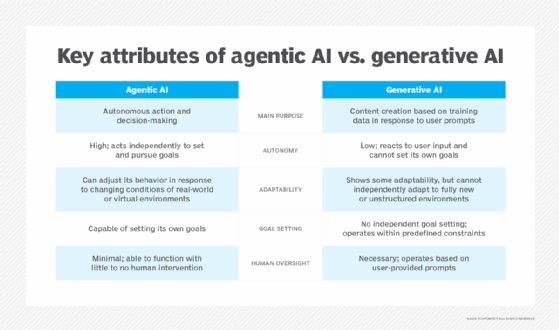
In 2026, expect continued advancement in both autonomous and agentic AI as these technologies transition from pilot programs to production deployments. Production deployments will focus on advanced use cases, particularly in healthcare, customer support and defensive cybersecurity.
However, these AI uses will also face increased scrutiny around governance and ethics, so prepare your organization for both the technology and its management implications.
It's also critical to get ready for a workforce transformation involving training and monitoring AI teams. You must empower employees to use agentic and autonomous AI efficiently, effectively and ethically.
2. Use of multi-agent AI systems
One of the crucial transformations that automation brought to IT was the chaining of multiple automated tasks into a pipeline of orchestrated workflows, enabling the deployment of a complete system. Similarly, 2026 will bring a collaborative capability to agentic AI that increasingly prioritizes teams of specialized agents working together through a multistage pipeline to provide fully formed systems.
Advantages of multi-agent systems include the following:
- Cross-department collaboration.
- Coordination and conflict resolution of multistage processes.
- Layered autonomy and constrained decision-making.
- Integration with core business applications, including CRM and ERP tools.
Positioning governance, interoperability and human upskilling correctly is essential to enable these enterprise-level workflows.
3. Advancements in language models and open source models
Expect 2026 to continue the trend toward more complete and capable large language models (LLMs) with practical business applications.
Advancements include the following:
- Multimodal LLM capabilities that use text, image, audio and video for more interactive and comprehensive interactions.
- Agentic and autonomous systems that complete a complex series of tasks through a pipeline.
- World models that enable AI systems to understand and reason about their environment, providing more comprehensive capabilities.
- Continued specialization of agents and models for specific industries and roles.
Open source development will continue to play a pivotal role in the use of language models, providing greater specialization, agility and flexibility for organizations.
4. Increased use of synthetic data
Synthetic data for training AI models is generated using algorithms, simulations and patterns rather than real observations or data sources. It enables data generation for information that's scarce, private or expensive, making AI model training easier. Data might be entirely synthetic or a hybrid of artificial and actual sources. Some models are trained on synthetic information and then fine-tuned on real data.
Synthetic data is transitioning from the experimental to the practical, with significant growth in this area anticipated in 2026. Businesses can learn how to generate and use synthetic data for their AI models, positioning themselves to stay competitive.
5. Introduction of AI-as-a-colleague
Expect AI to shift from being a mere tool alongside other applications to becoming a collaborative partner. AI in a partner role requires significant changes, including the following:
- Encouraging a cultural and organizational shift to embrace the technology and extend it beyond the concept of a software tool.
- Restructuring the workforce for optimization and collaboration.
- Modification of skill requirements for new and existing employees, affecting talent acquisition.
Experts expect this collaborative role will improve productivity and enhance organizational agility.
6. Development and deployment of AISecOps teams
AI-augmented security teams will use digital twins and adversarial learning to deliver immediate, environment-specific security capabilities in 2026. AI threat detection and automated responses will be the foundation of modern security deployments.
To make these innovations happen, businesses will need to consider new governance requirements, the evolution of human skills and new AI-driven attack threat vectors. Organizations that fail to adopt these approaches leave themselves vulnerable to security incidents with steep financial and market costs.
7. Emphasis on sustainability
AI offers transformative opportunities for businesses. However, it also generates environmental concerns, such as rising energy consumption, that can create compliance issues or negative publicity for organizations.
Sustainability is a key topic in today's IT environments. In 2026, organizations will face increasing pressure to weave sustainability into their AI strategies. Various sustainability opportunities exist, including the following:
- Meeting organizational sustainability goals.
- Satisfying sustainability compliance requirements.
- Improving efficiency by integrating renewables.
- Implementing energy-efficient hardware and sustainable operating systems.
- Establishing environmentally friendly data center practices.
8. Rising expectations for ethical AI
Ethical AI is becoming a top priority for executives. Investor scrutiny, new regulations, privacy requirements and responsible data use will drive this trend forward.
Business leaders must incorporate AI explainability and transparency into their AI deployment frameworks. Organizations must demonstrate the responsible and ethical use of AI technologies to meet the expectations of investors and consumers.
9. Global development of AI regulation
Voluntary and optional initiatives can no longer govern AI. Instead, organizations must adhere to frameworks that enforce legal requirements that focus on responsible use, transparency and human oversight.
Several key regulatory frameworks exist, including the following:
- EU AI Act. The European Union passed the EU AI Act to enforce risk-based obligations for AI system providers and users in the EU. It emphasizes strict accuracy, documentation and transparency with extensive human oversight.
- ISO/IEC 42001. The ISO/IEC 42001 is an internationally recognized and certifiable standard that emphasizes establishing, implementing, maintaining and improving AI management systems for transparency and ethical use.
- NIST AI Risk Management Framework. As another risk-based construct, the NIST AI Risk Management Framework identifies, assesses and manages AI-related risks for improved mitigation.
These laws and standards serve as a foundation for responsible and compliant AI use. They -- and others like them -- will govern the strategies, procurement and use of AI technologies for organizations worldwide in 2026 and beyond.
10. Integration of AI governance into standard processes
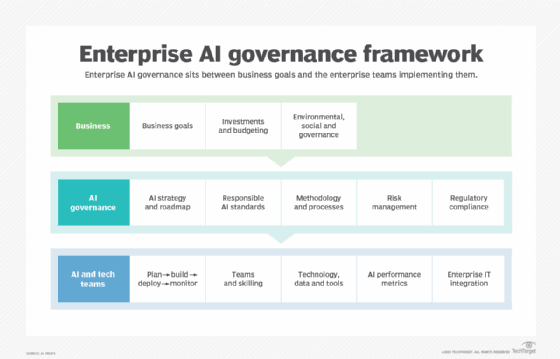
Operationalizing AI governance involves designing and implementing AI governance frameworks within organizational processes. Governance is no longer an add-on or supplemental component of AI deployments. Instead, it's integrated from the ground up into all aspects of development and deployment. It must also include measurable metrics that prove compliance.
The following are some specific initiatives:
- Compliance as a core requirement of AI deployments.
- Continued emphasis on human oversight to maintain ethics and privacy.
- AI and machine learning lifecycle management that includes versioning, configuration and monitoring.
- Transparency and documentation formalization, with data lineage, explainability reports, auditing and monitoring to satisfy regulatory requirements.
- AI governance as it relates to data sovereignty, adhering to the current attention on data management and privacy.
Bonus tip: Increase the measurability of AI performance
Enterprise leaders must increasingly demand data that demonstrates the value, safety and compliance of AI systems across the business in 2026. This information enable a data-driven strategy and is essential for meeting compliance requirements.
Data must show that AI performs well in the following categories:
- Model accuracy.
- Explainability.
- Energy consumption.
- Return on investment.
- Compliance.
- Ethics and privacy.
Damon Garn owns Cogspinner Coaction and provides freelance IT writing and editing services. He has written multiple CompTIA study guides, including the Linux+, Cloud Essentials+ and Server+ guides, and contributes extensively to TechTarget Editorial, The New Stack and CompTIA Blogs.