No one cries when a tech CEO leaves their job. But when they do, the subjective question of "Did they leave the world a better place?" can be a useful KPI for measuring legacy. Adobe CEO Shantanu Narayen definitely did that.
Narayen announced on March 12 that he will step down after 18 years once the company names his replacement. Surviving -- actually, thriving -- for that many years puts him in rare air. His key to longevity, at least in part, involved surrounding himself with smart people -- and listening to them, said Liz Miller, analyst at Constellation Research.
Though Narayen signed off on the decisions, he opened himself to others' big ideas, such as launching Marketing Cloud in 2012. At the time, that represented a big pivot for Adobe, whose bread and butter for decades had been applications.
Thus, Adobe evolved from the era of disks and CD-ROMs to the cloud, from box licenses to online subscriptions, and in recent years from manual labor to generative and agentic AI automation. Through it all, Adobe valued above all the human ownership of creative ideas, defending the creators, designers and authors who turn their ideas into petabytes of pixels.
The cloud thing hasn't gone perfectly -- more on that below -- but Narayen maintained Adobe's gold-standard reputation for creative and document management technology.
Along the way, he grew Adobe's marketing and e-commerce platforms both from scratch and through acquisitions such as Marketo, Magento and Workfront. They are now used by large consumer companies such as Coca-Cola, Lowe's, Walmart, Disney and Sephora.
"I joke that he's like 'Uncle Shantanu' to every marketer out there, in his quarter-zip, coming out telling us that everything's going to be okay," Miller said. "Shantanu is also very smart. He is someone who really enjoys playing three-dimensional chess -- seeing all the different pieces of the business, seeing all the different pieces of the market. He is one of those people who really believes that customer feedback is a gift."
I grew up with PDF. Its 1993 release was one of the first stories I wrote as a tech journalist.
In 2000, Adobe co-founder and original CEO John Warnock was succeeded by Bruce Chizen, the company's second chief executive. A few years later, Narayen, then Adobe president and COO, popped up on the first quarterly earnings call I ever covered.
Hoping to combine what was heard on the street with the perspective of Adobe brass in news stories, I paid close attention as he looked into his crystal ball, deciphered sales and market trends, and dropped opaque hints about how Adobe's product line was to evolve in the near term.
Much later, back on the Adobe beat for TechTarget's customer experience site in 2017, Narayen would take my questions at noisy press-and-analyst scrums held at the Adobe Summit user conference. Some other CEOs prefer to call on familiar, friendly faces at events like these. The rest of us get to watch the same old people lob the same old dumb softballs and grind the same old axes. That's tiresome. In contrast, Narayen did his best to give everyone, including me, a fair shot.
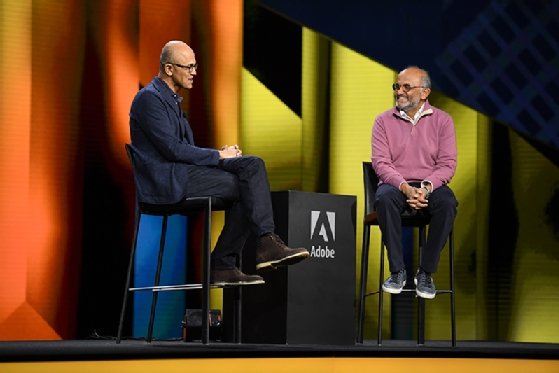
In his signature quarter-zip, Shantanu Narayen, on the right, talks with Microsoft CEO Satya Nadella at Adobe Summit in 2019.
PDF was the foundation
When most people think of Adobe technology, they think of flashy stuff: stunning images in Photoshop and Illustrator. TV shows and feature films made in Premiere. The commercial print and digital content we consume in InDesign. AI graphics and audio in Firefly. Digital apps on Experience Cloud.
Before all that -- before the internet went mainstream, back when "Adobe" meant "Illustrator, Photoshop and PageMaker," when Warnock was still CEO -- Adobe released PDF, the Portable Document Format.
If legends are gospel, Adobe had absolutely no clue what it had when it released PDF. Warnock was looking to create a digital equivalent of paper so that people who didn't own his pricey apps could preview what an image or publication looked like on the screen without having to buy a seat license or download a heavy file. (The original PDFs did indeed strain a lot of modems, but eventually they became much lighter.) That blew up into trillions of PDFs floating around the internet today, with more created every second. It started as a way designers could proof their files on paper and email them around.
Quickly, PDF became the bedrock of printing workflows. Today, while print ain't what it used to be, PDF is the standard digital document format across numerous other industries, such as legal, manufacturing and construction, to name a few.
For all of Warnock's accomplishments and inventions, the lowly PDF might have been his capstone. In fact, the headline for John Warnock's 2023 obituary in The New York Times was "John Warnock, Inventor of the PDF, Dies at 82."
In 2007, when Narayen was COO of Adobe, and in the months leading up to his promotion to CEO, the company donated the PDF document standard to the ISO. That decision drove the proliferation of PDFs and led to different flavors of the document standard, including PDF/A for digital archiving.
Making PDF a free standard gave rise to a whole tech ecosystem of independent developers who made PDF software and shared the wealth. Narayen could have gone the route of a partner ecosystem or marketplace like the App Store. Instead, he freed these companies to build their own tools as they saw fit to address market opportunities.
Today, Narayen's continuous support of that ecosystem is a massive -- and completely underrated -- part of his legacy.
"Speaking for the industry as a whole, we are grateful to Shantanu for ensuring Adobe's continued participation in advancing this globally critical technology, and for the collaborative spirit Adobe demonstrates and fosters in the PDF Association and ISO working groups," said Duff Johnson, CEO of the PDF Association. This vendor-neutral document standards organization celebrated its 20th anniversary last month.
Turbulence ahead for Adobe
Currently, though, Adobe's future isn't all roses and chardonnay, which is probably in part why Narayen decided to step down as CEO. Adobe faces two massive challenges, and the next CEO will have to deal with them swiftly and decisively.
First off is the "SaaSpocalypse," a possible future where AI creations replace traditional cloud apps and vendors. Whether it's fact or fiction, Wall Street investors have battered tech companies, and Adobe is no exception: Despite beating earnings estimates, its stock has dropped 26% since last year at this time, and 60% since its pandemic peak.
We'll see how Adobe and its SaaS peers determine how to integrate AI into their products without AI swallowing them whole.
Adobe stock, some analysts say, is undervalued, and it's time to "buy the dip." We'll see how Adobe and its SaaS peers determine how to integrate AI into their products without AI swallowing them -- and their market cap -- whole.
The other issue is far worse: long-term tarnish to Adobe's reputation stemming from its cloud pricing policies and tactics. The company came under government scrutiny in 2024 for its termination fees and the hurdles it imposed on customers before they could cancel a subscription.
The day after Narayen announced his departure from Adobe, the company settled with the U.S. Department of Justice for $150 million, agreeing to pay $75 million in civil fines and $75 million in free services to customers. He oversaw everything in that chain of events, and it will take some time for customers to forget this situation.
You can't win them all. That said, who among us has made 100% correct decisions over 18 years?
It's hard to wax nostalgic about tech executives, especially right now, considering all that's going on in politics. But Shantanu Narayen navigated an evolving tech landscape with aplomb for nearly two decades.
Instead of shooting from the hip like many tech CEO cowboys, he listened to wise counsel from the brain trust around him and made crucial decisions that brought Adobe through market transition and market turmoil -- most of the time, with grace.
You can't please all the users all the time, and it's impossible to please cynical journalists even half the time. But through it all, this guy maintained the vision of founders John Warnock and Chuck Geschke while modernizing Adobe's technologies. Whoever's next will inherit some market headwinds, but also an amazing legacy.
Don Fluckinger is a senior news writer for Informa TechTarget. He covers customer experience, digital experience management and end-user computing. Got a tip? Email him.