Agentic AI is often discussed as if it will make enterprise systems act autonomously. In industrial settings, that idea needs more care. The distance between concept and implementation is wider.
Factories, plants and warehouses already use automation. Robots can weld, assemble, move materials, inspect products and perform repetitive work. Sensors can monitor equipment. Programmable logic controllers can control machinery. Manufacturing execution systems can help execute production work. SCADA systems can help operators monitor and control industrial processes, while industrial data historians record machine and process data over time.
That is real automation.
It is not the same as letting an AI agent decide on its own what a plant, machine or production line should do.
The difference matters because industrial work is physical. A bad recommendation is not just a bad answer on a screen. It can affect equipment, safety, downtime, compliance, inventory, service schedules and the people working around the machinery.
That does not mean agentic industrial AI has little value. It means the near-term value is different from the fully autonomous story vendors sometimes suggest.
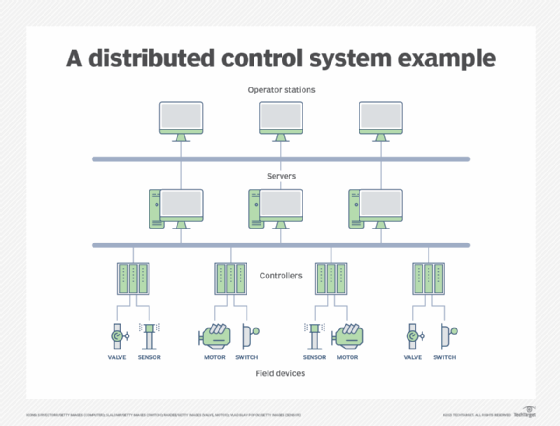
Industrial automation already depends on connected systems, controllers, sensors and field devices. Agentic AI can add another layer of coordination, but it is not the same as fully autonomous equipment.
Existing industrial automation is usually engineered around defined tasks, safety systems, sensors, controls and repeatable workflows. Agentic AI is starting to work around those processes by interpreting signals, coordinating steps, recommending actions and connecting information across systems.
That is why connected workers are industrial AI's proving ground. The near-term question is not whether every machine can run itself. It is whether agents, systems and frontline workers can share enough context to support better execution.
Agentic AI is more coordination than control
Industrial AI could eventually support far more autonomous operations. That might happen in some settings, especially in controlled environments where the work is repeatable, the risks are bounded and the operating data is reliable.
But that is different from where most organizations are today.
The current agentic AI story in industrial environments is more about coordination than full physical autonomy. Agents may help determine what needs attention, where work should be routed, what data should be checked, which technician should be assigned, which part is required or when a human needs to review a recommendation.
That is valuable work. It is also not the same as a machine running itself without oversight.
That distinction matters because industrial agentic AI adoption remains limited in production.
A 2026 qualitative study of industrial AI adoption found that many organizations still face barriers around verification, nondeterministic outputs, domain-specific context, qualification standards and production readiness. Human verification remains important when companies cannot yet prove that agents can operate reliably inside production workflows.
That lines up with the broader tension around how AI can transform ERP. Agents may help automate workflows and reduce time sinks, but the risk of error remains significant when the work depends on business context, strong data foundations and governance that many enterprises have not fully built.
In other words, the agentic AI opportunity is real. So is the gap between possibility and production readiness.
Buyers should separate the future state from the current operating reality. For now, the stronger near-term question is not whether agentic AI will make equipment fully autonomous. It is whether AI agents can help coordinate the work around industrial operations more safely, clearly and effectively than current systems do.
Industrial agents need connected systems
AI agents are growing up.
The first versions many enterprise buyers encountered were basic customer service assistants that answered common questions, retrieved order status or routed a case to a human agent. Then came broader AI assistants and copilots that could summarize information, draft content, search enterprise data or recommend next steps.
Now vendors are pushing a more agentic model: AI that can perform or coordinate specific tasks inside a defined workflow. In some cases, those tasks are narrow and contained. In others, vendors are trying to connect agents across more of the enterprise software stack, so they can pull context from different systems and help move work from one step to the next.
That shift is also reaching industrial software.
IFS's 2025 acquisition of TheLoops shows how agentic AI is moving beyond customer experience and into more complex industrial environments, including enterprise asset management, field service management (FSM) and connected worker workflows. TheLoops started in CX, where agents often help resolve customer problems across systems. IFS wants to bring that same basic logic into industrial work, including manufacturing floors, field service, asset management and frontline operations.
That example matters because industrial agents cannot be useful if they only see a narrow slice of the work.
They need connections to the systems where industrial work actually lives.
Connectors make agents better informed, not free running
An industrial agent may need enterprise asset management data to understand asset history, maintenance schedules and open work orders. ERP data can check inventory, purchasing status, supplier records and cost information. It draws on FSM data to track technician availability, dispatch status and service tickets. A manufacturing execution system, connected worker or operational data offers work instructions, machine status, safety steps and production context.
Those connectors do not make the agent a free-running autonomous worker. They make the agent better informed.
That is an important difference.
An agent that can check inventory before recommending a repair is more useful than one that cannot. An agent that knows a technician is already assigned to a similar job nearby can route work more intelligently. An agent that can see whether a work order is open, delayed, rejected or completed has better context. An agent that can draw from connected worker data might know what the worker actually observed, not just what the back-end system expected to happen.
That is support. It is coordination. It may be automation in some bounded tasks.
It is not the same as handing control of the plant to an AI agent.
Connectors do not make the agent a free-running autonomous worker. They make the agent better informed.
The same point shows up in cross-platform ERP work. Our coverage of cross-platform agentic AI applications has shown that useful agents may need to work across systems even when industry standards remain incomplete. That can create value, but it also makes governance, integration and oversight more important.
The more systems an agent touches, the more important the control model becomes.
"Digital co-worker" is useful vendor hype
TheLoops and IFS use the phrase "digital co-worker" to describe the role agents could play in industrial environments.
That phrase is useful, but only up to a point.
It is useful because it suggests that agents may take on defined skills or tasks inside a working environment. An agent might help gather context, check a record, recommend a next step, update a case, route a work order or monitor whether another agent completed a task according to the rules it was given.
But "co-worker" can go too far, too.
These agents are still tools. They are not human colleagues. And they should not have the judgment, authority or agency of real co-workers, especially in industrial settings where decisions can affect equipment, safety, downtime, compliance and physical operations.
That distinction matters. An agent may help with work that people perform today. It may also change the role of some workers over time, pushing them toward more monitoring, review and exception handling. But that is not the same as replacing frontline workers or letting equipment run itself without human oversight.
Digital co-worker is vendor hype. It is also useful shorthand when understood correctly.
The agent is not the worker. It is part of the system around the worker.
Supervisor agents still need human supervisors
TheLoops example also points to another important part of agentic AI: monitoring.
The company has described a monitoring layer and a supervisor agent that can evaluate whether agents are performing tasks in accordance with the rules and definitions they were given. That kind of oversight will be important as agentic AI expands across industrial workflows.
But it does not remove the need for people.
A supervisor agent can help monitor other agents. It can flag whether a task followed a defined rule. It can help enforce a workflow pattern. It can also become part of a larger multi-agent orchestration strategy as companies try to coordinate multiple agents across systems and processes.
But even supervisor agents need human supervisors.
Someone still must decide which rules matter. They must determine when exceptions should stop the process and when recommendations should not become actions. Deciding how much authority an agent should have and what kind of work should remain firmly in human hands.
That is especially true in industrial settings.
A recommendation that is good enough for a draft email is not necessarily good enough for maintenance work, field service dispatch, safety checks, supply chain decisions or anything that touches physical equipment. The risk profile is different. The oversight model must be different too.
Questions that separate agent-supported work from autonomy
Is the agent recommending, routing, monitoring or acting?
Which systems can the agent access?
What action can the agent take without approval?
What physical equipment, safety or compliance risk is involved?
What happens if the agent has stale or incomplete data?
Who owns the rules the agent follows?
How are agent actions monitored?
Which exceptions stop the workflow?
Where is human approval required?
Can the organization verify the agent's output in production?
What happens if the agent conflicts with another workflow, system or agent?
Who decides when agentic AI can move from support to action?
If those answers are unclear, the organization is not ready for autonomous industrial AI. It may still be ready for agent-supported work.
The near-term value is agent-supported work
Industrial AI is moving toward agent-supported work, not fully autonomous equipment overnight.
Agents may help coordinate, recommend, route, monitor and document work. They may reduce manual effort and improve context. They may help workers find information faster, check the right systems, understand what happened before and decide what should happen next.
They may also change worker roles over time. Some work might move from direct execution to oversight, review, exception handling and process improvement. Some tasks people perform now could be automated. Some workflows might become less manual and more agent-supported.
But that is not the same as replacing frontline workers or letting machines make every decision.
The near-term value is more practical than that. Industrial AI agents can provide a support layer around industrial work and workflows. They can help connect systems, surface context, coordinate steps and reduce some manual effort. They can also be monitored by supervisor agents or orchestration layers that check whether agents are acting within the rules they were given.
The best buyer question is not "Can this agent run the plant?"
The better question is: What work can this agent safely support, with what data, under what rules and with what human oversight?
If that answer is clear, agentic industrial AI may be useful now. If it is not clear, the organization could still be looking at a future-state autonomy story rather than a production-ready operating model.
James Alan Miller is a veteran technology editor and writer who leads Informa TechTarget's Enterprise Software group. He oversees coverage of ERP & Supply Chain, HR Software, Customer Experience, Communications & Collaboration and End-User Computing topics.