
Getty Images/iStockphoto
ServiceNow's Autonomous CRM takes aim at Salesforce
ServiceNow adds CRM and marketing automation features to its stack.

ServiceNow continued its fusillade against Salesforce -- and, to a lesser degree, Oracle, Microsoft and other integrated CX platforms -- with the release of Autonomous CRM, marketing automation features and vertical-industry customizations.
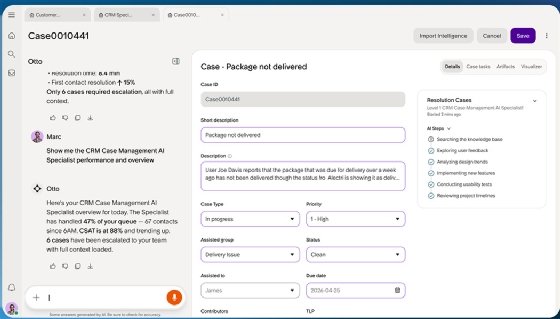
The CRM addition to its customer service and AI automation suite has been something ServiceNow has been talking about for some time. Today, the company advanced that idea further with a bundle of AI agents for field service, case management and sales.
ServiceNow has "service" in its name, as its roots are in IT service management (ITSM). Over the last few years, however, it has built out sales-friendly features such as order management and configure-price-quote, forming a CRM. Now the company must demonstrate its worthiness to current and prospective users to expand beyond the boundaries of customer and employee service, said Rebecca Wettemann, founder of independent research firm Valoir.
"ServiceNow's challenge with CRM is not a technical one -- it's been doing many of the key CRM pieces for a while," Wettemann said.
"It's about convincing business leaders who think of ServiceNow as an ITSM platform that it understands the CRM space and not only can technically meet the needs of sales and service leaders but can speak their language and give them guidance on how to [deploy] the tech to best do their jobs."
Embedding AI in workflows
ServiceNow customer Kyle Seiter is CIO of medical mobile medical diagnostics company TridentCare. His company dispatches medical professionals and equipment such as X-rays, ultrasound and lab services to patient-care settings in places like nursing homes, rehab hospitals and correctional facilities in 46 U.S. states. TridentCare is an early adopter of ServiceNow AI tools to sharpen lead-to-cash (customer lifecycle) processes, automating scheduling of people and equipment, and rescheduling as well -- one of those complex processes that is difficult to manage manually.
One of TridentCare's initial AI projects has been to streamline X-ray dispatching, a medical service that represents a sizeable chunk of its business.
"It's really a cost-weighted algorithm that gets applied to our particular business needs, which has allowed us to automate and remove the cognitive load that all of our dispatchers have today and move to near 100% automation in the first step of dispatching," Seiter said. "That means tens of thousands of manual touches have been eliminated from our business, adding scale and future opportunity."
Having gone through this process so far, Seiter said the idea of a SaaSpocalypse, where AI codes a new custom enterprise stack that replaces traditional applications, is a red herring.
Established platforms like ServiceNow will have to orchestrate automation of fragmented back-end systems, which will not be managed by -- or replaced with -- one-off apps once enterprise IT stacks have been rebuilt for AI. Many stacks might look fragmented right now, but that is not the end-state companies like his are working toward.
"The market has gotten a little sideways on how AI has the potential of disrupting the enterprise suite of software, saying that there is no need for [SaaS applications]," Seiter said. "I see that as a farce."
ServiceNow also plans to evolve vertical-specific Autonomous CRM features to address process automation across industries such as financial services, telecommunications, healthcare, manufacturing, government and retail, among others.
Tenon marketing integration
ServiceNow also made first moves toward a more fully developed CX platform, thanks to an OEM deal with marketing automation startup Tenon. The platform will incorporate natively embedded Tenon features, including customer journey building, audience segmentation, and email and text marketing channels.
Tenon received funding in multiple rounds from ServiceNow Ventures and built its marketing automation features on ServiceNow. Some observers might wonder why ServiceNow doesn't just acquire Tenon, but there's a good reason it doesn't, said Terence Chesire, group vice president, ServiceNow CRM and Industry Workflows.
"The reason we value them being independent is that they have a strong heritage in marketing," Chesire said. "We want them to form a strong opinion about how they should approach marketing and educate us in that process. We think that's the best way that we can make sure that they bring a distinct view."
Will all this fly with technology buyers? Wettemann said that user trust in ServiceNow's AI guardrails, mixing deterministic business rules with the probabilistic nature of large language models, will be key to the success of Autonomous CRM.
"ServiceNow's pitch is increasingly going to be, 'The people you trust with your business-critical IT operations should be the ones you trust with AI,'" Wettemann said. "A lot of initial DIY efforts didn't give much thought to issues of governance, permissions, data leakage or auditability. Organizations are now realizing this is a key piece of the overall AI value puzzle."
Autonomous CRM and other CX features were released in conjunction with ServiceNow's Knowledge 2026 user conference May 5-7 in Las Vegas.
Don Fluckinger is a seasoned B2B technology journalist with over 30 years of experience, specializing in enterprise IT, digital experience and content management. As a senior news writer at Informa TechTarget, he delivers award-winning analysis that helps IT and business leaders navigate complex technologies to enhance customer and employee experiences. Got a tip? Email him.
Dig Deeper on Customer Experience
-
![]()
Atlassian adds 'multi-player' agent collaboration, expands context
By: Ben Lutkevich
-
![]()
The AI handshake: More MCP interoperability for Salesforce's Slackbot
By: Don Fluckinger
-
![]()
Atlassian MCP updates take aim at AI token usage
By: Beth Pariseau
-
![]()
Agentforce Operations tackles workflow orchestration
By: Don Fluckinger