
Blue Planet Studio - stock.adobe
Pegasystems refines Blueprint agent builder, expands marketing tools
Pegasystems emphasizes "de-risking" agentic buildouts for its customers in regulated industries.

Pegasystems continues to build its product line with an eye toward ushering its risk-averse, compliance-heavy customers in verticals such as banking and insurance into the agentic AI era.
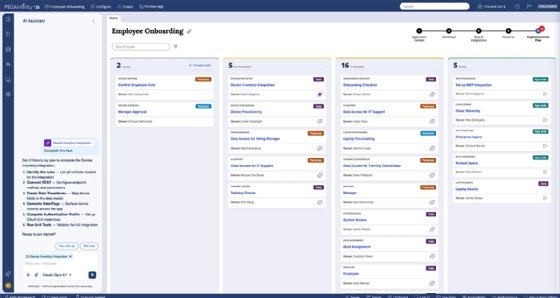
The company previewed many new tools slated for release in the third quarter of this year as part of its Pega Infinity '26 update. Its Blueprint agent builder enables line-of-business users to design their own agents with a combination of deterministic business rules and probabilistic generative AI.
Blueprint-designed agents will also be able to invoke MCP servers while still working within data governance rules. For users supporting agents built in other environments, MCP support will also open up data on the Pega platform to third-party agents from Anthropic, OpenAI, Google, AWS and others while retaining governance policies.
This is part of what Pegasystems calls the "de-risking" of putting AI agents into production.
The Blueprint agent builder can assemble more critical elements of the supply chain for agents than AI alone can, said Predrag Jakovljevic, principal analyst at Technology Evaluation Centers. Blueprint steers the design of AI agents without an over-reliance on prompts, which can be ambiguous for agents. In effect, it adds structure to probabilistic workflows.
"Without a supply chain foundation, AI fails," Jakovljevic said. "You must have not only correct data, but also the semantic knowledge graph, ontology and decisioning layer so that AI agents can work properly. And those things come from underlying SaaS and on-premises solutions."
Moreover, Pegasystems plans to introduce Customer Engagement Studio, a marketing-centric front-end to its Customer Decision Hub. It promises to deploy agentic-powered marketing campaigns in minutes.
Finally, Pegasystems will also change its AI pricing model from token-based to outcomes-based. Each "case," in the company's parlance -- a completed task from start to finish -- will incur charges. This is in line with several other customer experience vendors' current or future plans, including HubSpot, Zendesk and Salesforce.
SaaS vs. AI codebase
Pegasystems has been around since 1983. Founder Alan Trefler has seen his company -- and its customers -- migrate to a cloud-based SaaS model over the decades. Now, the "SaaSpocalypse," a scenario in which SaaS companies are replaced by LLM-powered coding agents writing custom software for individual companies, has been floated this year by pundits, Wall Street analysts and, allegedly, a few bleeding-edge startups attempting to power their businesses with it.
SaaS vendors -- and their customers -- are pushing back on that idea. They're confident that their AI won't obsolete their platforms, and that users will not want to assume the liability for data security and governance tools built into established vendors' products.
Agents built in SaaS platforms like Pega Infinity are also AI-coded -- or at least AI-assisted with plain-language prompts -- and SaaS companies themselves use AI tools such as Claude Code to author some of their products. But the SaaS world is betting that nobody will want to start from scratch with their IT stacks, especially large organizations, and they're looking to SaaS vendors to provide user-friendly environments for building agents and keeping them from running out of control.
Trefler said that the structure of the Pega platform -- and how it is built on workflows -- will be key to his company's survival.
"I believe workflows are going to be absolutely central, because they provide a deterministic way to get stuff done," Trefler said. "They can be informed by AI, and they also candidly let you see what's going on. I think we've got a very, very powerful positioning against the people who just say, 'I will generate huge amounts of sloppy code because Claude can spit it out.'"
It's been widely reported that some customers of different technology vendors are taking a hard look at the returns -- or potential future returns -- of AI agents, now that pilots are moving into the launch phase and the real costs of building, launching, maintaining and paying LLM usage fees (or outcomes-based fees) are revealing themselves.
Trefler said that agentic AI offers Pegasystems customers an easier path to doing what they were already doing.
"We've been talking about the autonomous enterprise for many years," Trefler said. "[Now,] we've been able to marry our workflow engine with technologies like Blueprint, which enables you to reduce the effort and increase the speed to reimagine how your business should work. We are just hyper-powering something we've done for decades."
Pegasystems previewed the new Pega Infinity '26 features and pricing model at its PegaWorld user conference in Las Vegas this week.
Don Fluckinger is a seasoned B2B technology journalist with more than 30 years of experience specializing in enterprise IT, digital experience and content management. As a senior news writer at Informa TechTarget, he delivers award-winning analysis that helps IT and business leaders navigate complex technologies to enhance customer and employee experiences. Got a tip? Email him.
Dig Deeper on Customer Experience
-
![]()
Pegasystems CEO and founder Alan Trefler on AI agent ‘madness’
By: Bill Goodwin
-
![]()
Pega targets token tax on agentic application development
By: Adrian Bridgwater
-
![]()
Pegasystems adds vibe coding to Blueprint app builder
By: Don Fluckinger
-
![]()
Pegasystems founder and CEO Alan Trefler on future of GenAI
By: Shaun Sutner