CX used to be easier to describe as a set of systems.
There was CRM. There was the contact center. There were marketing tools, customer data platforms, analytics systems, feedback tools and digital engagement channels. Each had a defined role and its own team. Each could be improved, replaced or optimized -- more or less -- on its own.
That version of CX is getting harder to defend.
Customer experience now depends less on any one tool and more on whether the larger environment holds together. The question is not only whether a company has CRM data, contact center AI, personalization tools, journey analytics or marketing automation. The harder question is whether those systems can coordinate the work that sits between them.
That is why CX orchestration is becoming the hard part. It is the layer of work that determines whether customer context follows the customer, whether a handoff works, whether AI acts on the right information, whether service learns from what marketing promised and whether someone owns the next step when the customer problem crosses systems.
Customers do not experience the CX stack. They experience the handoffs.
CX is no longer a collection of separate tools
The front office is becoming more connected.
CRM, contact center platforms, digital engagement tools, analytics systems, customer data platforms and AI features are increasingly treated as part of a single operating environment. That makes sense. Customers do not move through a company by software category. They research, buy, onboard, use, ask, complain, renew and sometimes leave.
Customers do not experience the CX stack. They experience the handoffs.
The work behind those moments usually cuts across systems.
A customer might land in service because a product page was unclear, a bill was confusing or a self-service path did not actually solve the problem. A marketing offer might create an expectation that support cannot meet. A sales handoff might leave onboarding to figure out the customer context after the fact.
From inside the company, those might look like separate issues. To the customer, they feel like one experience. None of that is new. What is changing is how much companies now expect software and AI to smooth out those edges.
That expectation raises the bar. It is no longer enough for each CX tool to perform its own function well. The tools must support a larger flow of customer work. They have to carry context across touchpoints, route the right work to the right place and make it clear who owns the next step.
That is orchestration, not just integration. Integration means systems can connect. Orchestration means the work, context, rules and ownership move correctly across those systems.
That is also where customer journey orchestration fits the broader CX problem. It can help coordinate customer experiences across channels, but the enterprise must still ensure the work, data and ownership behind those experiences do not break down.
That is where omnichannel orchestration becomes more than a channel strategy. The real work is making sure customer context, next steps and business rules do not reset every time the customer moves from one touchpoint to another.
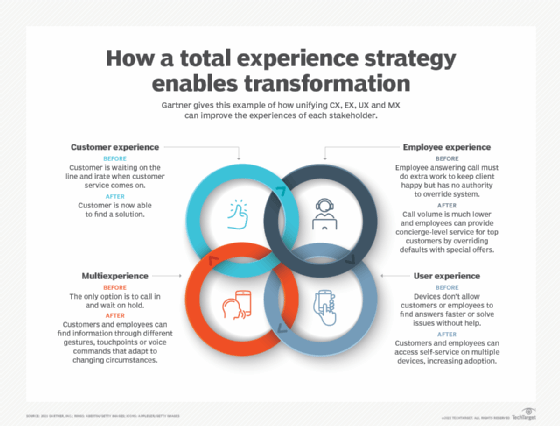
CX orchestration depends on more than improving one customer-facing tool. It requires coordination across customer experience, employee experience, user experience and multiexperience workflows.
Service shows where orchestration breaks
The contact center is often where CX orchestration issues first surface.
Customers usually contact service after something else has already gone wrong. The product was confusing. The policy was unclear. The bill did not make sense. The website did not solve the problem. The customer had to repeat information. The handoff from one team to another failed.
From the company's point of view, that might look like contact volume. From the customer's point of view, it feels like effort. That is why improving the contact center experience often depends on fixing work that starts outside the contact center.
That is where contact center metrics can be misleading.
A company can improve its handle time, deflect more contacts, or route calls more efficiently while still leaving the customer's problem mostly untouched. The contact center experience might improve at the edges, but the reason customers needed help in the first place might still lie elsewhere -- on the website, the bill, the policy, the product or the handoff between teams.
Service can absorb that work for a while, but it cannot fix the entire operating model on its own.
That is where orchestration becomes organizational, not just technical. Product, billing, operations, digital, marketing and service may all touch the same customer problem. If those teams do not share the signal, the same issue keeps landing in the contact center.
The contact center ends up processing the symptoms. The business fails to fix the cause.
AI can make weak orchestration more visible
AI makes this problem more urgent because it can move work faster through a weak process.
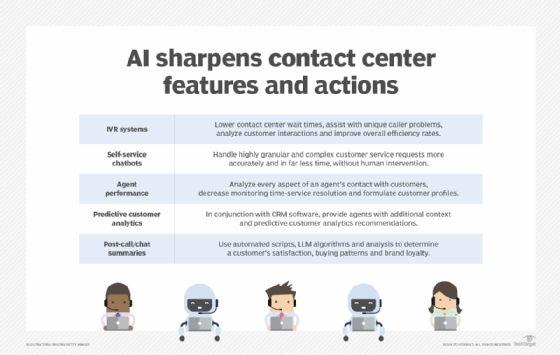
That can be useful when the work is narrow and well-defined. AI can summarize calls, route requests, support agents, retrieve knowledge, detect intent, translate conversations and reduce after-call work.
Those contact center AI features can create real gains. But they are not the same as fixing the customer journey.
If the knowledge base is incorrect, AI can surface the wrong answer more quickly. If the handoff is broken, AI can move the customer through a weak workflow more efficiently. If the business has not identified what keeps creating avoidable contact volume, AI might help the service team process the consequences more quickly.
That is not transformation. It is acceleration.
CX orchestration must answer a more basic question before the AI layer does too much: What work is the company actually trying to improve?
If the answer is unclear, the company risks optimizing the wrong part of the problem.
Contact center AI can help route requests, support agents, analyze interactions and summarize conversations, but those features work best when they support a coordinated CX workflow.
Customer data must move with the work
Most CX orchestration problems eventually become data problems.
That is unavoidable. Customer context is scattered across the enterprise. CRM contains the account information. Marketing systems track the campaign history. Service platforms capture complaints. E-commerce systems record transactions. Product data reveals usage patterns. Billing systems track disputes. Analytics platforms identify trends.
That is why customer data platforms sit close to the orchestration problem. A unified customer view can help, but only if the data is current, governed and available inside the workflow where the customer issue is being handled.
A customer does not care which system owns which fact. They care whether the company seems to understand the situation.
That does not mean every team needs every piece of data at all times. It means the right context must move with the work.
An agent should not have to ask a customer to repeat information the company already has. A marketing team should not keep targeting a customer who is in the middle of an unresolved service problem. A service team should not discover halfway through a call that a policy, promise or product change elsewhere in the business created the issue.
That is why CX orchestration depends on more than a unified profile. It also depends on rules, permissions, workflow design and ownership.
Data must be usable. But it also has to be governed, current and tied to the process where it is being used.
Orchestration is not the same as automation
Automation completes a task. Orchestration coordinates the work around the task.
That difference matters in CX because many customer problems are not single-step problems. They involve context, timing, judgment, escalation and handoffs. They often move across systems and teams before the customer sees the result.
That is why automating one step can help without solving the larger experience.
A refund is not just a refund if it depends on policy rules, finance approval and customer communication. A retention issue is not just a CRM note if it also depends on product usage, support history, pricing and the account team's judgment. A delivery problem might show up in service, but the real work could sit in fulfillment, logistics or e-commerce.
Orchestration asks where the customer issue started, which systems hold the relevant context, who owns the next step, and what should happen when the workflow encounters an exception. It also asks where AI should support the work and where a person still needs to stay close to the decision.
Those questions are not glamorous. But they are often where the customer experience succeeds or fails.
CX orchestration needs feedback loops
A better CX system should not only resolve customer issues. It should help the business learn from them.
That is where feedback loops matter.
If customers keep contacting service about the same billing confusion, that should not stay a service problem. If customers struggle with onboarding, that signal should reach the teams responsible for product, documentation, digital experience and customer success. If self-service fails, the business should know whether the problem is the content, the interface, the policy or the underlying process.
This is where voice-of-the-customer programs, experience analytics and contact center insights can become more useful. Not because they produce another dashboard, but because they help the organization see where the experience is actually breaking.
The point is not to collect more feedback; it is to make the feedback useful to the teams that can fix the cause. That is hard because the owner of the customer interaction is not always the owner of the customer problem.
CX orchestration must close that gap.
What CX orchestration needs to coordinate
CX orchestration is not just system connectivity. It is the operating work behind the customer experience.
At minimum, it should make clear:
Which customer context needs to move across systems.
Who owns the next step when a customer issue crosses teams.
Where handoffs happen among service, sales, marketing, digital and operations.
How AI-generated summaries, routing or recommendations fit into the workflow.
When an issue should be escalated instead of automated.
Which data source is trusted for the decision.
What service interactions are telling the rest of the business.
Whether metrics show a better experience, not just a faster process.
The goal is not to make every interaction more complicated. It is to make the work behind the interaction visible enough to manage.
The business case must be bigger than efficiency
A lot of CX technology is still sold around efficiency.
That is understandable. Faster service, lower cost to serve, more automation and less manual work are easy to measure. But the stronger case for CX orchestration goes beyond labor savings.
Done well, it can reduce repeat contacts, improve customer trust, make personalization more useful, help frontline employees do better work and give leaders a clearer view of where customer problems are forming. It can also help companies connect CX investments to revenue, retention, loyalty and risk reduction.
That is a more demanding case to make. It requires companies to measure more than speed. They need to understand whether customers are getting better answers, whether problems are being prevented, whether handoffs are improving and whether teams are acting on what the customer experience is revealing.
Efficiency matters. But if CX orchestration only makes a broken journey move faster, it has not solved enough.
The hard part is ownership
The biggest challenge in CX orchestration may not be the technology. It may be ownership.
Someone must decide which systems matter, which data is trusted, which workflows should change, which AI use cases are worth scaling and which team owns the customer problem when it crosses departmental lines.
That is where CX orchestration becomes a management issue.
Vendors can provide platforms, integrations, AI agents, analytics and workflow tools. Those can all help. But the business still must decide how customer work should move across the organization.
That means CX leaders, CIOs, marketing leaders, service leaders, sales leaders, operations teams and data teams cannot treat orchestration as someone else's problem.
The customer journey already crosses their boundaries. The operating model must catch up.
CX orchestration is the new hard part because the easy story -- add better tools, automate more work, personalize more interactions -- is no longer enough. Enterprises already have plenty of tools. What they need now is a better way to make the tools, teams, data and decisions work together around the customer.
That is where the next phase of CX work begins.
James Alan Miller is a veteran technology editor and writer who leads Informa TechTarget's Enterprise Software group. He oversees coverage of ERP & Supply Chain, HR Software, Customer Experience, Communications & Collaboration and End-User Computing topics.