Free DownloadThe ultimate guide to contact center modernization
This comprehensive guide examines the transformation and inner workings of the modern contact center, including its benefits, challenges, technologies and trends. Readers will also get a big-picture analysis of what businesses must do to personalize customer interactions and maximize ROI. Hyperlinks, research findings and comments throughout this page connect to related articles that provide additional insights, new developments and advice from industry experts critical to planning, implementing and managing today's complex, multifunctional contact center.
6 contact center trends shaping the future of customer service
As organizations look to turn contact centers into strategic assets, AI is reshaping analytics, omnichannel communications and agent workflows -- but not without trade-offs.
The benefits from AI are within reach -- but only with a sound strategy. Rather than blindly follow the buzz around AI, contact center leaders need to ground their strategy in what's driving the market today. In particular, some key trends are shaping and elevating customer experience and customer service, and of course AI is playing a role in all these developments.
Businesses pursuing the long-standing goal of turning contact centers into profit centers are especially interested in artificial intelligence. AI introduces new opportunities to improve efficiency and insight into customer service while also driving revenue. However, AI raises questions about cost, complexity and realistic expectations.
This article reviews six trends that contact center leaders need to consider as they develop business and technology strategies. Each trend stands on its own, but they all have AI tie-ins, so contact center executives need to envision a larger strategy as well.
1. More holistic AI deployments
Contact centers have been relatively late in adopting AI. However, many deployments have been in use for a few years. Those initial deployments were on a standalone basis and not integrated beyond the task they were designed to address. Most of these rollouts were first or second generation chatbots with limited capabilities, so there was little need to integrate them much further. This led to a patchwork approach to AI, much like with point solutions, often with multiple vendors.
To some extent, this can be effective. But AI is evolving quickly, and adoption in the contact center is accelerating. The market has moved on, and the trend is toward a more holistic approach with AI. Chatbots were driven by conversational AI. The next level, however, is agentic AI, where CX applications -- and not just chatbots -- go beyond low-level problem-solving for customers.
Today's AI agents can take automation to a higher level with end-to-end capabilities both internally and with customers. But the benefits can only be realized with a more integrated approach. Getting those high-level outcomes requires real-time integration across a broader range of customer touchpoints than with less advanced chatbots. As such, contact center leaders need to move on from deploying AI in isolation, where each application stands alone from everything else.
2. Contact center AI plans also more holistic
Deploying AI bots is one thing. But organizations also need an overall strategy for the contact center. Purpose-built AI apps can provide value by setting customer appointments and agent schedules. But there's a broader trend for a holistic strategy.
Contact center leaders need to move on from deploying AI in isolation, where each app stands alone from everything else.
As agentic AI elevates CX, more orchestration is needed to connect tasks to processes, which drives specific outcomes. Simple automation is no longer the goal with AI. Now, contact centers need to consider more intelligent forms of automation, more effective forms of customer engagement and better agent experiences.
While these steps improve contact center operations, there's also a growing need for AI to have a business-level impact. In this holistic view, AI goes beyond the contact center and supports other business functions, such as sales and marketing.
Each AI strategy has a distinct relationship with customers, but customers only see the company -- the brand -- as one entity. This blending requires orchestration across various business departments to ensure AI can extract as much relevant customer data as possible, regardless of the type of interaction.
3. AI improves self-service
Regardless of the varying CX and AI strategies, contact center leaders cannot neglect the fundamental self-service aspect. For sure, contact center executives can deploy AI to cut costs, automate processes and, in some cases, reduce staff. But, above all, the end game should enhance CX.
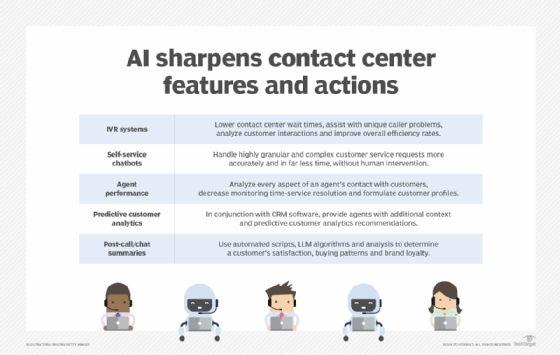
AI can enrich CX in many ways, but the best and fastest results are in self-service. In simple terms, this is about automation, especially for steering routine queries to chatbots to handle and away from human agents. With advances in conversational AI, today's bots -- or virtual agents -- are better equipped for self-service tasks, and this trend will continue.
Today's AI agents can do a better job than traditional interactive voice response (IVR), and the iterative nature of AI means these agents continuously improve without human supervision. Therefore, AI tools are increasingly handling more complex inquiries that IVR could never take on.
Since they are conversational in nature, AI agents can go beyond query-based, binary interactions and derive cues from a customer's emotional state, then provide empathy. This intelligence reduces the need for human involvement and ultimately enhances self-service outcomes -- an area where customer expectations have always been low. As such, earlier poor experiences with chatbots should not cloud the thinking about what today's bots can do for self-service.
4. Agentic AI use cases are growing
Every CX vendor now has an agentic AI story. At industry events, all vendors tout success stories where customers have realized tangible benefits and better customer outcomes with agentic AI.
Contact center leaders need to think about what customer outcomes would best validate their investment in AI.
As the track record builds, more use cases will arise. That said, several snags remain in place, such as hallucinations, false positives, inaccurate translation across languages and misunderstanding context or intent. Contact center leaders must recognize the associated risks and manage agentic AI pilots carefully. This should yield new forms of governance related to privacy, security and compliance.
When tackling agentic AI and its challenges, organizations should follow certain best practices. But once the agentic AI tools are ready to go at scale, the results will be evident quickly. The safest route is to first deploy agentic AI for automating workflows and processes, where hiccups will only be seen internally. A higher level of trust is required for customer-facing use cases, but this is where organizations will reap bigger rewards.
5. AI ROI tied more to customer outcomes
All these trends are important, but none of them exist in a vacuum. AI isn't free. And, aside from understandable concerns about performance at scale, businesses are justifiably concerned about ROI.
AI deployments tend to be open-ended. And, in this gold-rush environment, many businesses are investing to achieve a competitive advantage with no regard to cost. If AI falls short or if expectations are too high -- and both can be true at once -- there will come a point where spending must stop or be scaled back.
The need for ROI in the contact center is just as valid as anywhere else in the business, and there's a notable trend now toward outcome-based metrics with AI. This is an important development, as the contact center has long been driven by operational KPIs. These metrics are useful indicators of agent performance and internal efficiency, but they were never designed to measure customer satisfaction.
Legacy KPIs still have value. But with CX now strategic to the business, technology investments need to be measured by this new yardstick. With AI's ability to provide deep insights drawn from customer data, the effect on customer outcomes is greater than what KPIs could capture.
It's still early for standardizing around customer outcome metrics. But the main idea is contact center leaders need to think about what customer outcomes would best validate their investment in AI. These outcomes could involve a customer's satisfaction with a contact center interaction, post-purchase behavior or an affinity to a brand.
AI can solve many contact center challenges and enhance customer service.
6. AI makes customer service more personalized
This last trend might be the most important. At a strategic level, improving CX should be the leading driver for AI adoption. At the customer level, however, the best way to improve CX is to provide a personalized experience, where each customer is valued, seen and heard. We're all consumers, so that perspective is easy to understand -- but it's difficult for contact centers to provide.
Technology is not the only limiting factor. But if legacy systems are deeply entrenched, personalization is harder to do at scale. By nature, these systems are optimized around operational performance and can only provide limited inputs for agents to personalize customer interactions.
But AI provides new possibilities. It can access and analyze vast data sets, then distill that into what is most relevant to customers and their reason for contacting an organization. With AI, all of this is done at scale and in real time, which is well beyond what agents can do with existing tools.
AI can draw data from knowledge bases within the contact center and from across the whole organization. Agents need this rich data set to personalize customer interactions, but this level of service can only be enabled by AI.
By thinking about what's most important to customers, contact center leaders can see why this trend is so important to support, especially as AI capabilities keep improving every day.
A strategic and collective approach
The future of contact centers will be shaped less by any single technology than by how organizations balance automation, data integration and human judgment. AI can improve efficiency, insight and responsiveness, but it also raises expectations for governance, accuracy and trust.
Contact centers that approach these six trends strategically -- rather than chasing them individually -- are better positioned to become durable assets to their organizations rather than experimental cost centers without tangible ROI to rationalize their investments in AI.
Jon Arnold is principal of J Arnold & Associates, an independent analyst providing thought leadership and go-to-market counsel with a focus on the business-level effect of communications technology on digital transformation.