As UCaaS platforms add AI and become central to hybrid work, enterprises need to balance cloud scale with control over communications data, compliance and policy.
Unified communications as a service, or UCaaS, has been a dominant direction in corporate communications for years -- and for good reason.
UCaaS can lower infrastructure costs, reduce the burden of managing on-premises communications systems and make it easier to scale collaboration tools across distributed workforces. For many companies, cloud communications became the practical answer to hybrid work, remote work and global collaboration.
But hybrid communications is not going away anytime soon. The reason is control.
Enterprises still want the scalability, flexibility and AI features that come with cloud communications platforms. But they also need tighter control over where communications data lives, how it is governed, who can access it and what happens when that data becomes an input for AI systems.
That is why hybrid communications is starting to look less like a temporary migration phase on the way to full UCaaS and more like a practical enterprise compromise. Companies want modern collaboration tools, AI-enabled features and cloud flexibility. But they do not necessarily want to hand over all control of sensitive communications data to a cloud provider.
The old cloud-versus-on-premises framing is starting to feel too simple. The more relevant question is how much control enterprises can preserve inside a mixed communications environment.
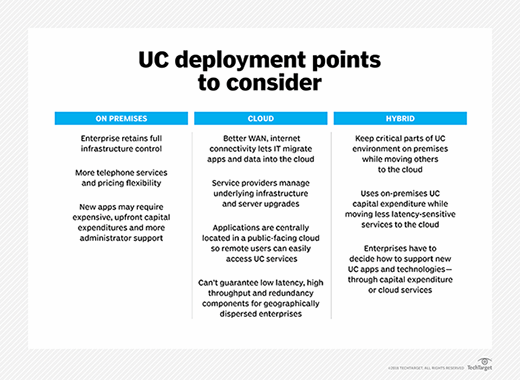
Hybrid UC environments can help enterprises balance cloud scalability with greater control over sensitive communications data and critical UC workloads.
Hybrid UC is becoming a control strategy
Cloud communications made sense when the main problem was giving employees consistent access to voice, video, messaging and collaboration tools from anywhere. It still makes sense for that. But the communications environment has changed.
UC platforms now carry meeting recordings, voice data, chat transcripts, shared files, metadata, AI-generated summaries and workflow signals. That data can cross regions, vendors, clouds and AI systems. It can also fall under different privacy, retention, sovereignty and compliance rules depending on where it is created, stored or processed.
That makes UC data harder to treat as ordinary collaboration exhaust. The tension is that cloud and AI offer scale while on-premises environments offer control, and many enterprises now have to find a balance between the two. That balance is why hybrid remains relevant.
For some organizations, especially in regulated industries or regions with strict data-residency requirements, a fully cloud-based UCaaS model might not provide enough control. Sensitive workloads might need to stay in private, regional or on-premises environments, while less sensitive communications can remain in the cloud.
That does not mean hybrid is automatically simpler. In fact, the opposite is often true.
A more controlled communications environment can also create more seams: regional deployments, different vendor arrangements, inconsistent policies, disconnected records and more complicated governance. Data sovereignty can help solve one problem while creating another. More control can mean more complexity for CIOs, UC leaders and compliance teams.
Pure UCaaS has an appealing simplicity. Much of the platform operation, scaling and governance tooling can be offloaded to the provider. But responsible organizations cannot simply outsource all questions of data compliance, privacy and control -- particularly in highly regulated sectors.
That is the tradeoff now taking shape. Hybrid communications can give enterprises more control, but it also requires more deliberate policy, architecture and oversight.
Hybrid communications is starting to look less like a temporary migration phase on the way to full UCaaS and more like a practical enterprise compromise.
AI raises the stakes for communications data
AI makes UCaaS more powerful, but it also makes communications environments harder to govern.
AI features are increasingly being used in communications platforms for meeting summaries, transcription, translation, action-item capture, scheduling assistance, sentiment analysis, meeting analytics, knowledge retrieval, workflow automation, compliance monitoring and copilots.
Those capabilities can make communications platforms more valuable. They can turn meetings, chats, voice interactions, shared content and recordings into searchable, usable business information. They can help employees make decisions faster, capture institutional knowledge and reduce the amount of work lost inside unstructured conversations.
But that value depends on communications data. Once AI starts summarizing meetings, analyzing conversations, extracting action items or surfacing patterns from calls and chats, communications data becomes more than a productivity asset. It becomes governed data.
That changes the risk profile.
AI systems can produce incomplete summaries, inaccurate conclusions, hallucinations or outputs that lack sufficient context. They can also raise difficult questions about explainability, employee privacy, surveillance, access control, retention and whether AI-generated summaries should be treated as official business records.
That is why AI in communications cannot be treated as a standalone innovation story. AI innovation in UCaaS has to account for compliance from the start, especially when summaries, transcripts, copilots and automated workflows depend on sensitive communications data.
The enterprise challenge is no longer just whether employees can use the new features, but whether the organization can govern those features once they are embedded into everyday communications.
Compliance has to move closer to the platform
For IT leaders, the main concern with AI-enabled UCaaS should not be limited to better summaries, cleaner transcriptions, copilots or workflow automation. The bigger question is compliance.
If communications data becomes an AI input, compliance has to be designed into the platform strategy from the beginning. That includes data residency, retention, e-discovery, access controls, audit trails, industry-specific rules, consent for recordings and transcripts, and human oversight of AI-generated outputs.
This is where compliance by design becomes important. In the pre-cloud era, some compliance controls could be added after deployment. That approach is harder to defend when communications platforms are cloud-based, AI-enabled, real-time and deeply embedded in daily work.
Summaries, meeting transcripts and AI-assisted follow-ups are not just convenience features; they are business records -- or at least potential business records, depending on how the organization uses, stores and governs them.
That makes hybrid or private UC environments more attractive for some regulated businesses. But the same principle applies even when the UC platform is fully cloud-based. Organizations still need to understand how the provider protects data, where that data is stored, how AI systems use it, what controls can be configured and whether the platform can support the company's specific governance and compliance requirements.
Before switching on AI features across communications tools, CIOs and UC leaders should know what data the tools can access, where the outputs live, who can review them, how long they are retained and what oversight exists when the AI gets something wrong.
Once AI starts summarizing meetings, analyzing conversations and extracting action items, communications data becomes more than a productivity asset. It becomes governed data.
UC is now part of the operating model
All of this matters more because hybrid work is now part of the enterprise landscape, even as more companies push employees back to the office. The days of a purely on-site workforce are gone for many organizations. Employees, partners, customers and contractors now communicate across offices, homes, mobile devices, contact centers, field locations and global regions. That means UC is no longer just a collaboration or productivity tool; it is part of the enterprise operating model.
In a durable hybrid-work environment, companies have to design UC platforms for collaboration across locations, devices and networks while also supporting security, reliability, employee experience and business continuity.
Modern UC platforms have to support collaboration, security, performance, employee experience, business continuity and policy enforcement at the same time. They carry policies around meeting access, recordings, retention, presence, data residency, AI summaries, compliance and more.
In that sense, the UC stack is becoming connective tissue for the enterprise. It is where conversations happen but also where decisions are captured, work is assigned, meetings are summarized and operational signals begin to surface. That puts UC closer to the same data-governance conversation as ERP, CRM, HR and customer service systems. In the past, communications tools might not have belonged in that category. Now they do.
This is not just because UC platforms integrate with those other systems, but because UC platforms themselves are where so much corporate information is shared, created and transformed.
Communications data does not disappear after the meeting
Communications data also lives beyond the meeting or message that created it. Recordings, transcripts, files, summaries and metadata can be stored, searched, analyzed and reused. That creates value, but it also creates long-term governance obligations.
A major complication is that UCaaS data sovereignty requirements can apply to recordings, transcripts, shared files and other communications data -- not just traditional business records.
That is why communications data is now an enterprise governance issue. It can move across physical locations, cloud environments, vendors, AI systems and regional boundaries. It can also remain useful long after the original interaction, especially once AI tools can summarize, classify, search and extract meaning from it.
This is another reason hybrid remains attractive. The sensitivity of recordings, transcripts, shared files and AI-generated summaries is not temporary. Those assets can become records, evidence, knowledge sources or compliance risks. Keeping some part of the communications architecture under tighter control can help organizations manage those obligations.
That gives the platform more operational importance, and it gives the vendor more leverage. IT leaders have to weigh not only features and pricing, but also data controls, regional options, AI policies, compliance support, lock-in risk and the ability to adapt the platform to the organization's governance requirements.
This is another reason some enterprises want more control over UC architecture rather than simply accepting whatever the cloud platform offers. The more central UC becomes, the harder it is to treat communications as a commodity service.
Hybrid is imperfect, but it is not obsolete
Hybrid communications is not a step backward. It is also not a perfect answer.
It can create fragmentation, add management complexity and make policy enforcement harder across vendors, regions and deployment models. But it also gives organizations a way to balance cloud scale and AI innovation with the control they still need over sensitive communications data.
That balance is becoming more important as UC platforms take on a larger role in how companies operate. AI-enabled UC can help organizations summarize meetings, capture institutional knowledge, identify patterns and improve decision-making. The appeal is that generative AI can turn meetings, chats, voice interactions and recordings into usable business information. But those benefits come from using data that is often sensitive, regulated or operationally important.
For many enterprises, the answer will not be full cloud or full on-premises. Instead, it will be a deliberate mix: cloud where scale and innovation matter, and more controlled environments where sovereignty, compliance, security or business risk require it.
Hybrid UC is not on the way out. It is becoming one way enterprises write the rulebook for hybrid work.
James Alan Miller is a veteran technology editor and writer who leads Informa TechTarget's Enterprise Software group. He oversees coverage of ERP & Supply Chain, HR Software, Customer Experience, Communications & Collaboration and End-User Computing topics.